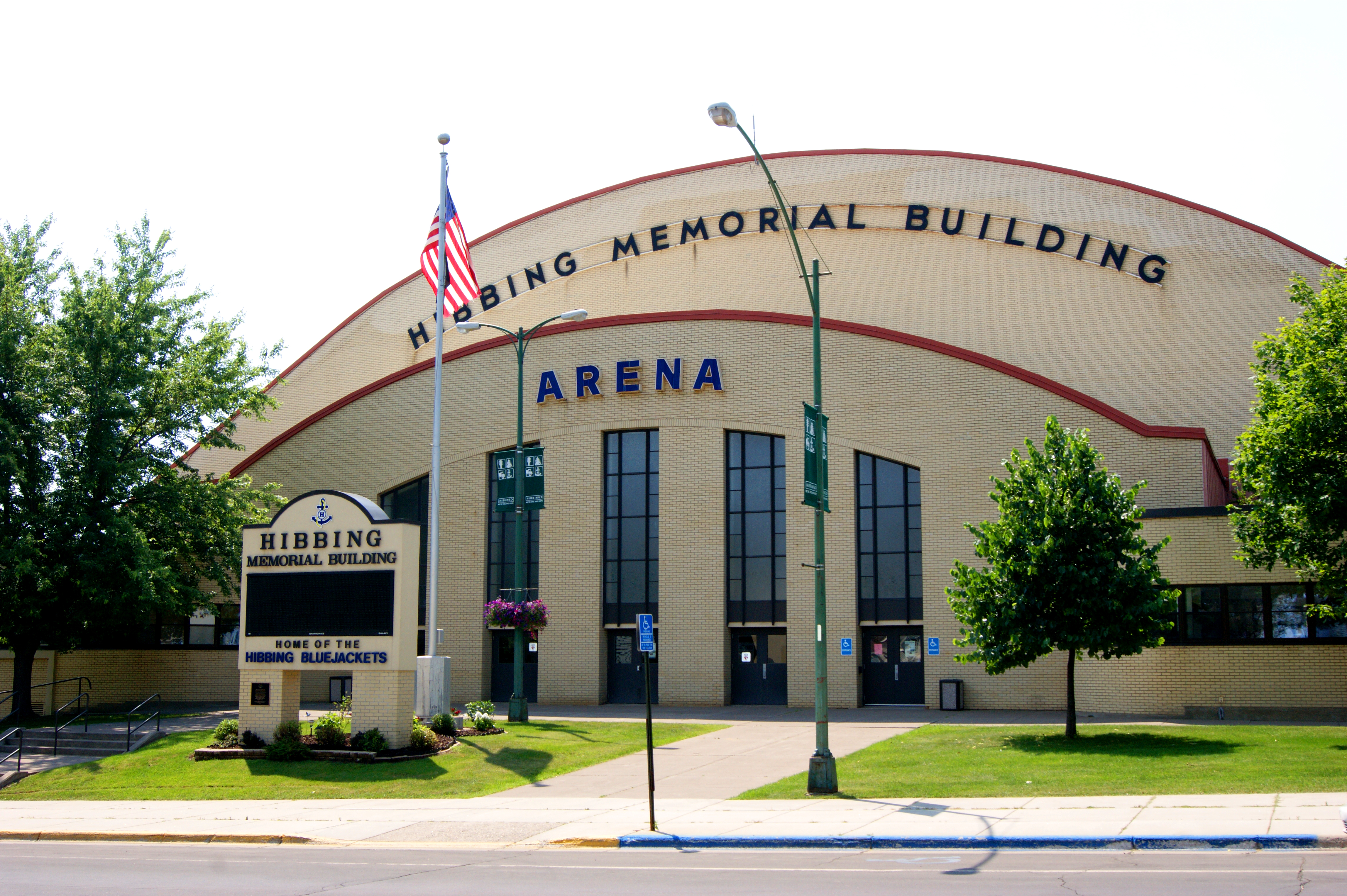
Hibbing Memorial Building
On December 28, 1933, firefighters in Hibbing, Minnesota worked for more than twelve hours in subzero temperatures trying to save the Memorial Building. They failed. Faulty electrical wiring had sparked a blaze that consumed the eight-year-old structure -- its skating rink, curling rinks, bowling alley, auditorium, and veterans' meeting rooms all declared a total loss. The building had been dedicated just eight years earlier, on September 18, 1925, before an estimated crowd of 5,000, as a memorial to the men of Hibbing who served in World War I. Financed at a cost of approximately $400,000, it was the civic heart of an Iron Range mining town flush with the wealth dug from the Mesabi Range. Within two years, Hibbing rebuilt it. The replacement, completed in 1935, still stands -- a testament to a community that refused to let its memorial stay in ashes.
Iron Range Arena
The rebuilt Memorial Building emerged as a versatile arena and civic hub. With 3,460 permanent seats and additional standing and floor capacity bringing the total to approximately 5,460, it could handle crowds that dwarfed Hibbing's population. Minnesota State High School League hockey and basketball games filled the stands with partisan fans from across the Iron Range. Figure skating competitions, trade shows, rodeos, concerts, and graduations all rotated through the building's calendar. For a small city carved out of the northern Minnesota woods by the iron mining industry, the Memorial Building punched well above its weight -- a venue that belonged to a much larger place, funded by a community that believed its memorial deserved nothing less.
Blackhawks on Ice
Professional hockey found the Iron Range. In the 1930s and 1940s, the NHL's Chicago Blackhawks chose the Hibbing Memorial Building for six training camps, bringing top-tier professional athletes to a town of miners and loggers. The connection between Chicago and the Iron Range ran through the steel mills: Mesabi ore became Chicago steel, and Chicago's hockey team came north to skate on Mesabi ice. The WHA's Chicago Cougars continued the tradition in the 1970s, holding their own training sessions in the building. Before the 1933 fire, the Hibbing Maroons of the Central Hockey League had played their home games there. Hockey, curling, and skating were not just recreation on the Iron Range -- they were cultural identity, and the Memorial Building was where that identity took the ice.
Presidents and Senators
The Memorial Building's capacity and its location at the heart of the Iron Range -- a politically active region with deep ties to organized labor -- made it a magnet for candidates. President Harry S. Truman spoke there in 1952 during a campaign swing through Minnesota. In 1960, Senator John F. Kennedy drew a crowd of more than 10,000 people, packing the arena well beyond its permanent seating capacity. The Iron Range was a crucial Democratic stronghold, and Kennedy understood the value of showing up in person. Decades later, the building hosted campaign events for John Edwards in 2004 and Hillary Clinton in 2008. Each visit reinforced the same message: even in a town of fewer than 20,000 people, the Memorial Building could summon a crowd worth addressing.
A Memorial That Endures
Today, the Hibbing Memorial Building remains managed by the City of Hibbing as a multipurpose civic space. The Hibbing Curling Club calls it home -- a fitting tenant for a building that has housed ice sports for nearly a century. Local parks and recreation offices operate from within. Civic events, cultural programming, and sporting competitions continue to fill the schedule. The building sits in a city that also claims the Hull-Rust-Mahoning Open Pit Iron Mine, the largest open-pit iron mine in the world, and the childhood home of Bob Dylan. Hibbing has always been a place where outsized things happen in a modest setting. A World War I memorial that burned, rose again, hosted NHL training camps and presidential speeches, and kept its doors open for a hundred years fits that pattern exactly.
From the Air
Located at 47.4233°N, 92.9371°W in Hibbing, Minnesota, on the Mesabi Iron Range. The town is immediately identifiable from the air by the Hull-Rust-Mahoning Open Pit Iron Mine, the largest open-pit iron mine in the world, which stretches along the city's southern edge. The Memorial Building is in the downtown area north of the pit. Range Regional Airport (KHIB) serves Hibbing with commercial and general aviation service. Chisholm lies to the west and Virginia to the east along the Range. Terrain is rolling Iron Range topography at approximately 1,500 feet MSL. The open pits, mine dumps, and tailings basins of the Mesabi Range are prominent visual features from any altitude.