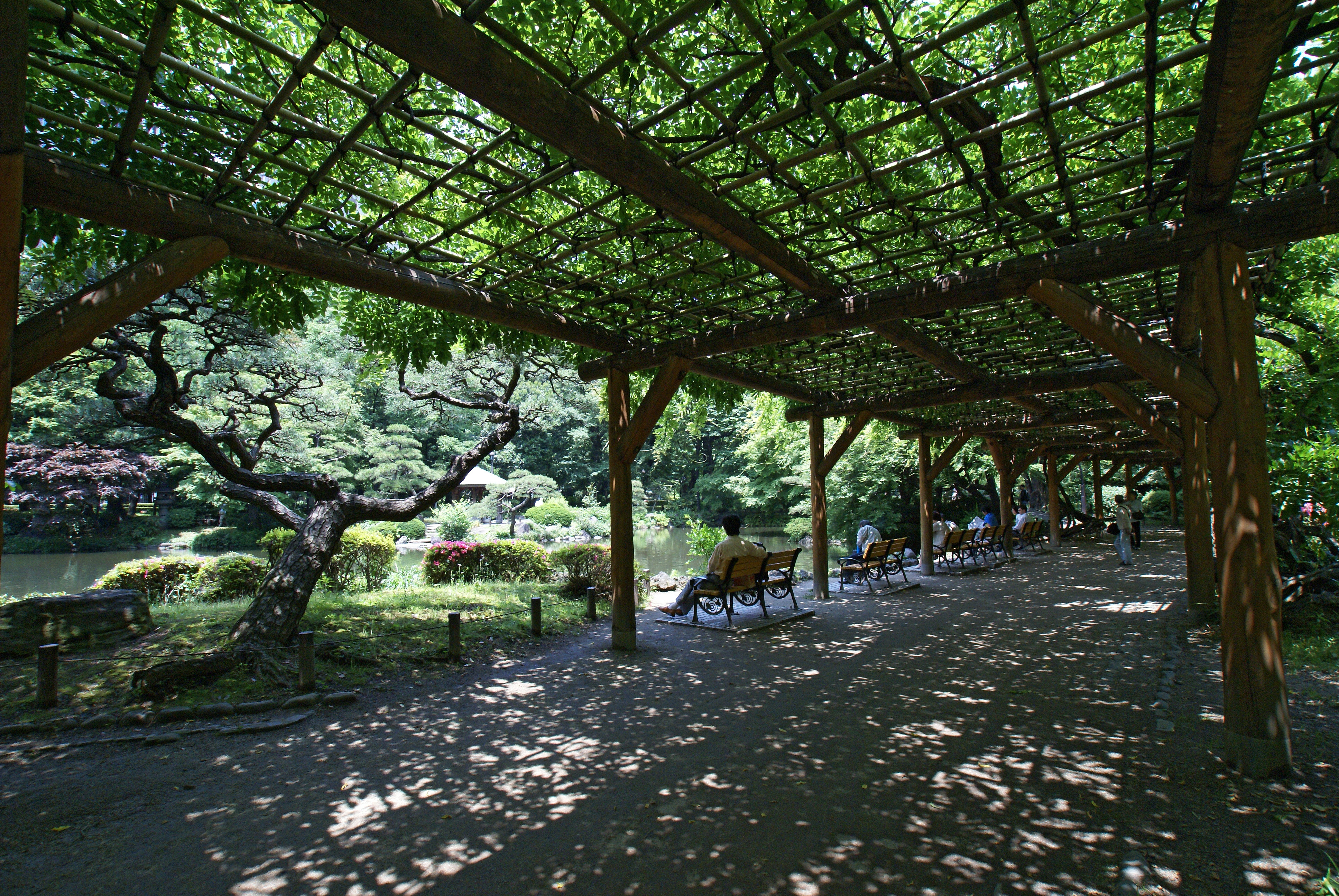
Hibiya Park: The Risky Ginkgo and the Riots
In 1901, a landscape architect nearly lost his career over a tree. The designers of what would become Japan's first Western-style park wanted the grounds cleared, but one ginkgo was already ancient -- roughly five hundred years old, rooted in the soil since before Columbus reached the Americas. The architect fought to save it, risking his position, and won. That ginkgo still stands in Hibiya Park today, known affectionately as the Risky Ginkgo. It is one of the quieter stories in a park whose forty acres, wedged between the Imperial Palace and Tokyo's government district, have witnessed riots, war, rock and roll, and the persistent reinvention of a city that never stops building.
From Seawater to Samurai to Soldiers
The land beneath Hibiya Park was once underwater. An inlet of the sea ran northward to a cove where the Kanda River emptied into Tokyo Bay. During the rule of shogun Tokugawa Hidetada in the early 1600s, the river was diverted east into the Sumida River, and the spoil from that massive engineering project was used to fill in the cove, creating dry land. The reclaimed ground became the estates of two powerful daimyo clans -- the Mori and the Nabeshima -- during the Edo period. When feudalism ended and the Meiji era began, the military claimed the space for army maneuvers. By the turn of the twentieth century, Japan was looking westward for cultural models, and the government decided to convert the drill grounds into something the country had never had: a public park in the European style. Hibiya Park opened on June 1, 1903, designed around Western flowers, Western cuisine, and Western music.
The Day the Park Burned
Hibiya Park's role as a peaceful green space lasted exactly two years. On September 5, 1905, thousands gathered in the park to protest the Treaty of Portsmouth, which had just ended the Russo-Japanese War. The treaty's terms were seen as humiliatingly lenient toward Russia, and the crowd's fury was directed not only at the diplomats but at government bureaucrats who had refused to consult the public on foreign policy. The protest erupted into the Hibiya incendiary riots, a two-day convulsion that engulfed the city. Seventeen people were killed. Three hundred thirty-one were arrested. Property damage spread across entire neighborhoods. The riots marked a turning point in Japanese democracy: the public had made clear that foreign policy was no longer the exclusive domain of elites. Hibiya Park, barely two years old, had already become the stage for one of the most consequential political uprisings in modern Japanese history.
Gothic Brick and the God of the Forge
The park accumulated landmarks through the twentieth century. The Shisei Kaikan, a Gothic-style brick building completed in 1929, once housed the Domei Tsushin state wire service and its postwar successors, Kyodo News and Jiji Press -- making it the nerve center of Japanese journalism for decades. The Hibiya Open-Air Concert Hall, known as Yaon, became one of Tokyo's most cherished music venues, hosting everything from military bands to the first full-scale rock concert in Japan in 1969. Tennis courts drew fierce competition for reservations, coveted by office workers in the surrounding financial and government districts. A large fountain built in 1961 became the park's visual centerpiece. But World War II exacted a devastating toll: nearly all of the park's trees and metal fencing were stripped and repurposed for the war effort. The park that had been designed to showcase Western culture was gutted to fuel a war against the West.
Forty Acres of Survival
Hibiya Park endures as a forty-acre anomaly in one of the world's most expensive real estate markets. It sits at a crossroads that defines modern Tokyo: the Imperial Palace to the north, the Kasumigaseki government ministries to the west, the commercial bustle of Shinbashi to the southeast, and the luxury of the Imperial Hotel just beyond its borders. The Risky Ginkgo still spreads its branches, five centuries of growth surviving earthquakes, firebombing, and the relentless pressure of urban development. The park's trees, replanted after the war, have matured into a canopy that softens the hard edges of the surrounding skyscrapers. The fountain is being replaced as of 2025, a reminder that even in a park defined by permanence, Tokyo never stops tearing down and rebuilding. For the government workers, tourists, and Tokyoites who pass through its paths each day, Hibiya Park remains what it was designed to be in 1903: a Western idea, filtered through Japanese sensibility, rooted in soil that was once the bottom of the sea.
From the Air
Located at 35.674°N, 139.756°E in Chiyoda, central Tokyo. From altitude, the park appears as a prominent rectangular green space directly southeast of the Imperial Palace East Gardens, bordered by the dense urban grid of Kasumigaseki and Shinbashi. The tree canopy and open lawns contrast sharply with surrounding high-rises. Best viewed at 2,000-4,000 feet AGL. Tokyo International Airport / Haneda (RJTT) lies approximately 8 nautical miles south. Narita International Airport (RJAA) is approximately 35 nautical miles east-northeast.