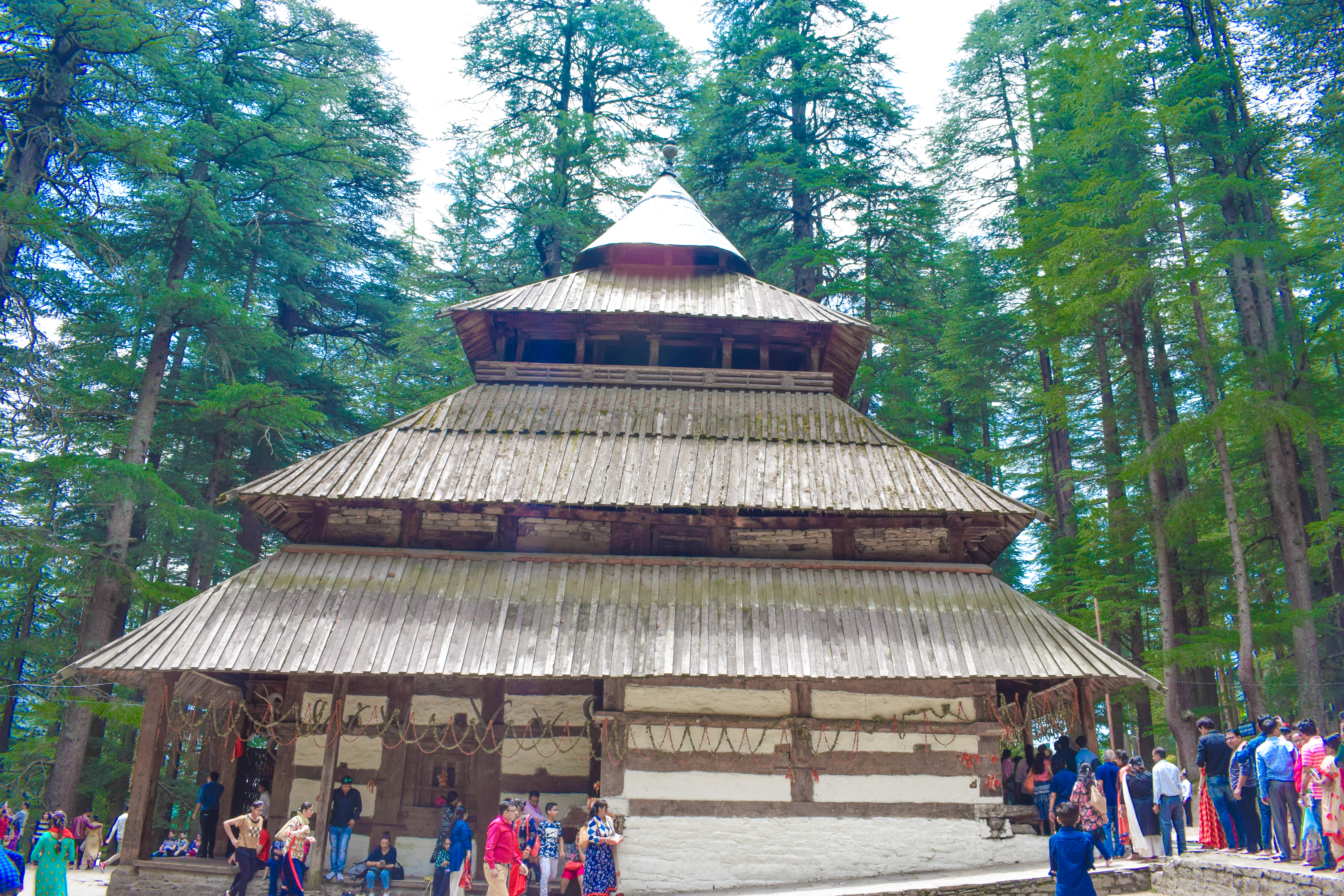
Hidimba Devi Temple
Most Hindu temples honor gods. This one honors a woman who became one. In a cedar forest called Dhungiri Van Vihar at the foot of the Himalayas in Manali, a four-tiered wooden pagoda rises 24 meters above a cave where, according to the Mahabharata, a rakshasi named Hidimbi once meditated her way to divinity. The Hidimba Devi Temple -- locally known as the Dhungari Temple -- was built in 1553 by Maharaja Bahadur Singh, not over ruins or relics, but over an enormous boulder jutting from the earth. That rock is the deity. No sculpted idol commands the inner sanctum. Instead, worshippers venerate the stone itself, along with a brass image of the goddess barely 7.5 centimeters tall.
The Demoness Who Stayed Behind
The story comes from the Mahabharata. During their years of exile, the five Pandava brothers passed through what is now Manali. Hidimbi lived there with her brother Hidimb, both born into a rakshasa family -- beings of enormous strength who occupy a morally ambiguous space in Hindu mythology, neither purely demonic nor entirely human. Hidimbi had vowed to marry whoever could defeat her brother, reputed to be fearless and immensely powerful. When Hidimb attacked the traveling Pandavas, Bhima -- the strongest of the five brothers -- killed him. Hidimbi and Bhima married, and their son Ghatotkacha would later prove a formidable warrior in the great war against the Kauravas. But when Bhima and his brothers eventually left, Hidimbi did not follow. She remained in the cedar forests and undertook tapasya -- a sustained practice of meditation, prayer, and penance -- until she attained the status of a goddess.
Timber, Brass, and Living Rock
The temple's design is unlike the stone shikhara towers common across the Indian plains. Four stacked roofs climb upward: three square tiers covered with timber tiles, crowned by a brass cone that catches the Himalayan light. The base is whitewashed stonework plastered with mud, grounding the structure in the earth from which the sacred boulder protrudes. Intricately carved wooden doors depict the goddess Durga, scenes from Lord Krishna's life, the nine Navagrahas, animals, dancers, and foliate designs -- a catalog of Hindu cosmology rendered in deodar cedar. Inside, the enormous rock fills most of the sanctum. A rope hangs before it, and according to local tradition, zealots in earlier centuries would bind the hands of those deemed sinners and swing them against the stone. Roughly seventy meters away stands a smaller shrine dedicated to Ghatotkacha, Hidimbi's son, extending the Mahabharata narrative across the forest floor.
Where Navaratri Belongs to Hidimba
Across most of India, the nine-night festival of Navaratri centers on the worship of Durga. In Manali, the spiritual focus shifts. Here, Navaratri belongs to Hidimba Devi, and the temple draws its largest crowds during these autumn nights when devotees gather to honor a local goddess whose mythology predates the standardized Hindu pantheon. The annual Hidimba Devi Fair, held each spring, deepens this sense of a living, localized faith. Hidimba is not an abstraction or an import -- she is the specific deity of this valley, this forest, this rock. Her story resonates because it inverts expectations: the rakshasi who was supposed to be monstrous chose devotion, the wife who was supposed to follow her husband chose independence, and the meditator who was supposed to be forgotten became the most revered figure in Manali's spiritual life.
A Forest Temple in the Himalayas
What distinguishes the Hidimba Devi Temple from India's more monumental shrines is its setting. Cedar trees tower around the pagoda, their trunks dark against the whitewashed base. Yaks graze nearby. The Himalayan peaks that frame the Kullu Valley are visible through gaps in the canopy, and in winter, snow dusts the timber roofs. The temple does not dominate its landscape the way a plains temple commands a flat horizon; it belongs to the forest, almost hidden within it. Inside, where the enormous rock fills the dim interior, the most striking feature is a set of footprints carved into a block of stone -- the imprint of the goddess's feet, worshipped by devotees who believe Hidimbi's presence remains embedded in the very ground she chose over the life she left behind.
From the Air
Located at 32.25N, 77.18E in Manali, Kullu Valley, Himachal Pradesh, at approximately 2,000 meters elevation. The temple sits in a cedar forest on the western edge of Manali, identifiable from the air by the dense tree cover against the town's developed areas. The Kullu Valley runs north-south with the Beas River as its central feature, flanked by snow-covered peaks. Nearest airport is Bhuntar Airport (VIBR), roughly 50 km south in the Kullu Valley. The Dhauladhar and Pir Panjal ranges provide dramatic visual context on either side. Best visibility from October through March when skies are clear.