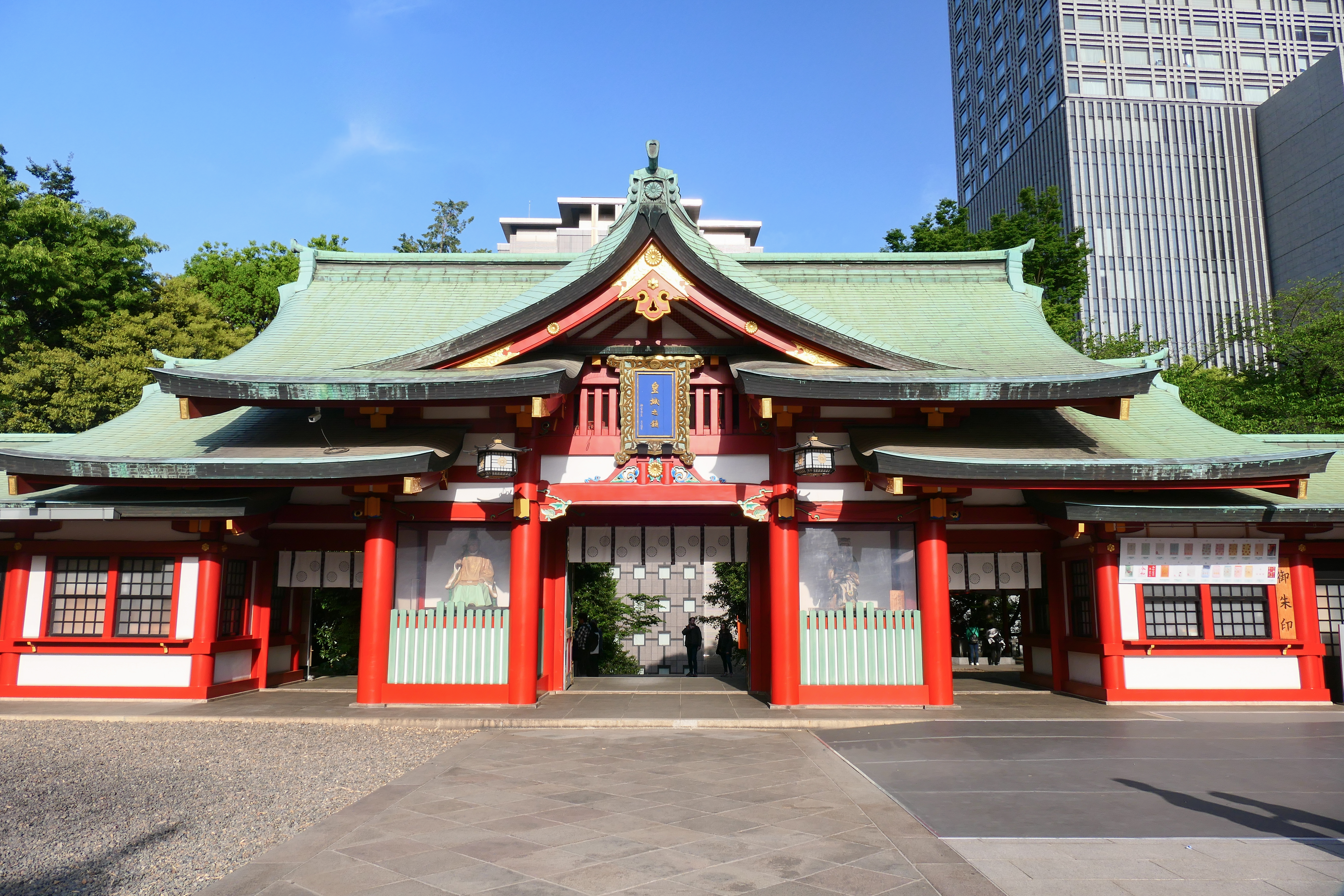
Hie Shrine: Escalators to the Gods
The first thing visitors notice about the Hie Shrine is the escalator. A gleaming modern escalator, climbing the steep hillside of Nagatecho in the political heart of Tokyo, delivering worshippers to a Shinto sanctuary that may date to the fourteenth century. It is an image that captures something essential about Japan: the willingness to place the hypermodern in direct service of the ancient, without irony, without apology. The shrine at the top of that escalator has been destroyed by fire, earthquake, and American bombs. It has been rebuilt each time. It guards a National Treasure -- a tachi, a single-edged sword of extraordinary craftsmanship -- alongside fourteen other Important Cultural Assets. And every June 15, its grounds host the Sanno Matsuri, one of the three great festivals of Edo, the city that became Tokyo.
Origins in Uncertainty
No one knows exactly when the Hie Shrine was founded. One theory credits Ota Dokan, the warrior and poet who built Edo Castle, with establishing the shrine in 1478. Another traces it further back, identifying it with a Sanno Shrine mentioned in records from the Kumano Nachi Taisha in 1362 -- more than a century earlier. What is certain is that the shrine's fortunes became permanently entangled with the Tokugawa shoguns who transformed Edo from a backwater fortress into the largest city in the world. Tokugawa Ieyasu, the dynasty's founder, moved the shrine onto the grounds of Edo Castle itself. In 1604, his son Tokugawa Hidetada relocated it outside the castle walls so that ordinary people could worship there. The shrine was positioned to the southwest of the castle, in the ura kimon direction -- the back demon gate -- according to onmyodo, the Japanese practice of cosmological geomancy. It served as a spiritual guardian against malign forces approaching from that quarter.
Burned, Bombed, Rebuilt
Fire came first. The Great Fire of Meireki in 1657, one of the most devastating urban fires in world history, consumed vast sections of Edo, including the Hie Shrine's shaden -- its main worship hall. Tokugawa Ietsuna, the fourth shogun, rebuilt the shrine at its present location in 1659. From 1871 through 1946, the Hie Shrine held the prestigious rank of kanpei taisha, meaning it stood in the first tier of government-supported shrines -- a status reserved for places of the highest spiritual significance. Then the bombs came. American firebombing during World War II destroyed the shaden a second time. The shrine that stands today dates from 1958, a postwar reconstruction that preserves the traditional forms while using modern materials and techniques. The cycle of destruction and renewal is itself a Shinto principle: the understanding that sacred spaces are defined not by their physical permanence but by the continuity of devotion that rebuilds them.
Swords and Festivals
The Hie Shrine's greatest material treasure is a tachi -- a long, gently curved single-edged sword designated a National Treasure of Japan. Alongside it, the shrine holds fourteen Important Cultural Assets: thirteen additional swords and one naginata, a pole weapon with a curved blade. This armory reflects the shrine's centuries-long relationship with the warrior class that shaped Edo. But the shrine's most visible contribution to Tokyo life is the Sanno Matsuri, held every June 15. It ranks among the three great festivals of old Edo, a distinction it shares with the Kanda Matsuri and the Fukagawa Matsuri. The Sanno Matsuri's grand procession, which historically entered the grounds of Edo Castle itself, continues today as one of Tokyo's most spectacular ceremonial events. The shrine is also among the most popular destinations for Shichi-Go-San, the coming-of-age festival where families bring children aged three, five, and seven to receive blessings.
The Hill Between Two Worlds
The Hie Shrine sits atop a steep hill in Nagatecho, Tokyo's political nerve center, surrounded by the National Diet, government ministries, and corporate headquarters. The contrast is deliberate -- or at least, deeply Japanese. Visitors approaching from the street encounter a striking tunnel of vermilion torii gates, reminiscent of the famous torii rows at Fushimi Inari Taisha in Kyoto, before reaching the escalators that carry them upward through the urban canopy. At the summit, the city noise fades. The honden, the main hall, occupies a wooded plateau that feels removed from the glass-and-steel metropolis just below. Three metro stations serve the shrine -- Tameike-Sanno, Kokkai-gijido-mae, and Akasaka-mitsuke -- placing it within minutes of almost anywhere in central Tokyo. The accessibility is the point. The Hie Shrine was moved outside Edo Castle's walls in 1604 precisely so the people could reach it. The escalators are simply the latest chapter in that same invitation.
From the Air
Located at 35.675°N, 139.740°E on a wooded hilltop in Nagatecho, Chiyoda, Tokyo. From altitude, the shrine's tree-covered compound appears as a green patch amid the dense government and commercial district, with the vermilion torii gates potentially visible at lower altitudes. The National Diet Building is located approximately 300 meters to the east. Best viewed at 1,500-3,000 feet AGL. Tokyo International Airport / Haneda (RJTT) lies approximately 8 nautical miles south-southwest. Narita International Airport (RJAA) is approximately 35 nautical miles east-northeast.