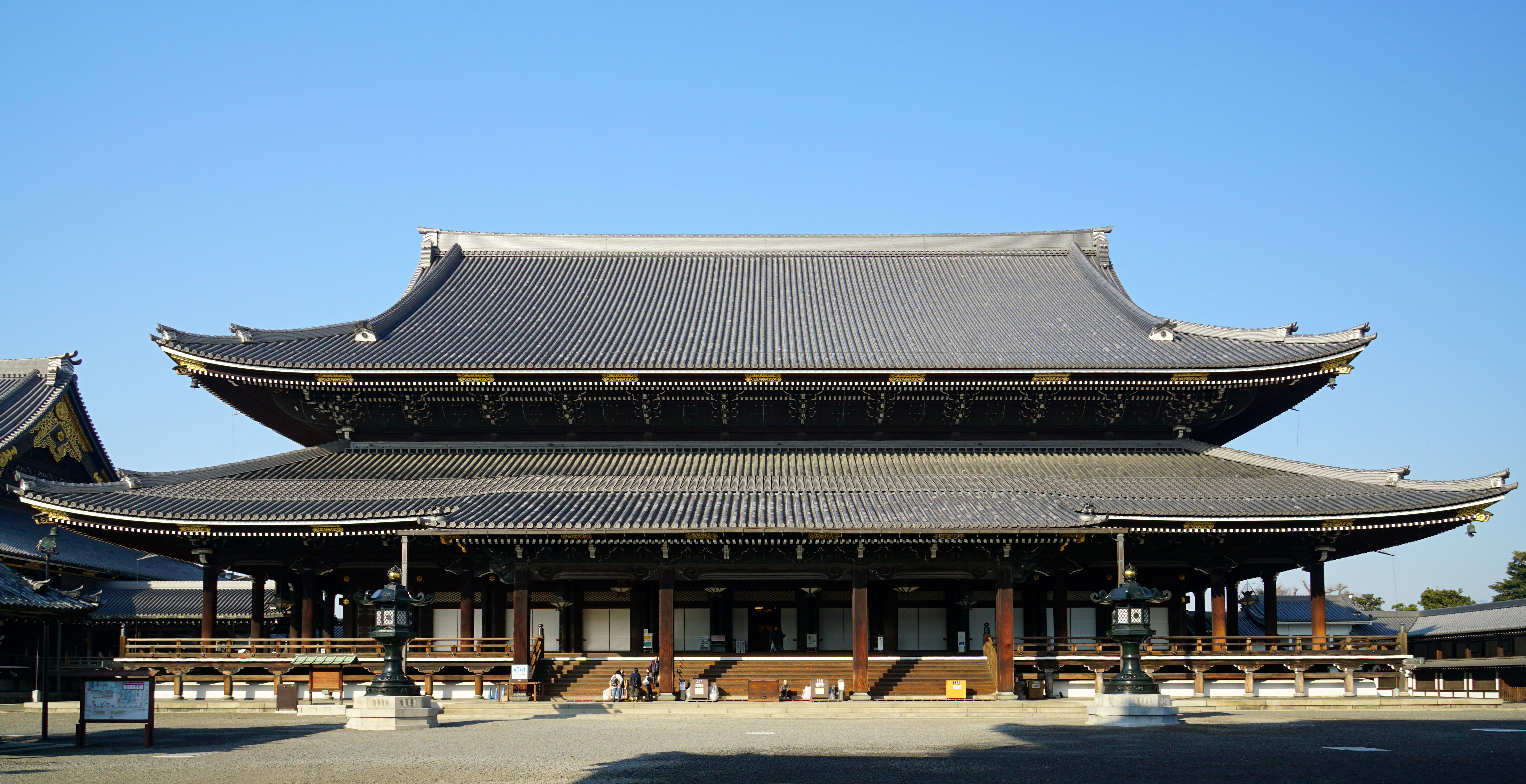
Higashi Hongan-ji: The Temple That Burned Four Times and Was Raised by Human Hair
Inside a glass case at Higashi Hongan-ji, coiled like a sleeping serpent, lies a thick rope braided from human hair. It weighs 375 kilograms. When the temple was being rebuilt in the 1890s after its fourth catastrophic fire, conventional rope could not bear the weight of the enormous wooden beams needed for the Founder's Hall. Female devotees across Japan responded by cutting off their hair and sending it to Kyoto, where it was woven with hemp into approximately fifty massive ropes strong enough to haul timbers into place. The rope on display is the physical proof of a devotion so fierce it literally became part of the building's structure. Higashi Hongan-ji sits just north of Kyoto Station, one of the first major landmarks visitors encounter in the city, and its story of destruction and resurrection -- four fires, four rebuildings, and one extraordinary act of collective sacrifice -- is as compelling as any in Kyoto's long history.
A Shogun's Strategic Division
Higashi Hongan-ji exists because of politics, not piety. In 1602, the shogun Tokugawa Ieyasu faced a problem: the Jodo Shinshu sect of Pure Land Buddhism had grown too powerful. Its head temple, Hongan-ji, commanded enormous wealth and millions of followers. Ieyasu's solution was elegant and ruthless -- he split the sect in two. He granted land just east of the original temple and encouraged a rival faction to build there, creating Higashi Hongan-ji, the 'Eastern Temple of the Original Vow,' as a counterweight to what became Nishi Hongan-ji, the 'Western Temple.' The division worked. Neither half could challenge the shogunate the way the unified sect once had. But it also created a productive rivalry: each temple tried to outdo the other in grandeur, scale, and devotion, pushing both to heights of architectural ambition that neither might have reached alone.
Four Fires and Four Resurrections
The history of Higashi Hongan-ji reads like a cycle of catastrophe and determination. The Goei-do and Amida Hall burned down four times during the Edo period alone. The Great Tenmei Fire of 1788 swept through Kyoto and consumed the temple buildings; they were rebuilt by 1797. An accidental fire destroyed them again in 1823; they rose again by 1835. Another fire struck in 1858, and temporary halls were hastily erected for Shinran's 600th Memorial Service in 1861. But on July 19, 1864, a city-wide conflagration caused by the Kinmon incident -- a battle between rival samurai factions at the gates of the Imperial Palace -- burned those temporary halls to the ground. The temple did not begin its final rebuilding until 1879, after the Meiji Restoration had settled the political turmoil. The Goei-do and Amida Hall were completed in 1895, with remaining buildings restored by 1911. These are the structures standing today.
The Largest Wooden Room in Kyoto
The Goei-do, or Founder's Hall, is the spiritual and physical center of Higashi Hongan-ji. It enshrines an image of Shinran, the 13th-century monk who founded Jodo Shinshu, the True Pure Land school of Buddhism. The hall is staggering in its dimensions: 76 meters long, 58 meters wide, and 38 meters tall, making it one of the largest wooden structures in the world and the largest wooden building in Kyoto. Inside, 927 tatami mats cover the floor. To the left stands the Amida Hall, housing an image of Amitabha Buddha alongside a figure of Prince Shotoku, who is credited with introducing Buddhism to Japan. The Amida Hall is ornately decorated with gold leaf and artwork from the Meiji era. Both halls were completed in 1895, and their construction required the hair ropes that remain on display -- a reminder that these enormous wooden rooms were raised not by machinery but by devotion and ingenuity.
The Gate from a Vanished Castle
Tokugawa Ieyasu's connection to the temple extends beyond its founding. The imposing gate at Higashi Hongan-ji was originally part of Fushimi Castle, the elaborate fortress that Ieyasu used as his base of power south of Kyoto. When Ieyasu had the castle dismantled, he gave the gate to the temple -- a gift that was also a reminder of who held authority. The gate survives as one of the few remaining physical traces of Fushimi Castle, which was otherwise demolished and its materials scattered across Kyoto's temples and shrines. Walking through it today, visitors pass beneath timbers that were cut for a military stronghold and repurposed for a place of worship, a transformation that mirrors the broader shift from the warring Sengoku period to the relative peace of the Tokugawa era.
A Temple at the City's Threshold
Higashi Hongan-ji stands barely a ten-minute walk north of Kyoto Station, making it one of the first significant cultural sites that travelers encounter after arriving in the city. Its massive rooflines are visible from the station plaza, rising above the surrounding buildings with an authority that has nothing to do with height and everything to do with mass. The temple is free to enter, and its grounds offer a striking contrast to the modern commercial district surrounding the station. The affiliated garden, Shosei-en, lies a short walk to the east -- a walled retreat originally designed as a villa for the temple's head priest. Unlike many of Kyoto's most famous temples, Higashi Hongan-ji does not charge admission and does not feel curated for tourism. It feels like what it is: a working temple where people come to pray, where the floorboards creak under stockinged feet, and where a rope made of human hair reminds visitors what faith once asked of the faithful.
From the Air
Located at 34.991°N, 135.758°E, immediately north of Kyoto Station in central Kyoto. The temple's enormous Goei-do roof -- one of the largest wooden roofs in the world -- is a prominent feature visible from altitude, with its distinctive grey-brown tiles forming a massive rectangular footprint amid the surrounding urban grid. The temple complex and its adjacent Shosei-en garden create a visible green and open space contrast against the dense city blocks. Best viewed at 2,000-4,000 feet AGL. Osaka Itami Airport (RJOO) lies approximately 22 nautical miles southwest. Kansai International Airport (RJBB) is approximately 50 nautical miles south.