Highgate Cemetery: Where the Dead Are Never Quite Still
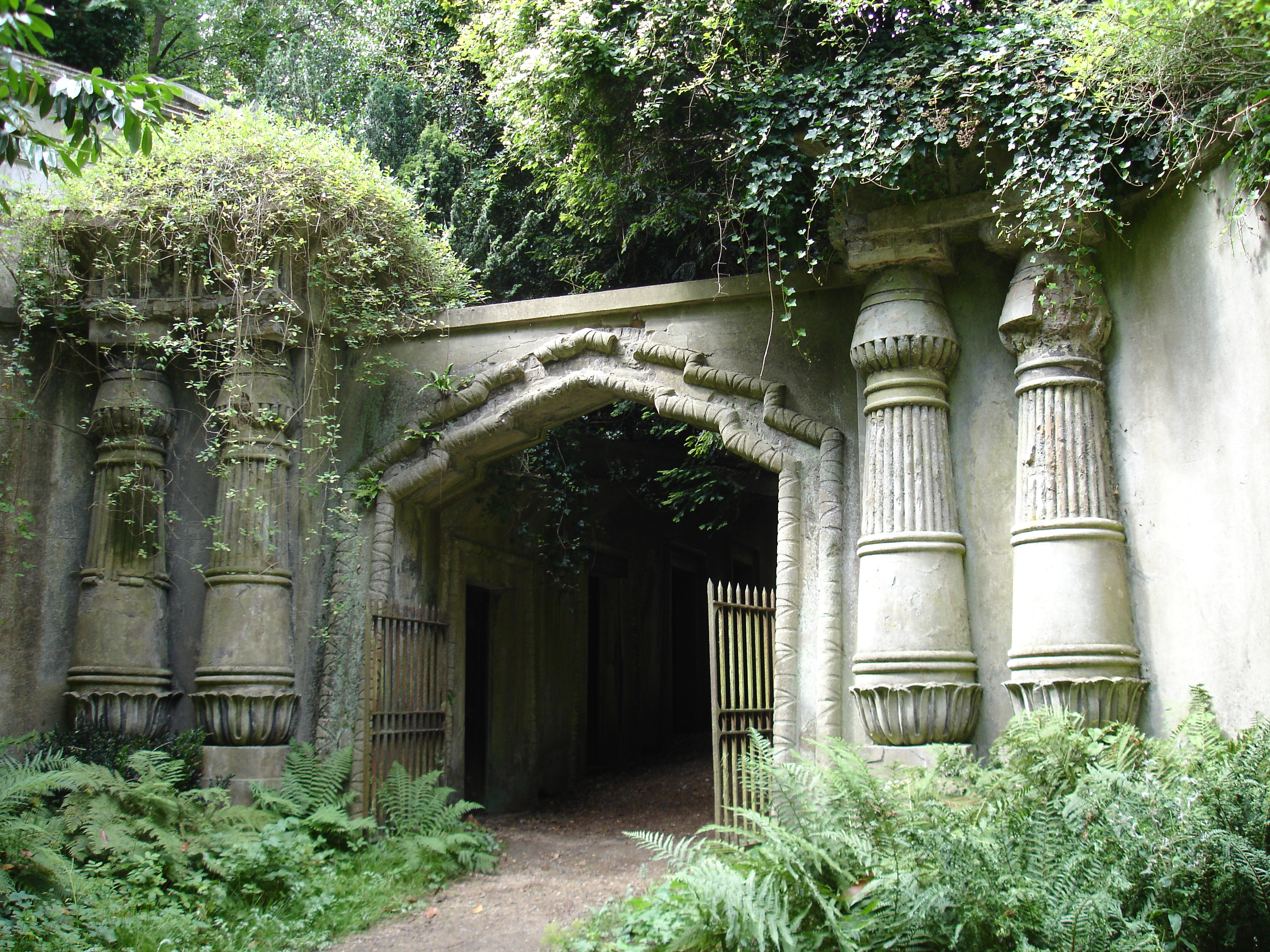
The Egyptian Avenue announces itself with a pair of obelisks flanking an arched entrance cut into a hillside in North London. Step through and the modern city vanishes. A passage of columns with lotus-bud capitals leads into the Circle of Lebanon, a ring of catacombs built around a 300-year-old cedar tree. Beyond it, paths wind through a canopy of ivy, elder, and self-seeded sycamore so dense that sunlight rarely reaches the monuments below. This is the western half of Highgate Cemetery, opened in 1839 and now accessible only by guided tour, a place that manages to be simultaneously a Victorian masterpiece, an urban nature reserve, and one of the most unsettling landscapes in London.
One of the Magnificent Seven
Highgate was the third of the seven great private cemeteries established in a ring around London in the 1830s and 1840s, when the city's churchyards could no longer absorb the dead. Designed by architect Stephen Geary, it opened in 1839 on a steep hillside above Swain's Lane, with views south toward the city. The cemetery was an immediate commercial and social success. Being buried at Highgate became fashionable, and the cemetery's proprietors invested in increasingly elaborate landscaping and architecture. The Egyptian Avenue and the Circle of Lebanon, designed by James Bunstone Bunning, gave the western grounds an exotic, theatrical quality that was quite deliberate: Victorian cemetery designers understood that grandeur attracted paying customers.
The East and Its Famous Dead
When the west side filled, an eastern extension opened across Swain's Lane in 1854, connected to the original grounds by a bridge. The east side is less dramatic architecturally but holds Highgate's most visited grave: Karl Marx, who died in London in 1883 and was buried in a modest plot. In 1956, the Communist Party of Great Britain erected the massive bronze bust that now marks the site, turning a quiet grave into a political landmark. The cemetery holds approximately 170,000 burials in around 53,000 graves. Among them are the scientist Michael Faraday, the novelist George Eliot, the philosopher Herbert Spencer, the punk musician Malcolm McLaren, and the Russian dissident Alexander Litvinenko, poisoned with polonium-210 in London in 2006. The range is extraordinary -- radicals and reactionaries, artists and assassins, all sharing the same North London hillside.
Decline and the Vampire Scare
By the mid-twentieth century, the private company that had operated Highgate since its founding was in financial trouble. Maintenance ceased. The western cemetery, never as profitable as the east, became overgrown. Monuments cracked and toppled. Trees pushed through roofs. In the early 1970s, reports of a supernatural figure in the cemetery sparked what became known as the Highgate Vampire affair, a media sensation that attracted self-proclaimed vampire hunters, vandals, and occultists to the grounds. Graves were broken open. Bodies were disturbed. The episode was more sensationalism than substance, but the damage to the cemetery was real.
The Friends and the Forest
In 1975, the Friends of Highgate Cemetery formed to rescue the grounds from collapse. The organization, now a registered charity, took over management and began the delicate work of stabilizing monuments without destroying the wildness that decades of neglect had created. The western cemetery, where trees and ivy have fused with the stone into something that looks half-ruin and half-forest, is now managed as both a heritage site and a nature reserve. At least 33 species of bird nest in the grounds, along with foxes, bats, and a rich population of insects. The cemetery is designated Grade I on the Register of Historic Parks and Gardens. It remains an active burial ground -- new interments still take place on the east side. The balance the Friends maintain is precise: enough conservation to keep the monuments from crumbling entirely, enough wildness to preserve the atmosphere that makes Highgate unlike any other cemetery in London. It is a place where the Victorian cult of death meets the quiet reclamation of nature, and where visitors come not to mourn but to be reminded of something older and larger than themselves.
From the Air
Highgate Cemetery occupies a hillside on Swain's Lane in North London (51.567N, 0.147W), roughly 6km north of central London. From the air, it appears as a dense wooded area between Highgate village and Waterlow Park, east of Hampstead Heath. The western and eastern sections are separated by Swain's Lane. Nearest airports are London City (EGLC) 15km southeast and London Luton (EGGW) 40km north. From altitude, the cemetery's heavy tree canopy distinguishes it from the surrounding residential streets of Highgate.