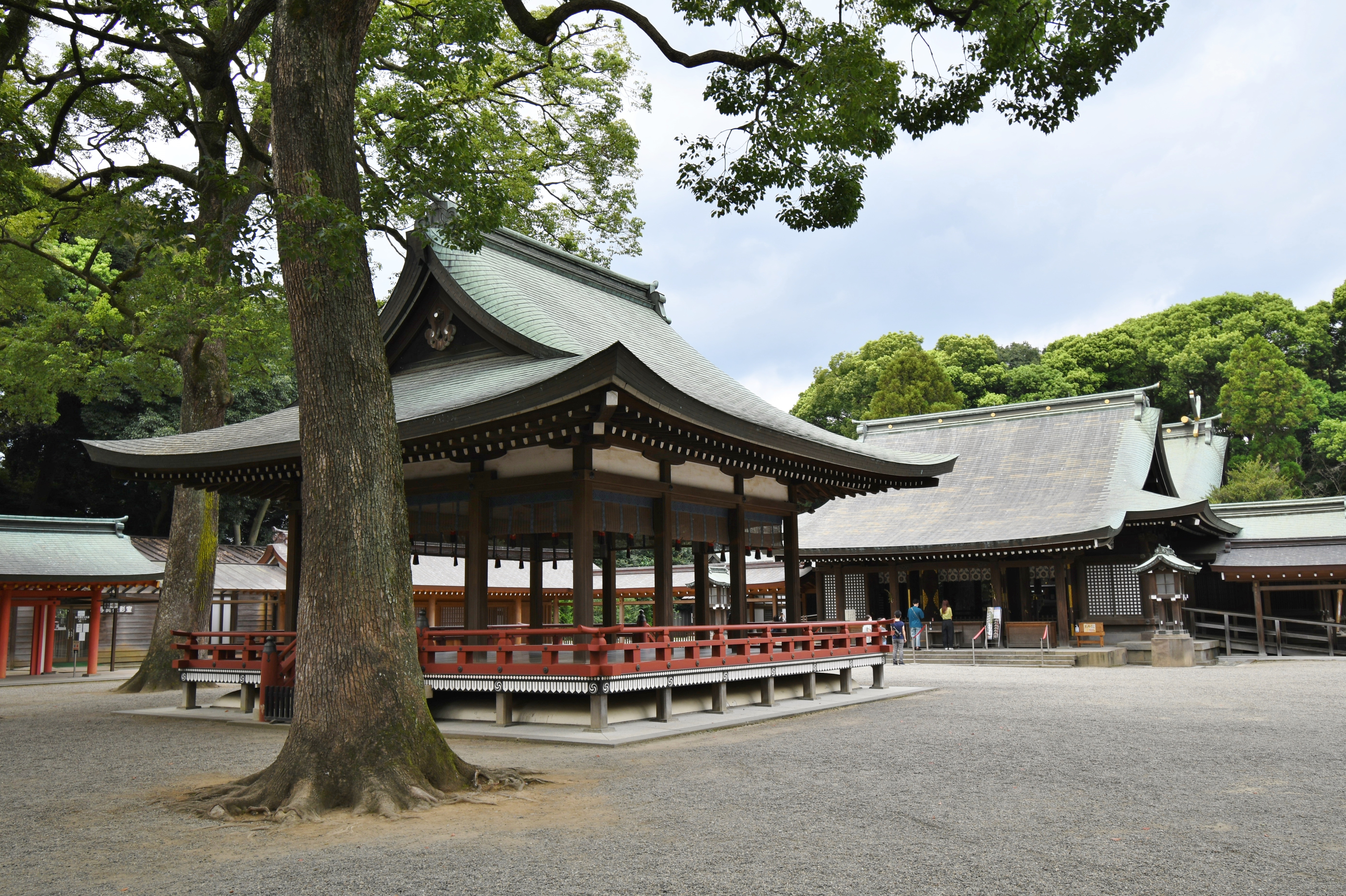
Hikawa Shrine
The city takes its name from the shrine, not the other way around. Omiya literally means "Great Shrine," a title bestowed after Emperor Meiji elevated Hikawa above every other Shinto sanctuary in the Kanto region. That distinction alone would make this place remarkable, but Hikawa Shrine carries far older weight. According to its own tradition, it was established in 473 BC during the reign of the legendary Emperor Kosho, when the ruling Musashi kuni no miyatsuko clan migrated from Izumo Province, bringing with them the worship of Susanoo, the storm god, brother of the sun goddess Amaterasu. Whether or not those dates hold up to modern scrutiny, the shrine's first verified appearance in the historical record, an entry in the Nihon Sandai Jitsuroku compiled in 901, still places it among the most ancient active religious sites in eastern Japan.
Gods of Storm and Harvest
Three kami reside at Hikawa. Susanoo, the tempestuous brother of Amaterasu, presides as god of sea, storms, fields, harvest, marriage, and love. His wife Kushinadahime governs rice, agriculture, marriage, childbirth, and child rearing. Okuninushi, god of nation-building, agriculture, medicine, and protective magic, completes the trio. The combination speaks to the shrine's origins in a landscape defined by water. The pond within the grounds is a remnant of Minuma, a vast swamp that stretched across the Kanto Plain until drainage projects in the middle of the Edo period transformed it into farmland. The shrine was built on a hill or promontory extending into that swamp, and its earliest spiritual function was enshrining the water god of Minuma, a deity whose favor meant the difference between harvest and famine.
Warriors at the Gate
Power has always sought Hikawa's blessing. Legend holds that the folk hero Yamato Takeru, his leg injured during a military expedition to conquer eastern Japan for the Yamato kingdom, visited the shrine after a mysterious old man appeared in a dream and directed him there. After worshipping, Yamato Takeru stood unaided, and the old regional name for the area, meaning "leg stand," is said to commemorate the miracle. In the Heian period, Taira no Sadamori prayed here for victory over Taira no Masakado during the Tengyo no Ran. During the Kamakura period, Minamoto no Yoritomo, the first shogun, ordered Doi Sanehira to rebuild the shrine in 1180, lavishing it with donations. The pattern repeats across centuries: those who wielded swords came here to kneel.
The Rank That Took Centuries to Earn
For a shrine of such prominence, Hikawa's claim to the title of ichinomiya, the highest-ranked shrine of Musashi Province, was surprisingly contested. The Azuma Kagami and other Kamakura-era sources awarded that distinction to the Ono Shrine in what is now the city of Tama, relegating Hikawa to the rank of "san-no-miya," or third shrine. It was the only myojin taishi in all of Musashi, a mark of the highest ritual prestige, yet the top provincial rank eluded it. Only in the late Muromachi period do records clearly refer to Hikawa as the ichinomiya, a promotion that may have taken the better part of five hundred years. Today, it stands as the undisputed head of a network of approximately 280 Hikawa shrines spread across the Kanto region.
From Post Road to Emperor's Pilgrimage
During the Edo period, Hikawa prospered from its position in Omiya-juku, a post station on the Nakasenado, one of the five great highways connecting Edo to the provinces. Travelers and pilgrims alike stopped to worship, and the shrine grew wealthy. The main structure was renovated in 1882, but the most significant modern transformation came in 1940, when a government-financed project reconstructed the main hall, gate tower, and associated buildings. Then, on December 11, 1868, Emperor Meiji himself had visited, the first imperial pilgrimage to Hikawa and the act that cemented the shrine's supremacy in the region. In 1976, the great torii gate from Meiji Shrine in Tokyo, damaged by lightning a decade earlier, was repaired and relocated to Hikawa, creating a tangible link between two of Japan's most important Shinto sites.
The Shrine in the Modern City
Today Hikawa sits within the urban fabric of Saitama City's Omiya ward, a twenty-minute walk from Omiya Station. The annual main festival on August 1 draws crowds who come to honor Susanoo and the harvest. The shrine grounds, with their ancient pond and towering trees, offer a pocket of deliberate stillness amid one of the densest metropolitan areas on Earth. The approach road, lined with stone lanterns and cherry trees, channels visitors from the noise of the surrounding city into a progressively quieter corridor that ends at the main hall. It is a passage that countless feet have worn smooth over more than a millennium, a path that still leads somewhere worth arriving.
From the Air
Located at 35.917N, 139.629E in Omiya-ku, Saitama City, on the Kanto Plain northwest of central Tokyo. The shrine grounds appear as a dense tree canopy within the urban grid, adjacent to Omiya Park. Best observed at 2,000-3,000 ft AGL. The nearest major airport is RJTT (Tokyo Haneda), approximately 30 nm south-southwest. RJAA (Narita) is roughly 45 nm east. Look for the large forested rectangle amid the dense urban fabric near Omiya Station, one of the busiest rail junctions in Saitama.