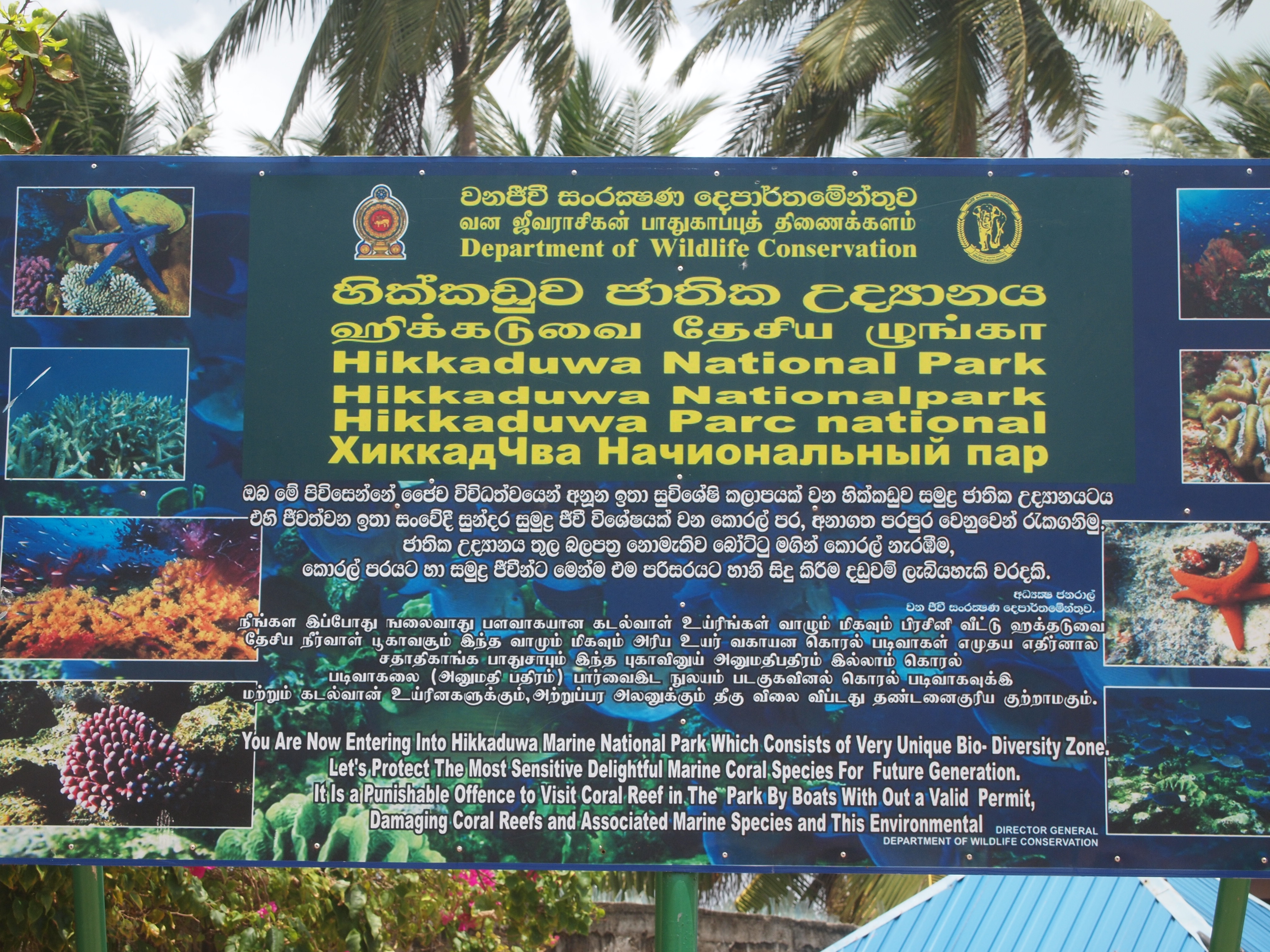
Hikkaduwa National Park
Sixty species of coral grow in water shallow enough to stand in. That is the paradox of Hikkaduwa: the reef's accessibility is both its greatest attraction and its most persistent threat. Located along Sri Lanka's southwestern coast near the town of Hikkaduwa, this fringing reef averages just five meters in depth, close enough to the surface that snorkelers can hover above brain corals the size of boulders and watch parrotfish graze on algae. It is one of only three marine national parks in Sri Lanka, and its story is less about pristine wilderness than about what happens when a fragile ecosystem and mass tourism occupy the same shallow water.
A Reef That Builds the Shore
The Hikkaduwa reef is not merely scenic. It functions as a natural breakwater, absorbing wave energy that would otherwise erode the coastline. Staghorn corals branch upward like underwater antlers. Elkhorn corals spread in broad, flat plates. Brain corals sit heavy and round on the seabed, their convoluted surfaces resembling the organ they are named for. Table corals extend horizontal shelves that shelter smaller fish beneath. Across 31 genera, these 60 recorded coral species create a three-dimensional architecture that supports over 170 species of reef fish from 76 genera. Below the coral zone, between five and ten meters depth, beds of seagrass and marine algae from the genera Halimeda and Caulerpa carpet the sandy bottom, forming a quieter ecosystem that connects the reef to the deeper ocean floor.
Decades of Reclassification
The authorities saw the reef's vulnerability early, though their responses always lagged behind the damage. On May 18, 1979, the area was declared a wildlife sanctuary. Nine years later, on August 14, 1988, it was upgraded to a nature reserve with an extended land boundary. But the designation did little to slow the influx of visitors, and over the following twenty-five years, the growing number of tourists accelerated the reef's degradation. Coral was broken by careless anchoring and trampled by wading feet. Ornamental fish were harvested from breeding populations to supply the commercial aquarium trade, a practice that continued despite the reef's protected status. By 2002, the situation demanded a stronger measure, and on September 19 of that year, the reef was declared a national park. Scientists have estimated that at least thirty to forty percent of the coral reef would need to be restored before it could sustain itself without intervention.
Boxing Day and After
When the Indian Ocean tsunami struck on December 26, 2004, Hikkaduwa and Pigeon Island, Sri Lanka's two marine national parks, escaped the direct force of the waves better than the communities onshore. The reef was not shattered by the wall of water itself. Instead, the damage came secondhand: terrestrial debris, swept offshore by the retreating surge, settled onto the coral. Sediment smothered living tissue. Two large fishing nets, torn from the coast, tangled on the outer edge of the reef and dragged across its surface. In the weeks that followed, a collaborative effort by conservation groups and volunteers worked to clean the beach and remove debris from the reef, pulling free the nets and clearing what could be cleared. The tsunami was a reminder that a reef this close to shore lives and dies with the land behind it. What happens to the coast happens, sooner or later, to the coral.
The View from Five Meters Down
From the air, Hikkaduwa's reef appears as a pale shadow beneath turquoise water, a lighter band running parallel to the shore where the coral rises close to the surface. The distinction between reef and open ocean is visible even at altitude: the water inside the reef line is calmer, greener, and shallower than the deeper blue beyond. On any given day, glass-bottomed boats drift above the coral, their passengers peering down at a world that looks timeless but is not. The reef is changing. Whether it is changing toward recovery or decline depends on choices being made now, on the boats overhead, in the fishing villages along the shore, and in the offices where conservation budgets are written. Hikkaduwa's coral has survived tsunamis, tourism, and thirty years of bureaucratic reclassification. Whether it can survive the next thirty depends on whether protection means anything more than a sign at the water's edge.
From the Air
Hikkaduwa National Park is located at 6.145N, 80.093E along the southwestern coast of Sri Lanka. The fringing coral reef is visible from low altitude as a pale band running parallel to the shoreline in shallow turquoise water. Best viewed from the west at 500-1,500 feet AGL to distinguish the reef line from the deeper ocean beyond. The nearby town of Hikkaduwa is visible along the coast. Koggala Airport (VCCK) is approximately 12 nautical miles to the southeast. Bandaranaike International Airport (VCBI) is roughly 75 nautical miles to the north. The reef contrasts clearly with the darker blue of open water beyond it.