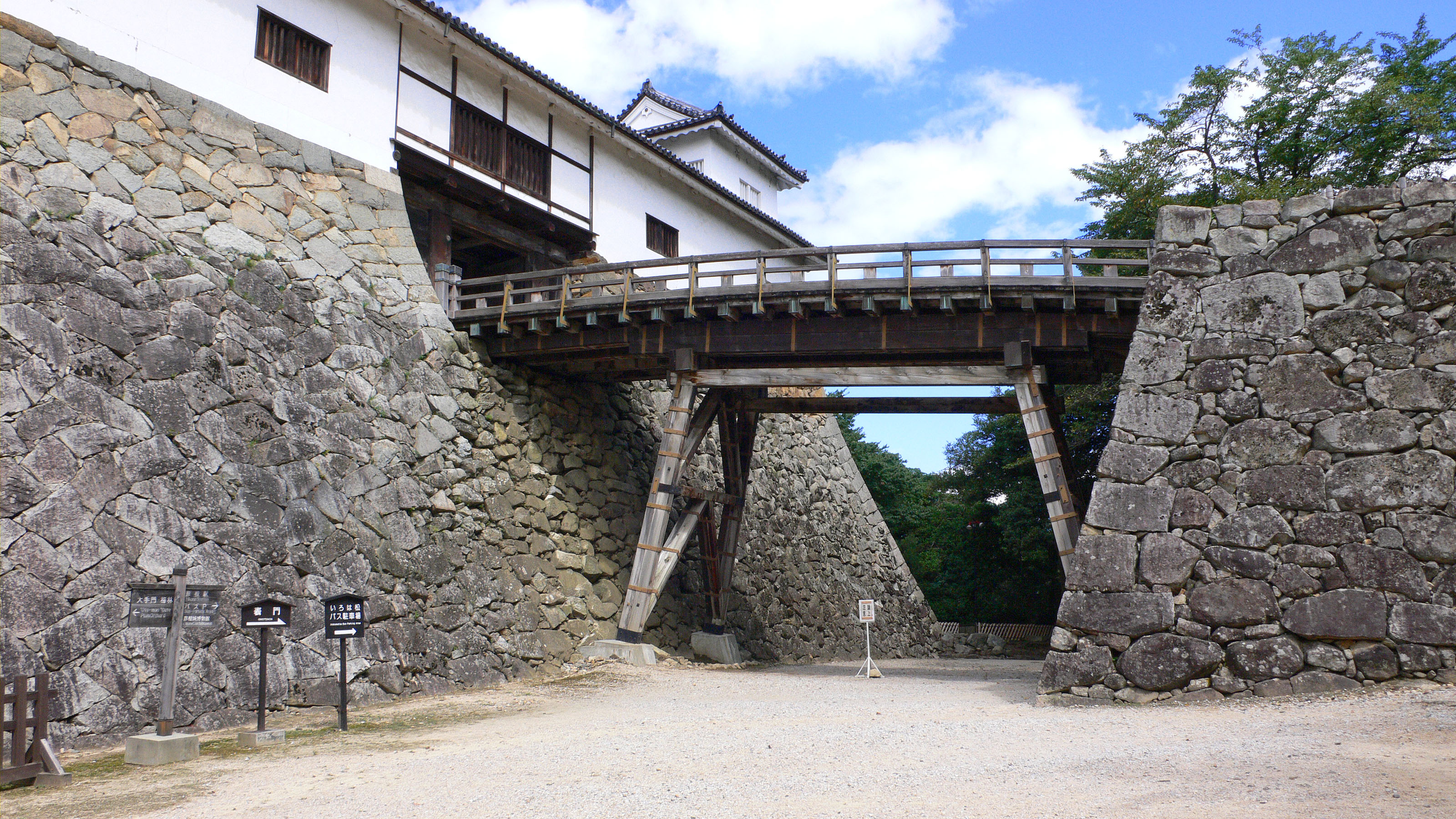
Hikone Castle: The Fortress an Emperor Refused to Destroy
On the night of August 15, 1945, American bombers were scheduled to destroy the city of Hikone. The raid never happened. At noon that day, Emperor Hirohito's voice crackled across Japanese radio for the first time, announcing surrender. The castle that rises on Mount Konki above Lake Biwa's eastern shore had already defied destruction once before -- when Emperor Meiji, touring the region in the 1870s after ordering every feudal fortification in the country torn down, personally exempted Hikone from the wrecking crews. Twice saved by emperors, the castle stands today as one of only twelve in Japan retaining its original tower keep, and one of just five whose structures carry the supreme designation of National Treasure.
A Castle Built on Rivalry and Blood
The hill where Hikone Castle stands was always contested ground. Eastern Omi Province sat astride the Nakasendo highway, the critical corridor connecting Kyoto with the eastern provinces, making it a natural chokepoint for anyone trying to protect or seize the capital. The Azai clan built nearby Sawayama Castle first. Oda Nobunaga destroyed the Azai and gave Sawayama to his general Niwa Nagahide. Under Toyotomi Hideyoshi, the castle passed to his closest advisor Ishida Mitsunari. After Mitsunari's defeat at the Battle of Sekigahara in 1600, Tokugawa Ieyasu awarded the domain to one of his most trusted commanders, Ii Naomasa. But Naomasa rejected the existing fortress -- its defenses were outdated, and it reeked of the enemy regime. He chose a fresh site on the lakeshore and began an entirely new castle designed to the latest military specifications.
Twenty Years of Stone and Cypress
Ii Naomasa never saw his castle completed. Wounds sustained in battle killed him in 1602, just as construction began. His son Ii Naokatsu carried the project forward, and it would take twenty years before the fortress was finished in 1622. The result was formidable: two concentric water moats surrounding a hundred-meter hill, the hilltop divided into three interlocking enclosures -- Kane-no-maru to the southeast, Nishi-no-maru to the northwest, and the Honmaru inner bailey at the center. Dry moats and stone-faced walls guarded every approach. The three-story tower keep, compact but elegant, anchored the complex with attached turrets that extended its defensive reach. Originally, the main entrance faced west through the Otemon gate, but later the Sawaguchi gate on the southeast, linking directly to the Nakasendo highway, became the primary approach -- a practical concession to peacetime traffic over wartime defense.
The Clan That Shaped a Nation
The Ii family governed from Hikone Castle for more than two centuries, and their influence reached far beyond this lakeside domain. Counted among the foremost fudai daimyo -- the hereditary vassal lords closest to the Tokugawa shoguns -- the Ii clan held some of the most powerful positions in the shogunate. The most consequential was Ii Naosuke, who in the 1850s served as tairo, the senior councilor, effectively running the country during an era of weak shoguns. Naosuke made the fateful decision to end Japan's two centuries of isolation, opening ports to Western powers under intense foreign pressure. Nationalists who championed the slogan 'Revere the Emperor, Expel the Barbarians' responded with assassination, cutting Naosuke down outside Edo Castle's Sakurada Gate in 1860. The final lord, Ii Naonori, read the winds differently. Despite Hikone's deep loyalty to the Tokugawa, he sided with imperial forces during the Boshin War. When shogunal troops gathered at Osaka Castle, the Hikone garrison simply marched home.
Cherry Blossoms Over the Moat
Peacetime transformed Hikone from fortress to garden. In 1934, over a thousand Yoshino cherry trees were planted across the castle grounds, and each spring the old moats now reflect clouds of pale pink. The Ii clan donated the castle and its grounds to the city of Hikone in 1944. After the war, the main keep and its attached turrets received National Treasure designation in 1952. Major restorations followed in waves -- the tower keep from 1957 to 1960, the various guard turrets from 1960 to 1968, and the daimyo palace rebuilt as the Hikone Castle Museum in 1987. In 2006, the Japan Castle Foundation named Hikone one of Japan's Top 100 Castles. The castle sits a fifteen-minute walk from Hikone Station, and its mascot, Hikonyan -- a cheerful white cat based on a legend about the Ii lord Naotaka being beckoned to shelter by a cat during a thunderstorm -- has become one of Japan's most recognized characters.
Where Lake Meets Fortress
Land reclamation has pushed Lake Biwa about a kilometer from the castle walls, but in the original design, water lapped at the fortress on its north and east sides. The relationship between castle and lake was not merely aesthetic -- it was strategic, turning two flanks into impassable water barriers. Today the view from the castle grounds sweeps across the reclaimed lowlands to the vast blue surface of Japan's largest freshwater lake, the mountains of the western shore forming a distant wall. The Genkyuen garden, a daimyo strolling garden at the castle's base, borrows this panorama of lake and mountain as part of its carefully composed scenery, blending the intimate scale of raked gravel and shaped pines with the immense backdrop of Biwa's waters stretching north toward the horizon.
From the Air
Located at 35.276°N, 136.252°E on a hill along the eastern shore of Lake Biwa in Shiga Prefecture. The castle's white tower keep is visible atop Mount Konki, with the concentric moats visible at lower altitudes. Lake Biwa, Japan's largest freshwater lake, dominates the landscape to the west and provides a major visual reference. Recommended viewing at 2,000-4,000 feet AGL approaching from over the lake. The nearest significant airport is Chubu Centrair International Airport (RJGG), approximately 50 nautical miles to the south-southeast. Osaka Itami (RJOO) lies roughly 60 nm to the southwest.