Hilden
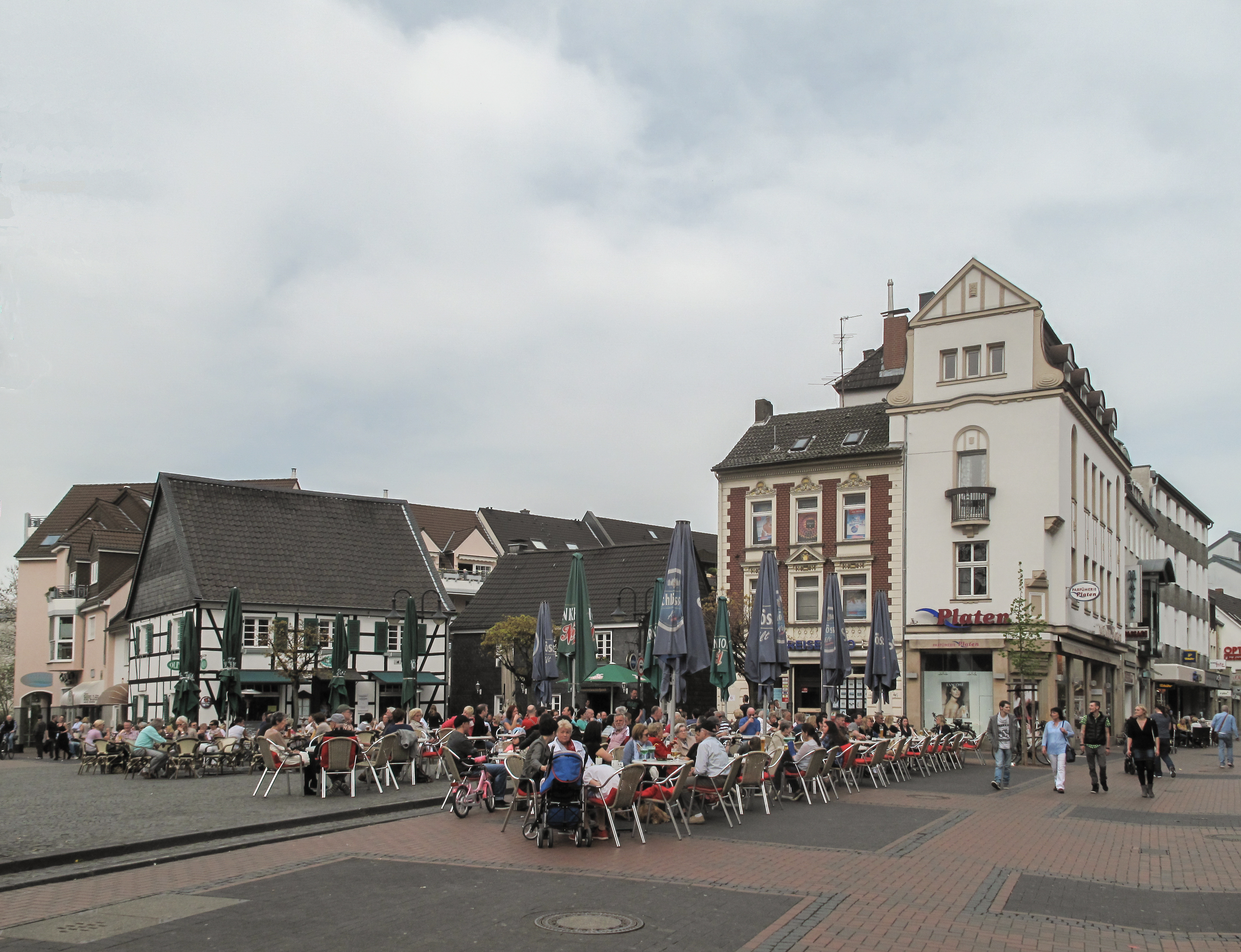
Walk through Hilden's Mittelstrasse pedestrian zone and you will pass a bronze bust set on a plinth at the market place. The face belongs to Wilhelm Fabry, born here in 1560, and his quiet stare has more authority than most of the people walking past him realize. Fabry is the man European medicine credits with founding scientific surgery — the practice of observing, recording and reasoning about what actually happens when you cut into a human body, rather than relying on Galen and guesswork. Hilden has produced a film director, a footballer, a rapper and a racing driver. The bust belongs to the surgeon.
Between Solingen and the Rhine
Hilden sits 10 kilometers west of Solingen and 15 kilometers east of Düsseldorf, on the right bank of the Rhine in the District of Mettmann. With roughly 57,000 inhabitants, it is the district's fourth-largest city — and unusually, it has no suburban villages or incorporated outlying districts. The town is one compact urban block, bordered by small woods. That tightness gives it a particular character: a real downtown, a real pedestrian zone, a real market square, all walkable in an afternoon. Written sources name Hilden as far back as the 11th century, when a Romanesque church rose in the middle of the early settlement. That church became Protestant during the Reformation, and a second church for the Catholic minority went up later. Both still stand.
Fabry's Surgery
What Wilhelm Fabry actually did, between his birth in Hilden in 1560 and his death in 1634, was to treat surgery as a discipline subject to evidence. He kept careful case histories. He invented and refined instruments. He pioneered amputation above the line of damage to prevent gangrene, and he published his observations — including the first systematic description of using a tourniquet during amputation. His wife Marie Colinet, herself a skilled midwife and surgeon, is credited with the first recorded use of a magnet to extract iron splinters from a patient's eye. Together they formed one of the most consequential medical partnerships of the early modern era. The Wilhelm-Fabry-Museum in Hilden preserves the story today, on the site of the town where their thinking began.
Factory Town, Hard Century
Industrialization brought textile mills, engineering workshops and paint factories to Hilden in the 19th century. Both world wars hit hard. A memorial in town lists the soldiers' names. During Nazi rule, Jews and political opponents were persecuted, and roughly 3,000 forced laborers were put to work in local factories — a fact the town's own records do not soften. American troops occupied Hilden in 1945, replaced by units of the British Army of the Rhine stationed in barracks built in 1937. The British stayed until March 1968. After Germany joined NATO in 1955, former adversaries became allies, and the relationship between the regiment and the local population became close enough that it produced a twin-town partnership with Warrington, in England, in 1968 — built on school exchanges and personal friendships before any official ceremony.
Refugees, Migrants, Reinvention
The end of the war brought a second transformation. Refugees from East Germany flooded into Hilden, nearly doubling its population. In 1956, the town council formally adopted a patronage relationship with the displaced citizens of Wohlau, a town in Lower Silesia from which more than a thousand former residents had been scattered across Germany. From the 1960s on, foreign migrant workers arrived for the postwar industrial boom. When the textile and paint industries collapsed in the 1980s crisis, Hilden reinvented itself again — today the German headquarters of 3M and Qiagen are here, alongside a thicket of technology and logistics firms.
A Town That Slows Down
In 1992, Hilden made an unusual choice: it lowered residential speed limits to 30 km/h across the entire town, to encourage cycling. The main street in the center is now a pedestrian zone. The old metre-gauge tram that once ran in three directions — to Düsseldorf-Benrath, Solingen-Ohligs and Wuppertal-Vohwinkel — was a minor tourist attraction in its own right before the buses took over in the 1960s. Today the S 1 line of the Rhine-Ruhr S-Bahn connects Hilden to Düsseldorf, Solingen, Dortmund and the airport, and three autobahns — A3, A46, A59 — wrap the town. The Schützenfest in June, the Hilden jazz days in early summer, the Christmas market in December: the rhythms are small-town. The surgeon at the market square would probably approve.
From the Air
Coordinates 51.17°N, 6.94°E. Düsseldorf International (EDDL) is about 18 km north-northwest; Cologne/Bonn (EDDK) is about 35 km south. Hilden's compact footprint, with no surrounding villages, makes it stand out as a distinct urban block between the larger sprawls of Düsseldorf and Solingen. Best viewing 3,000–6,000 ft; look for the dense town center cradled by small wooded patches, with the three autobahns A3, A46 and A59 forming a recognizable triangle near the town. The Rhine lies a few kilometers to the west.