Hillegersberg
On 14 May 1940, the Luftwaffe levelled the medieval heart of Rotterdam in a bombing raid that lasted less than fifteen minutes and killed nearly nine hundred people. The city you see today south of the river - Erasmus Bridge, the Cube Houses, the towers of the Kop van Zuid - is what was built afterward, on the cleared ground. But if you fly a few kilometres north, you find something else entirely: streets of nineteenth-century villas under old trees, two lakes glinting through the canopy, a small medieval church still standing on a low sand ridge, and the dungeon stones of a castle destroyed not by the Germans but by a Bavarian army in 1426. This is Hillegersberg. The bombers missed it. The village under the sand ridge has been continuously inhabited since the year 990, and almost everything that survived the centuries also survived the war.
The Giant on the Ridge
According to local legend, the low ridge of sand at the heart of the village - a feature the Dutch call a donk or morre - was formed when the mythical giant Hillegonda accidentally dropped sand from her torn apron. She built her house on the pile and the village took its name: Hillegonda's mountain, Hillegersberg. The image of the giant with her ripped apron still appears on the neighbourhood's coat of arms. The likelier explanation, courtesy of geographers, is that Hillegersberg was named after Hildegard of Flanders, wife of Count Dirk II of Holland (who lived 920-988). Either way, by the year 990 a church had been built on the ridge and people had begun gathering around it. Excavations have turned up flint tools from prehistoric inhabitants, Roman pottery, even a Roman bust of Emperor Hadrian - reminders that this small rise in an otherwise pancake-flat landscape has been catching humans' eye for at least two thousand years.
A Castle Destroyed in a Civil War
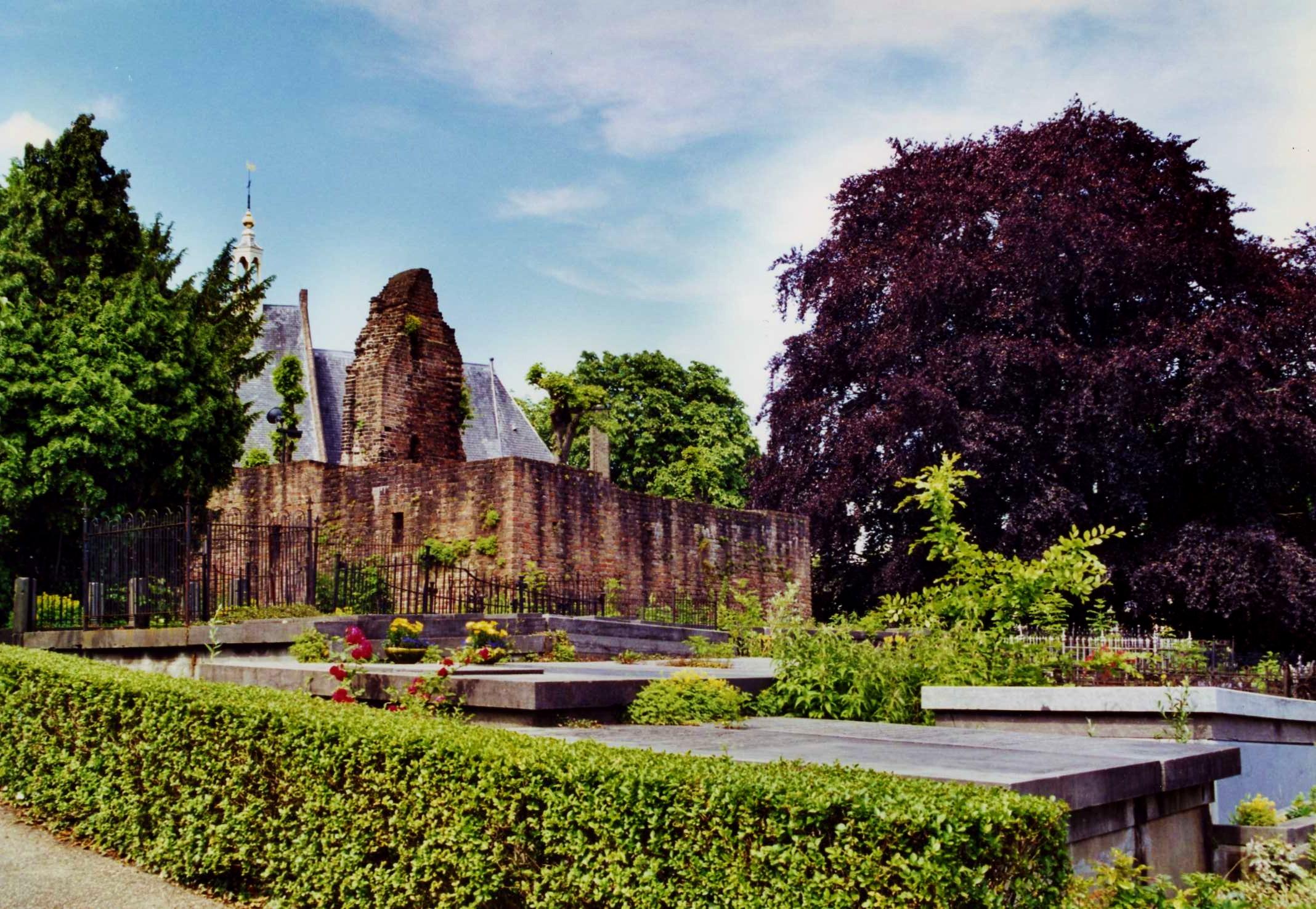
A castle was first mentioned in writing on 2 November 1269, in a certificate documenting a loan from one Vranke Stozep van Hildegardsberg. By 1343 it belonged to Heer Kerstant van den Berge. Then, in 1426, both castle and church were destroyed by the armies of Jacoba of Bavaria during the Hook and Cod wars - a century-long civil war between two factions of the Dutch nobility that has been called the most pointless internal conflict in medieval European history. The castle was not rebuilt. Its dungeon stones, however, can still be found tucked into a corner of the cemetery next to the Hillegondakerk, the church that replaced the destroyed medieval one around 1500 and still stands today. The site has been a Dutch national monument since September 1973.
The Lakes That Aren't Natural
If you walk through Hillegersberg today you cross a landscape of glittering open water - the Bergse Plassen, the lakes that give the neighbourhood its character. These look ancient. They are not. Between roughly 1600 and 1700, peat cutters dug out the moist soil for fuel, then the pits flooded with groundwater. The lakes are what's left of the peat that's already been burnt. By the early twentieth century the neighbourhood had grown from a village of 2,000 in 1885 to 7,000 in 1904, attracted by the water, the parks, and the easy commute to Rotterdam's centre. Plaswijckpark opened in the 1920s and remains a recreation ground today; part of it is grazed by Scottish Highland cattle. In 1941, during the German occupation, Hillegersberg was finally absorbed completely into Rotterdam - one of many surrounding villages the growing port-city annexed in the twentieth century.
The Two Town Halls
Hillegersberg held onto its independence longer than most. Its first town hall, built in 1752 at 10 Kerkstraat in the old village core, is now a restaurant. Its last town hall, the Buitenlust Villa on the C.N.A. Looslaan, was built in 1884 in neo-Renaissance style by the architect J.J. van Waning and commissioned by the wealthy De Kat family - it served as town hall from 1921 until annexation in 1941, then became the office of the Hillegersberg-Schiebroek borough, and today houses a nursery and a wedding venue. Both buildings are national monuments. Walk a few streets in any direction and you find the rest of what survived: the Prinsenmolen windmill turning over the River Rotte, the curved Boterdorpsebrug lock bridge, three small shopping streets (Bergse Dorpsstraat, the Kleiweg, Van Beethovensingel) that locals defend fiercely against retail chain encroachment. The Japanese School of Rotterdam, opened here in 1996, serves the families of executives from Japanese trading companies in the city. Celebrity chef Herman den Blijker grew up here. The detective novelist Janwillem van de Wetering lived here. By 2018 the borough of Hillegersberg-Schiebroek counted 43,991 residents - a working village that became a wealthy suburb, with a thousand-year-old church on a hill made by a giant.
From the Air
Hillegersberg sits on the north side of the Rotterdam municipality at 51.96°N, 4.49°E. From the air, the two lakes of the Bergse Plassen and the green canopy of Plaswijckpark stand out clearly against the dense urban grid of Rotterdam to the south. Rotterdam The Hague Airport (EHRD) is just 2 km west - the neighbourhood lies almost directly on the approach corridor. The medieval Hillegondakerk and adjacent cemetery are visible on the small sand ridge near the southern lake. Schiphol (EHAM) is 55 km north.