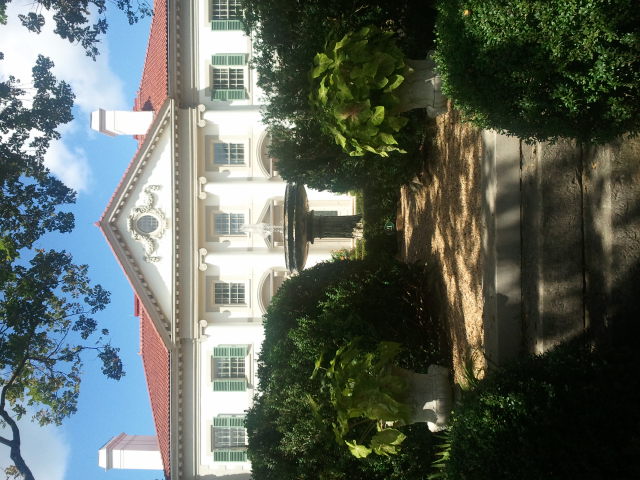
Hills and Dales Estate: Where Seventy Years of Love Built a Garden
'Forestry and botanical experts, amazed at the wonderful growth of flowers, shrubs and trees, have tried to explain this phenomenon by stating that there is some peculiar property of the soil, but they are wrong,' Fuller Callaway told The Atlanta Journal in 1916. 'It's just ordinary, LaGrange, Georgia soil. The real cause of the wonders which exist in this garden is the seventy years of love and devoted care which Mrs. Ferrell gave to the garden.' Callaway was standing in the gardens of his new Italian villa in LaGrange, built to complement grounds that Sarah Ferrell had been cultivating since 1841 -- gardens begun on a cotton slope, shaped with religious devotion, and still growing when a textile fortune married itself to their beauty.
A Garden Planted in Faith
The story of Hills and Dales begins not with the Callaways but with the Ferrells. Blount and Sarah Ferrell married in 1835 and settled on land given to them by her father. In 1841, Sarah Ferrell began transforming a slope that had been used for cotton cultivation into a formal boxwood parterre garden. She incorporated religious symbols and motifs into the design -- the garden was meant to be a reflection of faith and piety, not merely decoration. She grew a wide variety of plants and used locally quarried stone to build walls, steps, and terraces. Visitors noticed. The LaGrange Reporter described a 'majestic grove of oaks, the scented breeze' and reported being 'speechless with astonishment at the bewildering paradise opening out before us.' Nancy Ferrell had started gardens on the property as early as 1832, and her daughter Sarah expanded them into something that would outlive them both by more than a century.
The Five-and-Ten-Cent Magnate
Fuller Earle Callaway was born in 1870 in Troup County, Georgia, and showed entrepreneurial instincts from an early age, selling sundries to rural housewives while also farming. At eighteen, he opened a five-and-ten-cent store. Soon he owned several stores and a wholesale business. Then he invested in textiles, and the scale changed entirely -- eventually he had several businesses employing thousands of people. He married Ida Jane Cason of Jewell in 1891, and together they raised two sons: Cason Jewell Callaway and Fuller Earle Callaway Jr. In 1912, Callaway purchased the Ferrell estate. He had the wealth to build anything, anywhere. He chose to build here, on grounds already shaped by seventy years of patient cultivation.
An Italian Villa in Georgia's Famous Garden
Architect Neel Reid of the Hentz, Reid & Adler firm designed the Callaway home, drawing inspiration from his favorite architect Charles Adams Platt and Platt's adaptations of Italian villas set within formal landscape gardens. The result is unmistakably Mediterranean: white stucco exterior, red tile roof, a grand two-story semicircular portico with Ionic columns on the east side. Inside, Reid's signature classical style appears in the double staircase, stone fireplaces, and a long, narrow palm room with vaulted ceiling and low marble wainscot. Reid added fountains and statuary to the existing Ferrell Gardens, integrating the new home with the older landscape rather than overwriting it. 'Italian Villa Built In Georgia's Most Famous Garden,' proclaimed The Atlanta Journal on April 30, 1916, when the Callaways opened their home for their 25th wedding anniversary. The headline captured the essential achievement: the villa honored the garden, not the other way around.
The Sealed Bid
Ida Callaway died in 1936. Their two sons, Cason and Fuller Jr., both wanted the family home. Rather than argue, they submitted sealed bids. Fuller Jr. later said he 'worried half the night that he wouldn't get the place and the other half of the night that he would.' The bids were close, but Fuller Jr. won, and he and his wife Alice moved into Hills and Dales. Cason turned his energies elsewhere -- developing better farm practices at Blue Springs Farms near Hamilton, Georgia, and opening Ida Cason Callaway Gardens in 1952, named for his mother. The textile mills that made all of this possible were sold to Deering-Milliken in 1968. When Alice died in 1998, the estate was bequeathed to the Fuller E. Callaway Foundation.
Open Doors
Following the Callaway family's wishes, the estate became a museum. After renovations and the addition of a visitor center, Hills and Dales opened to the public in October 2004. Further renovations on the second and third floors were completed in April 2010, and today visitors tour all three floors of the home. The estate is a contributing structure to the Vernon Road Historic District on the National Register of Historic Places. What visitors encounter is rare: not just a preserved house or a maintained garden, but the living product of two families across two centuries. Sarah Ferrell planted her first boxwoods on a cotton slope in 1841. Neel Reid set his villa among them in 1916. The Callaways kept faith with both legacies. The soil, as Fuller Callaway insisted, is ordinary. Everything else is not.
From the Air
Located at 33.04°N, 85.05°W in LaGrange, Georgia, approximately 60 miles southwest of Atlanta. The estate sits in the Vernon Road Historic District. From altitude, LaGrange appears as a small city surrounded by the rolling Piedmont landscape of Troup County. The nearest airport is LaGrange-Callaway Airport (KLGC), roughly 4 miles south of the city. The estate's formal gardens and Italian villa may be partially visible at lower altitudes, but the surrounding tree canopy typically obscures ground details. Hartsfield-Jackson Atlanta International Airport (KATL) is approximately 70 miles to the northeast.