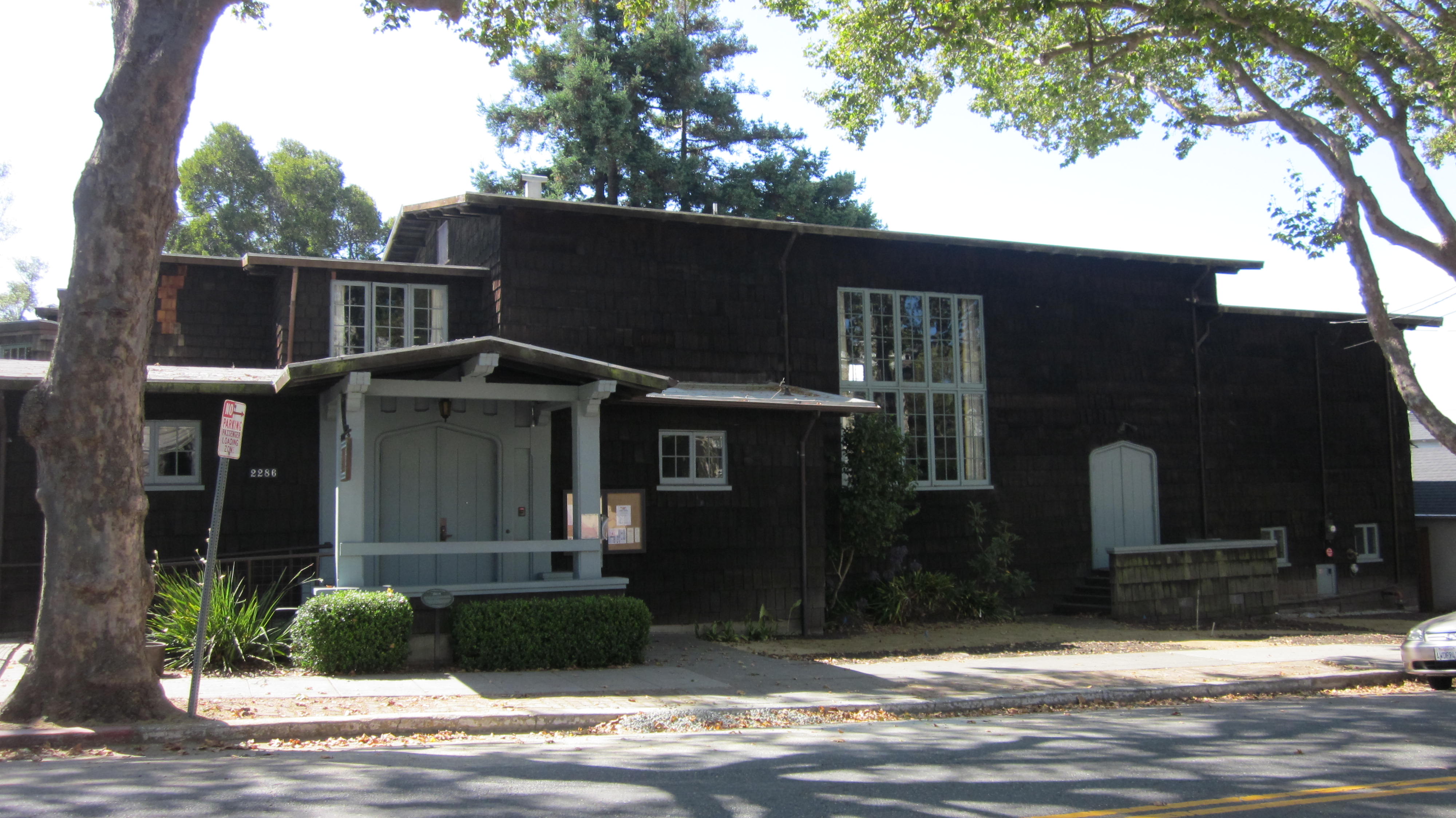
Hillside Club
"You must see to it that all the houses about you are in keeping with your own." The advice came from architect Bernard Maybeck to his friend and client Charles Keeler, a naturalist and poet who had just watched his new home take shape on Highland Place in Berkeley's North Hills. The year was 1895, and Maybeck had designed a house unlike anything in the neighborhood -- unpainted redwood shingles, open floor plan, a structure that seemed to grow from the hillside rather than sit on top of it. Keeler loved it. He also realized that one beautiful house surrounded by "stupid white-painted boxes" would amount to nothing. So he did something unusual: he started a club.
The Manifesto on Highland Place
Keeler began recruiting friends and neighbors to buy land near his home and build houses in sympathy with the landscape. In 1898, a group of civic-minded Northside residents -- many of them women -- formalized the effort by establishing the Hillside Club. Their mission was deceptively simple: protect the Berkeley hills from unsightly grading and unsuitable buildings. In practice, this meant disseminating Maybeck's architectural principles to anyone who would listen. Build with natural materials. Use unpainted redwood shingles. Let the house follow the contour of the land, not the other way around. Keeler articulated the philosophy in his 1904 book The Simple Home, which became the club's unofficial manifesto. A home, he argued, should be "infused with the art spirit" -- modest in scale, honest in materials, sensitive to its setting. The ideas drew from the broader Arts and Crafts movement then sweeping Britain and America, but the Hillside Club gave them a specifically Californian expression. Redwood replaced oak. Hillsides replaced meadows. The light was different, and the architecture followed.
Building the Brown Shingle Neighborhood
The club's influence spread quickly beyond philosophy into physical transformation. Beginning in December 1903, a committee that included Maybeck and fellow architect Ernest Coxhead surveyed the Northside neighborhood and planned improvements: artistic grades that worked with the terrain, retaining walls that preserved existing live oaks, a small bridge over Strawberry Creek. The goal was to minimize topographic alteration and enhance the natural beauty that had drawn residents to the hills in the first place. Unpainted, shingle-clad houses began to proliferate in the neighborhoods north of the UC Berkeley campus, their brown walls blending into the eucalyptus and oak groves. The style became known as the First Bay Tradition -- sometimes called Berkeley Brown Shingle -- and it remains one of the most distinctive residential architectures in California. Maybeck, John Galen Howard, and journalist Frank Morton Todd were all prominent early members, lending the club a mix of creative ambition and practical expertise that few neighborhood organizations could match.
Burned and Rebuilt
Maybeck designed the club's first permanent home, a 1906 clubhouse that opened on September 8 to immediate acclaim. It became the social and cultural center of the Northside, hosting lectures, concerts, dances, and the kinds of spirited arguments about aesthetics that tend to flourish when architects and poets share a building. Then, on September 17, 1923, the Berkeley Fire swept through the hills. The blaze destroyed 584 structures, and Maybeck's clubhouse was among them. The loss was painful but not paralyzing. John White, Maybeck's brother-in-law, designed a replacement that opened in 1924. White's building drew from the same Arts and Crafts vocabulary -- asymmetric massing, a monumental fireplace, materials indigenous to the area -- while acknowledging that it was a new structure for a changed time. The current clubhouse has stood on the site for over a century now, listed on the National Register of Historic Places since April 2004 and designated Berkeley Landmark number 266.
The Landscape the Club Made
Walk through Berkeley's Northside today and the Hillside Club's legacy is everywhere, even if the club's name appears nowhere on the houses. The narrow winding streets, the pedestrian paths and stone stairways cutting between properties, the brown-shingled houses tucked into hillsides beneath canopies of oak and bay laurel -- all of this reflects decisions made by a small group of neighbors more than 125 years ago. Among the club's first community projects was the construction of Hillside Elementary School, extending their aesthetic ideals beyond private homes into public buildings. The club still operates from White's 1924 building, hosting art shows, concerts, community meetings, and the kind of neighborhood gatherings that most cities have lost to suburban sprawl and digital isolation. It is a remarkable persistence. What began as one architect's advice to one homeowner became a club, then a movement, then an entire architectural tradition, then a neighborhood identity that has outlasted two clubhouses and a century of change.
From the Air
Located at 37.875°N, 122.260°W in the Northside neighborhood of Berkeley, tucked into the residential streets north of the UC Berkeley campus. From the air, the area is characterized by dense tree canopy and winding streets with brown-shingled houses -- a visible contrast to the more grid-like neighborhoods to the south. The UC Berkeley campus and Sather Tower (the Campanile) provide visual reference to the south. Nearest airports: KOAK (Oakland International, 9 nm south), KSFO (San Francisco International, 19 nm southwest). Best viewed at 2,000-3,000 ft in clear conditions.