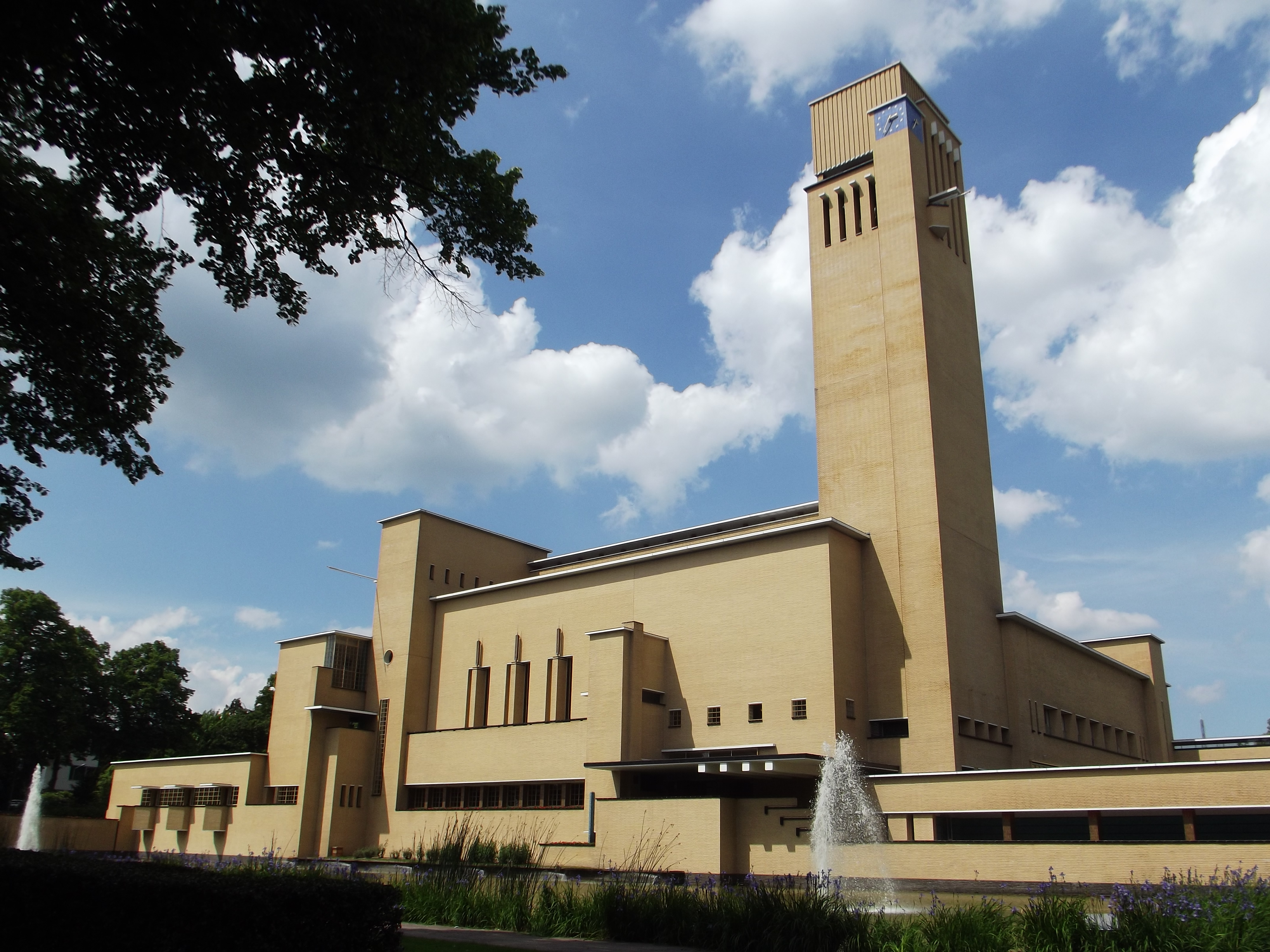
Hilversum Town Hall
A yellow tower rises out of a reflecting pool in the middle of a small Dutch town, and architecture students from Tokyo to São Paulo know its silhouette. The Hilversum Town Hall is the kind of building that turns up in textbooks not because it is large or ornate, but because it solved a problem nobody had quite solved before — how to make a civic building feel both modern and at home. Its architect was a municipal employee. Its bricks were locally fired. Its tower, until the 1960s, chimed the hour on every Dutch public radio station. And it was almost paid for by selling a Mondrian.
Dudok's Long Wait
Willem Marinus Dudok became Director of Public Works for Hilversum in 1915 — a young architect handed the keys to a small town's entire built environment. He had ideas about a new town hall almost immediately. He drew up a traditional design intended to slip discreetly into the old downtown, but the First World War had emptied the municipal coffers and the project went into a drawer. Dudok waited. In 1923 the municipality bought a low ridge to the northwest of the centre — the former Den Witten Hull estate, an elevated parcel surrounded by parkland and water. Suddenly the town hall did not need to fit anywhere. It could stand free, on a rise, framed by reflecting pools, with all the room it wanted. The first sketches for what would become the famous building appeared in 1924. Construction finished in 1931, by which time Dudok had been promoted to Municipal Architect. He had been waiting sixteen years.
Two Squares and a Tower
The building is, in plan, almost diagrammatically simple: two squares pressed together. The inner square is a courtyard ringed by offices, the rooms where municipal work actually happens. The outer square is lower, ringed by service spaces and crossed by a service road, with the soaring tower hinging the two compositions together. Dudok's debt to early Frank Lloyd Wright is visible in the long horizontal lines, the deep eaves, the way masonry is layered to give walls a sense of layered weight. But the palette is Dutch and unmistakable. Yellow-buff brick — slightly softer in tone than the standard Dutch red — was specified throughout, set in deep mortar courses that emphasize the horizontals. White trim sharpens the edges. The whole composition rises from the water of the surrounding pool, light-coloured and clean-edged, the kind of building that photographs as well at dawn as at dusk. The critics argued about whether it was modernist enough — some accused Dudok of *halfway* modernism, neither traditional nor strictly functionalist — but the people of Hilversum had no such doubts. They loved it on sight.
The Bell, the War, the Mondrian
Hilversum was, and is, the broadcasting capital of the Netherlands — the home of Dutch national radio. For decades, until the 1960s, the town hall's tower bell rang the hour live on national public radio, every hour, every day. To listen to the news from Hilversum was to hear, twice in passing, a small yellow tower in a small Dutch town keeping time for the whole country. The Second World War interrupted that quiet civic life. The Wehrmacht commandeered the building as its regional headquarters and camouflaged the prominent tower, because a yellow Dudok landmark visible from kilometers away was no friend to a German occupier. By the late 1980s a different problem had become urgent: Dudok's brick had been baked too softly. Frost had been chewing at the porous bricks for half a century, and most of the facade needed replacement. The restoration ran from 1989 to 1995. There was a serious municipal proposal at one point to fund it by selling off a Mondrian — the painter who came from nearby Amersfoort and whose grids of primary colours seem made in the same northern light as Dudok's facades. The painting stayed. The bricks got replaced one by one.
Why Architects Still Make the Pilgrimage
Today the Hilversum Town Hall is a Rijksmonument — a national protected monument — and visitors come from around the world to walk its corridors. Inside, Dudok designed almost everything: the door handles, the light fittings, the staircases, the way sunlight cuts across the council chamber floor. There is a coherence here that mass production has made nearly impossible to reproduce. The building is sometimes called the masterpiece of the so-called Hilversum School, an offshoot of Dutch modernism that prized warmth and craft over ideological purity. Looking at it now, in its restored yellow, surrounded by Hilversum's broadcast studios and Media Park glass, it reads less as a museum piece than as a quiet argument: that a municipal architect, given time and a good site, can give an ordinary town a building that the world wants to come see.
From the Air
Hilversum Town Hall stands at the northwest edge of the town centre, at 52.23°N, 5.17°E. From altitude the yellow-brick complex with its prominent tower is one of Hilversum's most legible features, set into parkland and ringed by the reflecting pool that frames Dudok's composition. The neighbouring Media Park — Hilversum's broadcasting district — sits a kilometre south, and the wooded heathland of 't Gooi extends to the east. Nearest airfield is Hilversum (EHHV) just south; Schiphol (EHAM) lies west.