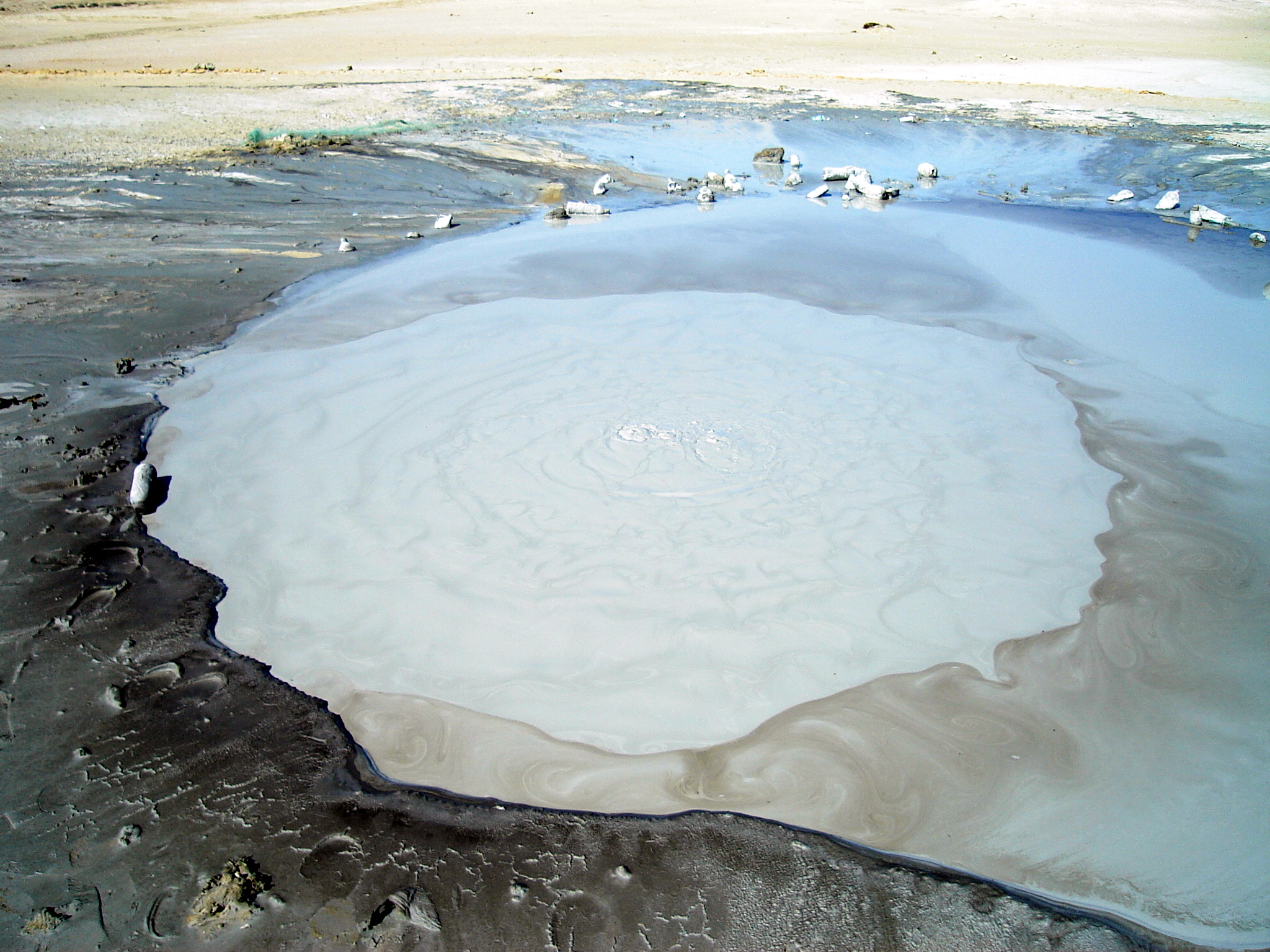
Hingol Mud Volcanoes
The earth breathes here. At the Chandragup Complex in Pakistan's Hingol National Park, pressurized gas and sediment push warm grey mud through fissures in the rock, building cones that reach 300 feet high. These are not the fiery volcanoes of popular imagination. No lava flows, no explosions of ash. Instead, the mud volcanoes of Hingol gurgle and sigh, their craters filled with slowly churning slurry that rises and falls with the rhythm of geological processes deep underground. About ten clusters of mud volcanoes dot the park, but the Chandragup Complex -- three major cones and several smaller ones -- is the most significant, both geologically and spiritually.
The Geology of Gurgling Earth
Mud volcanoes form where underground gases -- typically methane -- push fine-grained sediment and water to the surface through weak points in the earth's crust. The Makran coast sits atop a subduction zone where the Arabian Plate slides beneath the Eurasian Plate, creating the conditions for these formations. The Chandragup volcanoes -- the largest of which (Chandragup I) stands about 330 feet (100 meters) tall -- are located in the Mid-Hor area of Hingol National Park, roughly a kilometer off the Makran Coastal Highway. They were difficult to reach before the highway was completed in 2004, but visitor numbers have increased significantly since the road opened. NASA's Earth Observatory has documented the Pakistan mud volcanoes from space, noting their distinctive conical shapes against the surrounding desert terrain.
Where Sin Meets Sulfur
For Hindu pilgrims traveling to the nearby Hinglaj Mata Temple, the Chandragup mud volcano is not a geological curiosity but a living deity. Known as Baba Chandragup, the largest volcano is worshipped as an embodiment of Lord Shiva. Many pilgrims believe that the Hinglaj temple may only be entered after paying homage here. The night before the ascent, pilgrims stay awake fasting and meditating on the sins they will confess the next morning. They bake roti from ingredients contributed by every member of the pilgrim group. At dawn, they climb the muddy slope. At the rim, each pilgrim introduces themselves with their full name and place of origin, then calls out their sins before the group. The charidaar watches the mud: how it bubbles, how the wind responds. These natural signs are read as the deity's judgment -- forgiveness or the need for further penitence.
Sacred Offerings in the Crater
The rituals have evolved over time. Traditionally, the communal roti was the primary offering to Baba Chandragup. Today, pilgrims also bring coconuts, betel nut, and dal, tossing them into the crater where the warm mud accepts them slowly. Devotees throw coconuts to make wishes and express gratitude for prayers answered. Some scatter rose petals. Others paint their bodies and faces with the volcanic clay, which some believe has purifying properties. The Chandragup Complex is an essential stop on the Hinglaj Yatra, the annual spring pilgrimage that brings over 250,000 people to this remote corner of Balochistan. For those pilgrims, the bubbling mud is not geology -- it is the voice of the divine, speaking through the living earth.
From the Air
Located at 25.45N, 65.87E in Hingol National Park, Lasbela District, Balochistan, Pakistan. The mud volcanoes appear as conical formations in the desert, roughly 1 km off the Makran Coastal Highway (N-10). Nearest airports are Karachi (OPKC) to the east and Gwadar (OPGD) to the west. Best viewed at 1,500-3,000 feet AGL. The cones are distinctive against the flat surrounding terrain. The Hinglaj Mata Temple is nearby to the northwest.