Hirakata Park: The Amusement Park That Outlived Them All
Most Japanese amusement parks built in the twentieth century are gone. The bubble economy of the 1980s spawned dozens of them, and the long deflation that followed killed them one by one. Universal Studios Japan opened in Osaka in 2001 and accelerated the collapse, vacuuming up visitors from smaller parks across the Kinki region. Hirakata Park should have been one of the casualties. It was deep in debt. Its rides were aging. Its location -- the hilly eastern suburbs of Osaka, accessible by a single Keihan railway line -- was no match for the glittering attractions on Osaka Bay. Yet Hirakata Park is still open, as it has been since 1910, making it the oldest amusement park in the city. The locals call it "Hirapah," and they are fiercely protective of it.
Chrysanthemums and Roller Coasters
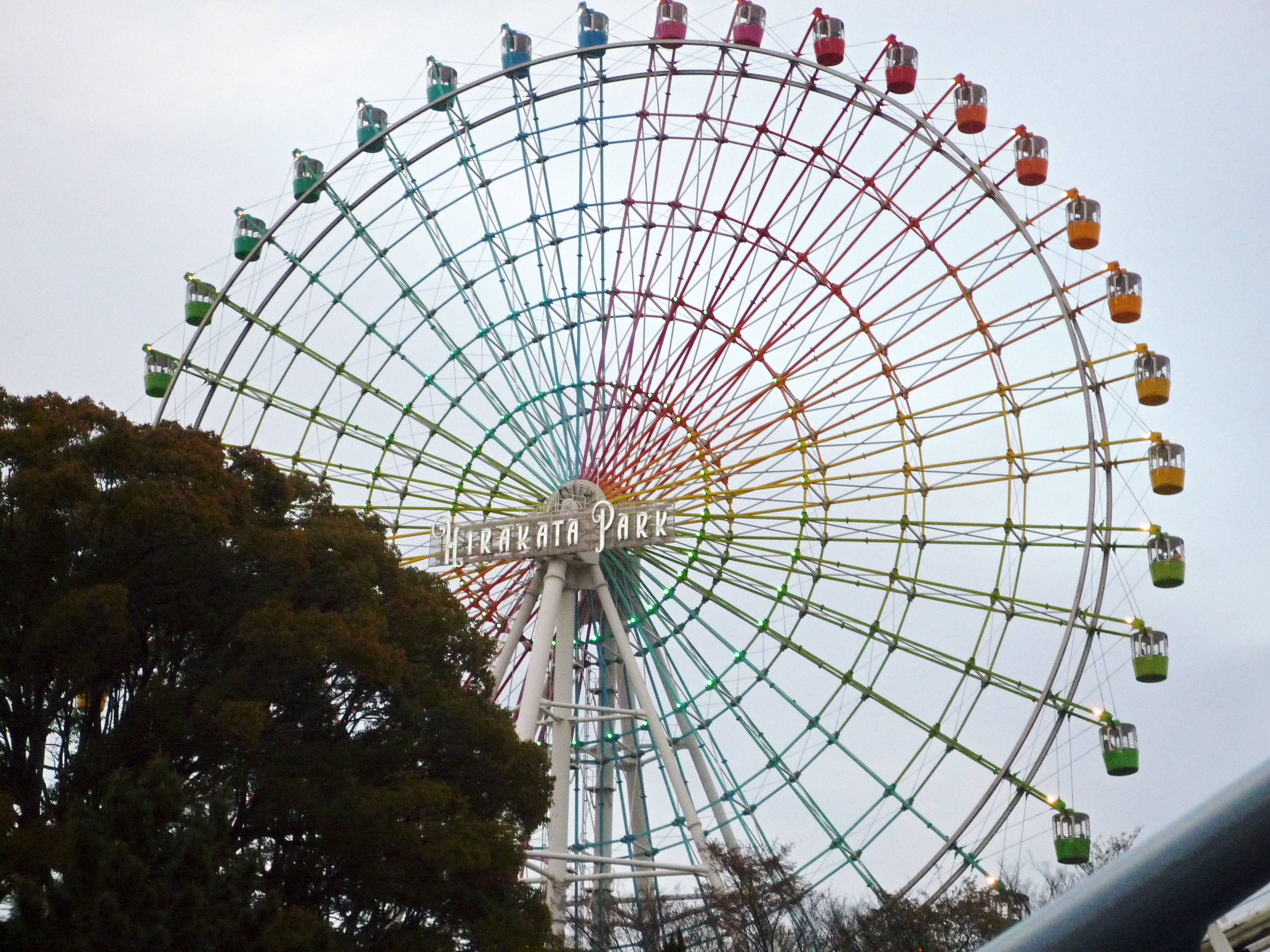
The park's origin has nothing to do with thrill rides. In 1910, the Keihan Electric Railway organized a Kikuningyo-ten -- a Chrysanthemum Figure Exhibition -- near Keihan Hirakata Station, using elaborate floral displays sculpted into the shapes of historical figures and scenes. The exhibition drew crowds, the railway sold tickets, and a permanent entertainment venue took root on the hilly terrain beside the tracks. The station was eventually renamed Hirakata-koen Station in honor of the park it had created. Over the following decades, the grounds expanded steadily: a public swimming pool in 1965, an ice rink in 1972 to keep visitors coming through winter, the Red Falcon roller coaster in 1988, and a Ferris wheel in 1991. By the end of the century, Hirakata Park offered over 40 attractions spread across its undulating hillside landscape.
The Crisis Nobody Expected to Survive
The early 2000s nearly ended it all. Japan's population was aging, birth rates were falling, and families had less reason to visit local amusement parks. When Universal Studios Japan opened in Osaka's Konohana ward in 2001, the effect on regional parks was devastating. One after another, smaller amusement parks across the Kinki region shuttered. Hirakata Park accumulated significant debt and seemed destined for the same fate. But the park's management refused to close. Instead, they leaned into what made Hirapah different: its unpretentious neighborhood charm, its accessibility by a single train line, its willingness to be silly rather than spectacular. The strategy needed a face.
The Hirapah Brother
In April 2009, Hirakata Park launched an inspired marketing gambit. They appointed comedian Ryuichi Kosugi as the park's "Hirapa Niisan" -- roughly translatable as "Hirapah Big Brother" -- a mock director and celebrity ambassador who appeared in deliberately over-the-top advertisements. Kosugi set a public goal of breaking the Guinness World Record for visitor numbers, generating buzz and media coverage. When he stepped down in March 2013, his successor proved even more effective: Junichi Okada, a member of the hugely popular boy band V6 and a native of Hirakata itself. Okada's hometown connection was genuine, and his fame extended the park's reach far beyond Osaka, drawing visitors from the Kanto region around Tokyo and Kyushu in the south. The campaign worked. Hirakata Park paid off its debt and saw attendance climb year after year.
Forty-Five Rides on a Hillside
The park today holds 45 attractions arranged across its naturally hilly terrain -- a topography that gives it a charm impossible to replicate on flat ground. Rides climb, dip, and wind through elevation changes rather than sprawling across a featureless plain. The two signature roller coasters are the Elf, a wooden coaster that rattles and groans through its curves with old-school menace, and the Red Falcon, a steel coaster that has been a park fixture since 1988. In a uniquely Japanese twist, several rides -- including the Giant Drop Meteor and the wooden Elf -- offer blindfolded versions, introduced in 2014, where riders experience the drops and turns entirely by sensation. Summer brings swimming pools, winter brings skating rinks and Snow Land, and the seasons keep the park alive in a way that year-round indoor attractions never quite manage.
From the Air
Located at 34.806°N, 135.638°E in Hirakata, on the eastern side of the Osaka metropolitan area along the Yodo River corridor. The park's hilly terrain and Ferris wheel are its most identifiable features from the air, set among dense suburban development. Osaka Itami Airport (RJOO) is approximately 10 nautical miles to the west-southwest. Kansai International Airport (RJBB) lies roughly 35 nautical miles to the south. At 2,000-4,000 feet AGL, the park is visible between the Yodo River to the south and the Ikoma mountain range to the east. The Keihan railway line running through the site provides a useful linear reference for identification.