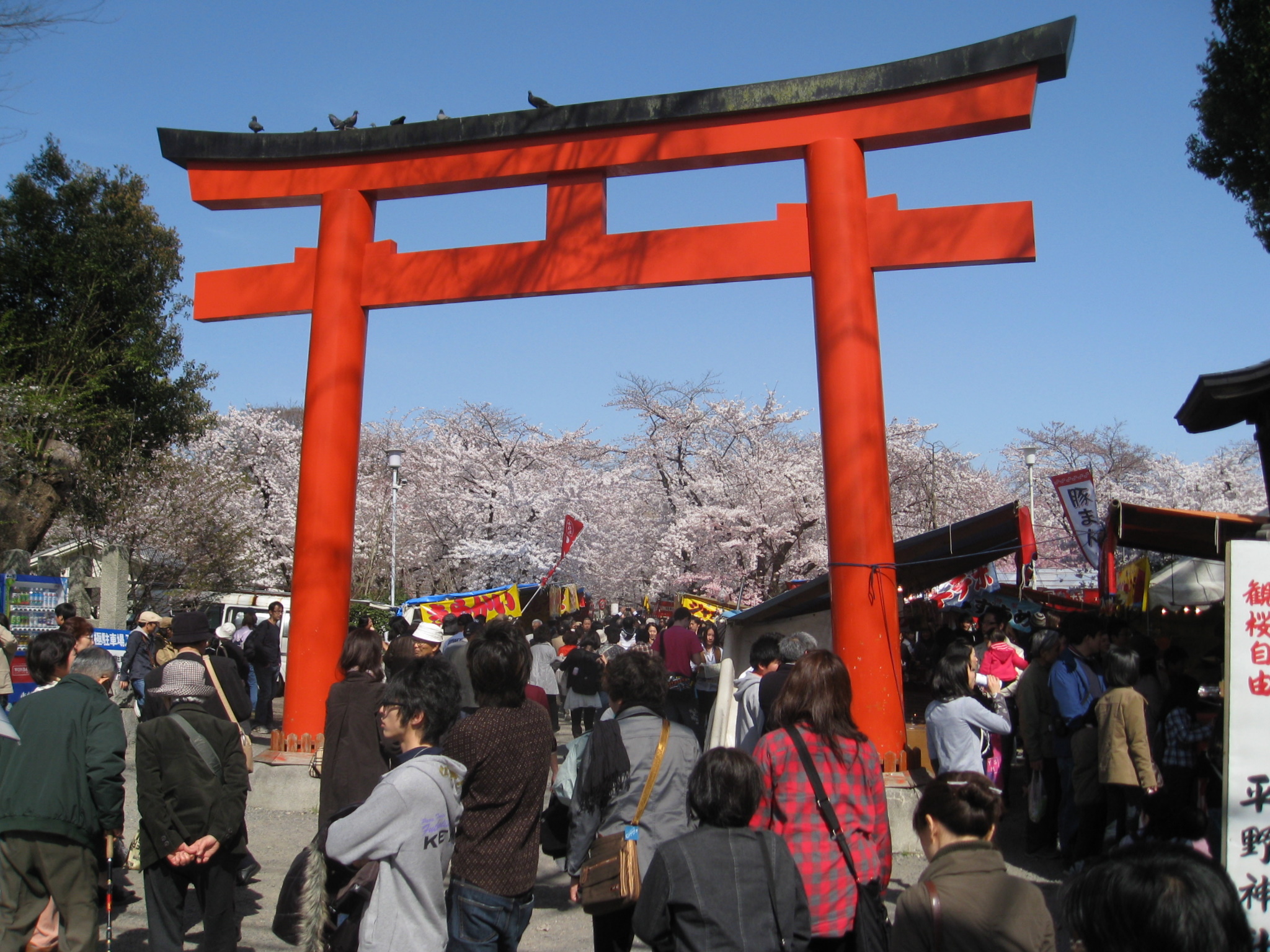
Hirano Shrine: Kyoto's Thousand-Year Cherry Blossom Festival
Every spring since 985, cherry blossoms have opened at Hirano Shrine. That is not a poetic approximation. The festival that began during the reign of Emperor Kazan has not stopped -- not through civil wars, not through fires, not through the devastating typhoon that destroyed the worship hall in 2018. Each year the morning ceremony still begins at the mausoleum of that same emperor, and each afternoon the procession still winds through the surrounding neighborhood and back through the shrine gates. More than a thousand consecutive springs of pink and white petals drifting across the grounds of one of Kyoto's most venerable sanctuaries, a place whose roots reach to the very founding of the city itself.
Born with the Capital
Hirano Shrine did not grow slowly from local devotion. It arrived fully formed in 794, carried on the authority of Emperor Kammu when he transferred the imperial capital from Nagaoka-kyo to the new city of Heian-kyo -- what the world now calls Kyoto. The shrine was established as part of the spiritual architecture of the new capital, ranked among the most prestigious religious sites in Japan. It earned a place on the Engishiki Jinmyocho, the official register of shrines compiled in the early tenth century, as a Myojin Taisha -- a shrine of the highest rank. More significantly, Hirano was designated one of the Twenty-Two Shrines, the elite group that received Imperial offerings, and within that group it ranked among the Upper Seven. From its earliest days, members of the Imperial family visited regularly, and both the Minamoto (Genji) and Taira (Heiji) clans maintained special relationships with the shrine.
Four Halls, One Unique Style
The main shrine is an architectural curiosity. Four separate halls, each housing a different deity, are arranged from north to south in two connected buildings constructed in the Hirano-zukuri style -- a configuration unique to this shrine. This distinctive arrangement, with paired halls sharing a roof while maintaining separate inner sanctuaries, exists nowhere else in Japanese shrine architecture. The buildings are designated as Important Cultural Properties. Beyond the main halls, the worship hall, inner gate, south gate, and the subsidiary Tsunashige Shrine are all recognized as Cultural Properties by Kyoto Prefecture. The compound is modest compared to Kyoto's more famous temples, but its architectural singularity gives it a quiet authority that rewards close attention.
A Millennium of Blossoms
The cherry blossom festival at Hirano Shrine is the oldest regularly held festival in Kyoto. It began in 985, during the reign of Emperor Kazan, and it has continued without interruption for over a thousand years. The shrine grounds are famous not just for the daytime display but for the illuminated night blossoms -- yozakura -- that transform the compound after dark. In 965, Emperor Murakami had already elevated the shrine's status by ordering that Imperial messengers deliver reports of important national events to the guardian kami of Japan, with Hirano among the sixteen shrines receiving these dispatches. The cherry festival added another dimension: a living calendar that marked the turning of the year, the renewal of life, and the continuity of tradition across centuries of political upheaval.
Typhoon and Recovery
On August 26, 2018, Typhoon Jebi -- the most powerful typhoon to strike Japan in twenty-five years -- tore through Kyoto. At Hirano Shrine, the damage was devastating. The haiden, the worship hall, was destroyed. Ancient trees that had framed the shrine grounds for generations were toppled. For a place that had endured more than twelve centuries, the destruction was a harsh reminder that sacred ground is not immune to natural fury. Recovery has been slow and difficult. The shrine has struggled to fund repairs, relying on donations and community support rather than the government patronage it once enjoyed. From 1871 through 1946, Hirano had been officially designated a Kanpei Taisha, standing in the first rank of government-supported shrines. That support ended after World War II. Today it holds the rank of Beppyo shrine under the Association of Shinto Shrines, respected but largely self-sustaining.
Petals Over Sacred Ground
Hirano Shrine occupies a paradox common to Kyoto's oldest sanctuaries: it is both deeply famous and quietly overlooked. The cherry blossoms draw crowds every spring, but the shrine rarely appears on the itineraries of international visitors who flock to Kinkaku-ji or Fushimi Inari. That relative obscurity is part of its appeal. Here, under branches heavy with blossoms that have bloomed for more than a thousand consecutive springs, the relationship between the sacred and the seasonal feels unmediated. The four deities in their four halls continue to receive offerings. The procession that began under Emperor Kazan still winds through the neighborhood streets. And the blossoms, indifferent to dynasties and disasters alike, continue to open on schedule.
From the Air
Located at 35.03N, 135.73E in the Kita-ku ward of northwestern Kyoto. The shrine sits in a residential neighborhood northwest of the Kyoto Imperial Palace. From altitude, the shrine grounds are identifiable by the dense tree canopy -- particularly spectacular during cherry blossom season when the pink and white display contrasts with surrounding rooftops. Best viewed at 2,000-3,000 feet AGL. Nearest major airport is Osaka Itami (RJOO), approximately 20 nautical miles southwest. Kansai International (RJBB) lies approximately 50 nautical miles to the south. Mount Hiei is visible to the northeast, and the Kyoto basin is framed by mountains on three sides.