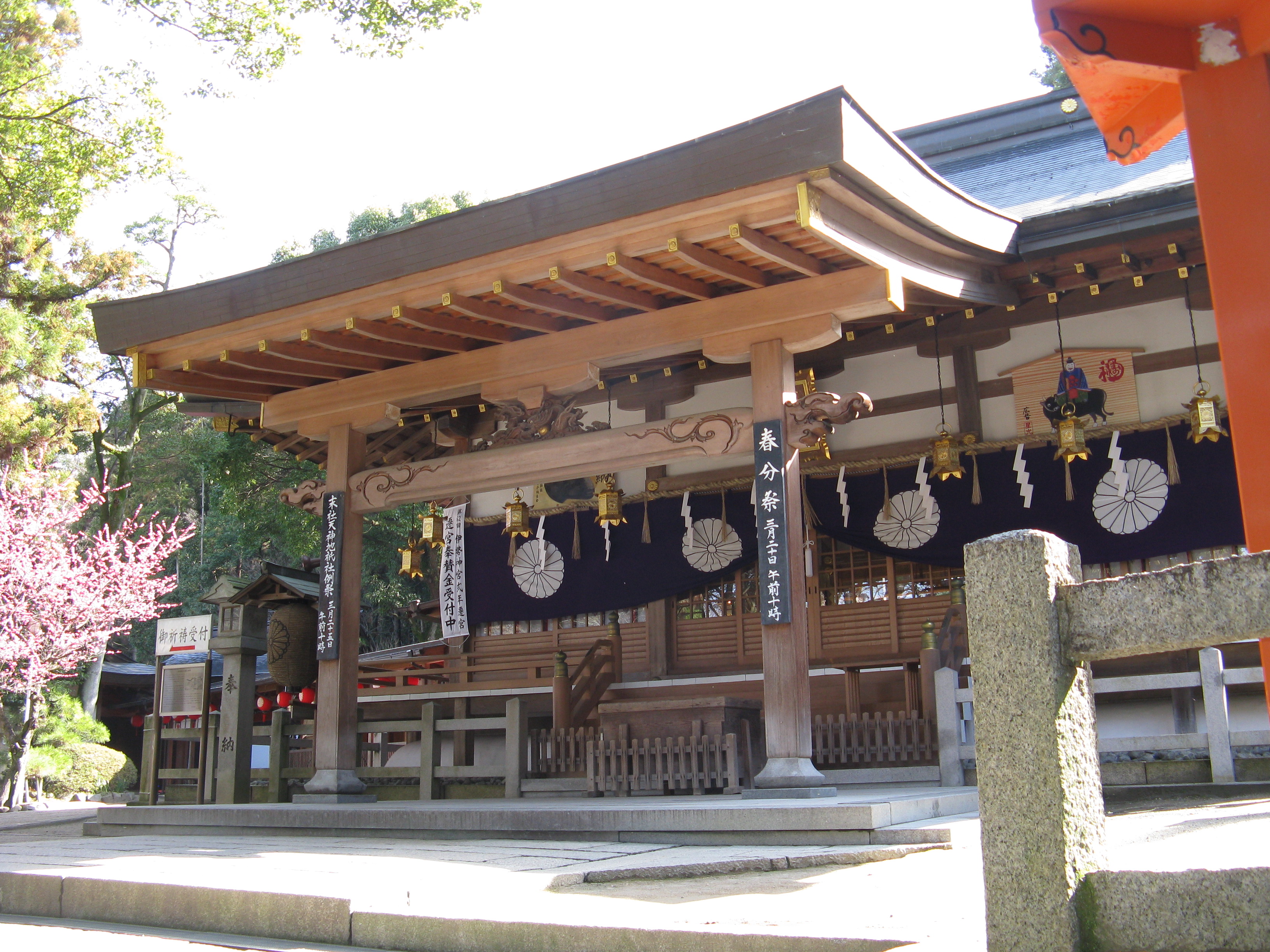
Hiraoka Shrine: The Mother of Kasuga
Before Kasuga Taisha became one of Nara's most celebrated shrines, its gods lived here. In the western foothills of the Ikoma Mountains, where the urban sprawl of Higashiosaka yields to forested slopes, Hiraoka Shrine has stood since at least the Kofun period -- possibly much longer. When the powerful Fujiwara clan built their grand shrine in Nara in 768 AD, they performed the ritual of bunrei, dividing and transferring the spirits of two deities from this older, quieter place among the cedars. Hiraoka became Moto-Kasuga -- the former Kasuga, the original -- a title that carries both honor and a hint of loss. The parent shrine watches from the foothills while its more famous offspring draws millions of visitors each year.
Gods of the Mountain, Gods of a Clan
Hiraoka Shrine began as a site of mountain worship, its spiritual focus directed at Kozudake, the peak rising immediately behind the sanctuary. Over time, the kami of that mountain came to be identified as Ame-no-Koyane, the tutelary deity of the Nakatomi clan. When the Nakatomi evolved into the Fujiwara -- the most powerful aristocratic family in Japanese history, whose members served as regents to emperors for centuries -- Ame-no-Koyane's importance grew accordingly. The shrine enshrines four kami in total: Ame-no-Koyane and his wife Himegami, along with the principal deities of Katori Jingu and Kashima Shrine, both associated with the Fujiwara clan's martial and spiritual authority. It was two of these four -- Ame-no-Koyane and Himegami -- who were transferred to Kasuga Taisha by bunrei, the Shinto practice of dividing a deity's spirit to enshrine it in a new location without diminishing its presence at the original site.
Chronicled in Imperial Records
During the Heian period, Hiraoka Shrine was designated a shrine of the first rank, the highest distinction available. Its name appears repeatedly in Japan's official chronicles: the Shoku Nihon Koki, the Nihon Montoku Tenno Jitsuroku, the Nihon Sandai Jitsuroku, and the Engishiki, the tenth-century compendium of laws and regulations that cataloged every shrine of significance in the realm. The Engishiki listed Hiraoka among the most prestigious shrines, and at some point during the Heian period it was recognized as the ichinomiya -- the first shrine -- of Kawachi Province. This designation meant it held the highest ritual rank among all shrines in the province, the place where the newly appointed provincial governor would pray first upon taking office. The shrine's main festival, held annually on February 1, continues a tradition of celebration that stretches back over a millennium.
Burned, Rebuilt, Neglected, Reclaimed
The centuries following the Heian period tested the shrine's resilience. During the Kamakura period, in 1275, the monk Eison of Saidai-ji temple led one hundred priests in prayers at Hiraoka for Japan's deliverance from the Mongol invasions -- a national crisis that mobilized every spiritual resource the country could muster. Three centuries later, in 1574, Oda Nobunaga burned the shrine to the ground during his campaigns to unify Japan through force. Toyotomi Hideyori, the son of Nobunaga's successor, sponsored its reconstruction between 1602 and 1605. Under the subsequent Tokugawa shogunate, the shrine received small estates and privileges but was largely neglected by a government more interested in controlling religion than venerating it. The current main shrine buildings date to 1826, rebuilt not through government patronage but through the determination of local parishioners who pooled their resources to restore what centuries of conflict and indifference had diminished.
Four Sanctuaries Among the Cedars
Today Hiraoka Shrine's main hall consists of four Kasuga-zukuri sanctuaries housed in a single structure, mirroring the architectural style of its more famous offspring in Nara. The Kasuga-zukuri form is distinctive: a single-bay structure with a curved gable roof, its entrance on the non-gable side, the whole building raised on posts and painted in vermilion. The shrine complex is designated a Tangible Cultural Property of Higashiosaka. Visitors approach through a traditional sando path lined with stone lanterns, passing beneath the main torii gate before reaching the haiden, or worship hall. The grounds retain the atmosphere of a mountain shrine despite Higashiosaka's relentless urbanization pressing in from below. The Ikoma Mountains rise behind, their slopes thick with cedar and bamboo, and on festival days the sound of kagura music drifts down from the hilltop, a reminder that this place was sacred long before anyone thought to write it down.
From the Air
Located at 34.670N, 135.651E in the western foothills of the Ikoma Mountains on the eastern edge of Higashiosaka. From altitude, the shrine is identifiable by the forested hillside of Kozudake rising behind it, contrasting with the dense urban grid of Higashiosaka to the west. The Ikoma mountain range forms the border between Osaka and Nara prefectures and is clearly visible as a north-south ridge. Osaka International Airport at Itami (RJOO) is approximately 15 nautical miles to the northwest. Kansai International Airport (RJBB) is approximately 30 nautical miles to the south-southwest. Recommended viewing altitude: 3,000-5,000 feet to see the shrine's mountain context against the urban plain.