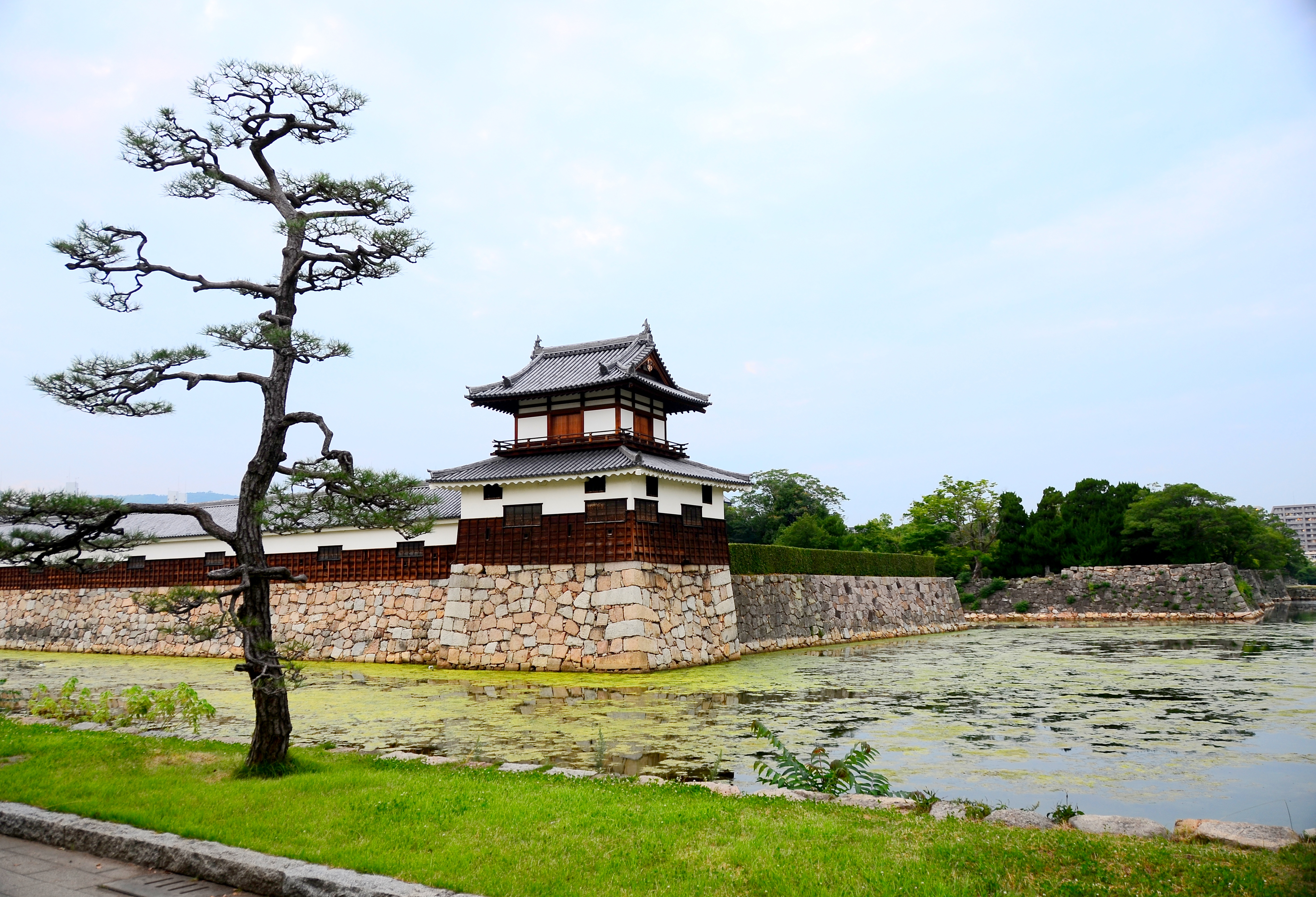
Hiroshima Castle
The city took its name from the castle, not the other way around. When Mori Terumoto, one of Toyotomi Hideyoshi's Five Elders, chose a river delta on the Inland Sea as the site for his new fortress in 1589, the area had no city at all. It was called Gokamura -- Five Villages -- a scattering of settlements on the marshy islands where the Otagawa emptied into the sea. The name would not do for a castle. "Hiro" was borrowed from an ancestor, Oe no Hiromoto; "shima" from an ally, Fukushima Motonaga, who helped select the site. Some say the name simply means "wide island," a description of the broad delta. Either way, the castle gave Hiroshima its identity, and for more than three hundred and fifty years, the two were inseparable.
Lords of the Delta
Mori Terumoto governed nine provinces from the castle he built between 1589 and 1599, controlling much of western Honshu from his position on the river delta. That authority ended abruptly after the Battle of Sekigahara in 1600, when he backed the losing side and was forced to retreat to Hagi in present-day Yamaguchi Prefecture. Fukushima Masanori took his place, ruling Aki and Bingo provinces from the castle until 1619, when the Tokugawa shogunate punished him for an unauthorized repair -- fixing flood damage without permission from Edo, a violation of the rules the shogunate used to keep regional lords from accumulating power. The Asano family succeeded him and held the castle for 250 years, from 1619 until the abolition of the feudal system during the Meiji Restoration in 1869. After the feudal lords departed, the castle became a military installation. During the First Sino-Japanese War of 1894-1895, it served as the Imperial General Headquarters. The foundations of those outbuildings remain today, just a few hundred paces from the main tower.
The Castle and the Bomb
By the summer of 1945, Hiroshima Castle housed the headquarters of the Second General Army and the Fifth Division, tasked with defending against a projected Allied invasion of the Japanese mainland. On August 6, 1945, the atomic bomb detonated approximately 820 meters from the castle. For decades, it was assumed that the blast had blown the entire main keep -- the tenshu -- away in an instant. Evidence discovered in 2010 suggests a more precise sequence: the explosion destroyed the lower pillars of the wooden structure, and the upper floors collapsed under their own weight once the supports were gone. The distinction matters because it tells us the castle did not vanish. It fell. The destruction was mechanical, not magical, and understanding it helps strip the bomb of any mythology while making its reality more comprehensible. Within the castle walls, three trees survived: a eucalyptus and a willow approximately 740 meters from the hypocenter, and a holly about 935 meters away. All three are preserved on the grounds today.
Concrete Memory
The present castle tower was completed in 1958, rebuilt in reinforced concrete as a replica of the original. Its five floors rise 26.6 meters above a stone foundation that itself stands 12.4 meters high -- proportions that echo the original keep without pretending to be it. The castle now serves as a museum of Hiroshima's pre-war history, a deliberate choice to focus on the centuries before the bomb rather than the event itself. In 1994, a gate and three yagura watchtowers in the ninomaru -- the second defensive ring -- were reconstructed using traditional wooden methods, bringing back some of the craftsmanship that concrete cannot replicate. The castle was originally a hirajiro, a flatlands castle, protected by three concentric moats and the Otagawa River. The two outer moats were filled in during the late nineteenth and early twentieth centuries, and the land they occupied is now covered by homes, schools, and office buildings. Only the innermost moat remains, reflecting the reconstructed tower and the Hiroshima Gokoku Shrine that was moved within its perimeter after 1945.
The First Broadcast
Inside the Honmaru -- the castle's innermost compound -- sits a concrete bunker with a specific historical claim: it was the site of the first radio broadcast transmitted from Hiroshima after the atomic bombing. In a city where every communication line had been severed and most structures had been obliterated, this small military bunker within the castle walls became the point from which the outside world first heard what had happened. The castle's role as a military headquarters meant it had communication infrastructure that survived, partially, when civilian infrastructure did not. Today, visitors walk past the bunker on their way to the reconstructed tower, and most do not notice it. The castle museum above tells the story of the Mori clan, the Asano lords, the feudal politics of a delta fortress. But the bunker below tells a different story -- the moment when a castle built to project feudal power became the last functioning outpost in a city that had ceased to exist.
From the Air
Located at 34.403N, 132.459E in central Hiroshima, approximately 460 meters north of the bomb's hypocenter. The castle's reconstructed tower and surrounding moat are visible from the air as a distinct rectangular compound within the urban grid. The Ota River runs to the west. Hiroshima Airport (RJOA) is approximately 45 km to the east. From 3,000-8,000 feet, the castle compound, its moat, and the adjacent Hiroshima Gokoku Shrine are clearly distinguishable from the surrounding modern development.