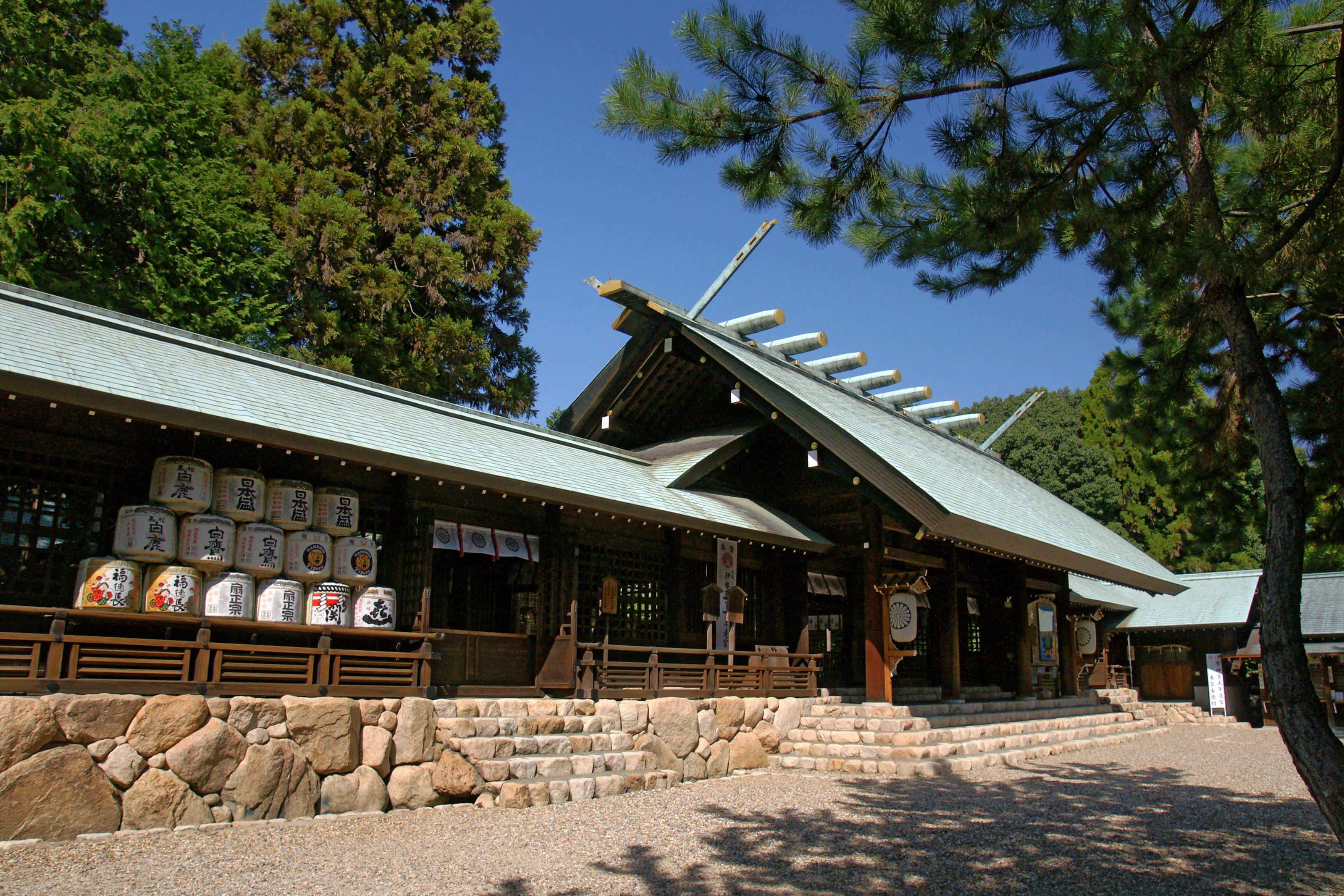
Hirota Shrine
The city of Nishinomiya takes its name from two words: nishi, meaning west, and miya, meaning shrine. The shrine in question is Hirota, and the fact that an entire city of nearly half a million people defines itself in relation to this place tells you something about its weight in Japanese sacred geography. According to the Nihon Shoki, Japan's oldest official chronicle, the sun goddess Amaterasu spoke directly to Empress Jingu in the 3rd century and commanded that she and the other kami be enshrined here. The Empress obeyed. Seventeen centuries later, Hirota still stands -- the only grand shrine in all of Hyogo Prefecture.
A Goddess Speaks, an Empire Obeys
The founding legend of Hirota Shrine is intertwined with one of Japan's most powerful mythological figures. Amaterasu, the sun goddess and most important kami in Shinto belief, declared to Empress Jingu that she and the gods of Japan must be enshrined at four sacred sites: Hirota, Nagata, Ikuta, and Sumiyoshi. The Empress Consort fulfilled the divine command, and according to tradition, her political ambitions were rewarded afterward. The Nihon Shoki, compiled in 720 CE, records this founding, making Hirota one of the oldest documented shrines in Japan. Whether the founding dates to the 3rd century as tradition holds, the shrine's roots stretch deep into Japan's pre-literate past.
The Imperial Circle
By the Heian period, Hirota had entered the highest tier of Japan's shrine hierarchy. In 965, Emperor Murakami established a system of sending Imperial messengers to report important national events to the guardian kami, selecting sixteen shrines for this honor. In 991, Emperor Ichijo expanded the list to nineteen, and Hirota made the cut. Then, in the 11th century, Emperor Shirakawa elevated Hirota further, designating it among the Twenty-Two Shrines -- the most honored sacred sites in the nation -- and granting it the title "Hirota Grand Shrine." That distinction matters today: while other shrines in Hyogo may use the term taisha, meaning grand shrine, none carry the Imperial designation that sets Hirota apart. From 1871 through 1946, it held the rank of Kanpei Taisha, a first-rank government-supported shrine.
A Calendar of Sacred Rhythm
Hirota operates on a ritual calendar so dense it touches nearly every day of the year. Each morning begins with the Asa-mi-ke-sai, a daily offering ceremony, and every evening closes with the Yuu-mi-ke-sai. The first and sixteenth of each month bring their own observances. The major festivals follow the seasons: the spring Haru Matsuri in April, the rice-planting Hirota Ohtaue in late May, the summer Natsu Matsuri in July, and the autumn Aki Matsuri in October. January alone holds four separate festivals, including the Yaku-yoke-sai purification rite in mid-month. The Nagoshi no Oohara Eshiki on June 30 marks the year's midpoint with a grand purification. This unbroken cycle of ceremony sustains a living connection between the shrine and the rhythms of the natural world.
Azaleas on Sacred Ground
Hirota is famous for its kobanomitsuba tsutsuji, a distinctive variety of azalea with three small leaves that blankets the shrine grounds each spring. The blooming season transforms the precinct into waves of color, drawing visitors who come as much for the flowers as for prayer. The shrine sits on a wooded hillside in the northern part of Nishinomiya, accessible by bus from several rail stations on the Hankyu Kobe Line and JR Kobe Line. The grounds retain a forested, contemplative atmosphere that contrasts with the dense urban fabric of the Kansai region surrounding them. Here, on land that tradition says was chosen by the sun goddess herself, the sacred and the natural have coexisted for the better part of two millennia.
From the Air
Located at 34.753N, 135.340E in the northern hills of Nishinomiya, between Kobe and Osaka. Best viewed from 3,000-5,000 ft. The shrine's forested grounds stand out against the surrounding urban development. Kobe Airport (RJBE) is approximately 15 km to the southwest. Osaka Itami Airport (RJOO) lies about 12 km to the northeast. Kansai International Airport (RJBB) is farther south across Osaka Bay. The Rokko mountain range provides a dramatic backdrop to the north, and Osaka Bay is visible to the south.