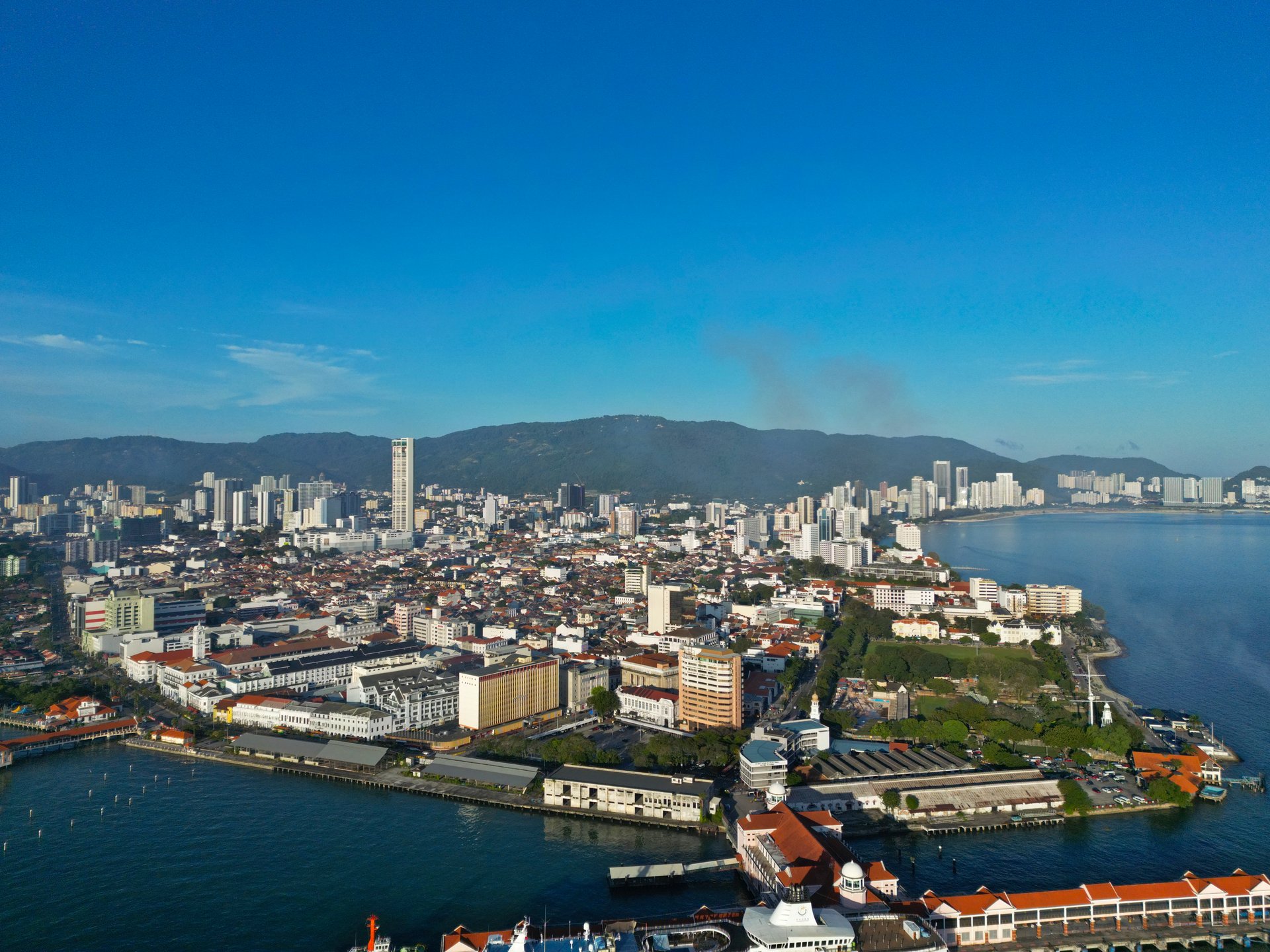
Historic Cities of the Straits of Malacca
Five flags have flown over these streets, and each one left behind buildings, recipes, and grudges. Melaka and George Town sit 350 kilometers apart on the western coast of Peninsular Malaysia, connected by the narrow waterway that has funneled trade between the Indian and Pacific oceans for millennia. UNESCO inscribed them together in 2008 as a joint World Heritage Site, recognizing something that neither city could demonstrate alone: the full arc of how Southeast Asian port cities absorbed wave after wave of foreign influence and turned it into something distinctly their own.
Where Empires Came Shopping
The Strait of Malacca is barely 65 kilometers wide at its narrowest point, a bottleneck that has shaped global commerce since Arab and Indian traders first sailed its length more than a thousand years ago. Melaka rose to prominence in the 15th century under the Malacca Sultanate, which built the city into one of the great entrepots of the medieval world. Spices from the Moluccas, silks from China, textiles from India, and camphor from Borneo all changed hands in its markets. The Portuguese seized Melaka in 1511, the Dutch took it in 1641, and the British assumed control in 1824. Each colonial power left behind fortifications, churches, and administrative buildings that still line the banks of the Malacca River. George Town emerged later, founded by the British East India Company in 1786 when Captain Francis Light claimed Penang Island for the Crown. Where Melaka tells the story of successive conquest, George Town tells the story of commercial ambition under a single colonial umbrella.
A City Built in Layers
Walking through Melaka's core zone, just 38.62 hectares, is an exercise in reading architecture like sedimentary rock. St. Paul's Hill anchors the historic center, its summit crowned by the ruined chapel where Francis Xavier once preached. Below it, the Stadthuys glows in Dutch red, built in the 1650s as the administrative heart of Dutch Malacca. The surrounding streets mix Chinese shophouses, Malay timber homes, and Indian-influenced mosques in a density that rewards slow exploration. The Malacca River threads through it all, once a commercial artery now lined with murals and cafes but still bearing the trace of its mercantile past. Since 1988, St. Paul's Hill has held official designation as a heritage zone, a recognition that what survives here is irreplaceable.
The British Blueprint
George Town's UNESCO core zone is nearly three times larger than Melaka's, at 109.38 hectares, reflecting the scale of the British colonial project on Penang. The streetscape is a catalog of 18th- and 19th-century commercial architecture: rows of shophouses with five-foot walkways, clan houses built by Hokkien and Cantonese immigrants, and grand colonial structures like the City Hall and Town Hall along the waterfront. What makes George Town remarkable is its multicultural layering. Walk a few blocks in any direction and you pass a Chinese temple, a Tamil Hindu shrine, a Malay mosque, and a colonial church. The neighborhoods bear the imprint of the communities that built them: Little India along Lebuh Pasar, the Malay quarter at Acheen Street, the Chinese clan jetties where stilt houses extend over the harbor. This isn't a preserved museum district; it is a living city where these communities still worship, trade, and cook in buildings their ancestors erected.
What Survived and What Didn't
Singapore and Phuket were both considered for inclusion in this World Heritage listing. Singapore lost its chance during the aggressive urban redevelopment of the 1970s and 1980s, when swaths of its colonial core were demolished and replaced with high-rises. Phuket's historical center, though charming, proved too small and lacking in built heritage to qualify. Melaka and George Town earned their inscription precisely because they preserved what those cities did not: the continuous physical record of multicultural exchange spanning nearly five centuries. That preservation faces ongoing threats. Tourism development pressure and traffic congestion strain both cities, and ICOMOS, the advisory body that evaluates World Heritage properties, has flagged both as concerns. In the longer term, climate change and rising sea levels pose flooding risks to Melaka's low-lying riverside core. The challenge is keeping these cities alive as communities rather than embalming them as tourist attractions.
The Trading Strait That Built Two Worlds
Seen from the air, the Strait of Malacca is a steady procession of container ships, tankers, and bulk carriers, one of the busiest shipping lanes on earth. Roughly a quarter of all goods traded globally pass through these waters. Melaka and George Town grew from that traffic, and in a real sense they still depend on it. The UNESCO inscription recognized these cities not just for their buildings but for what those buildings represent: Criterion (ii), an important interchange of human values forged from the exchange of Malay, Chinese, and Indian cultures under three successive European colonial powers; and Criterion (iii), unique testimony to a living multicultural heritage. The shophouses, temples, mosques, and churches are physical evidence of people figuring out how to live and do business together across vast cultural divides. That negotiation, messy and incomplete as it always was, produced something worth protecting.
From the Air
Centered on George Town, Penang at 5.42N, 100.35E. Penang International Airport (WMKP) is approximately 16 km south. Melaka's Batu Berendam Airport (WMKM) serves the southern city at 2.26N, 102.25E. From cruising altitude, the Strait of Malacca is visible as the narrow channel between Peninsular Malaysia and Sumatra. Best viewed at 3,000-5,000 ft to see the historic waterfronts and river corridors of both cities. Sultan Abdul Aziz Shah Airport (WMSA) in Subang and Kuala Lumpur International Airport (WMKK) are regional alternatives.