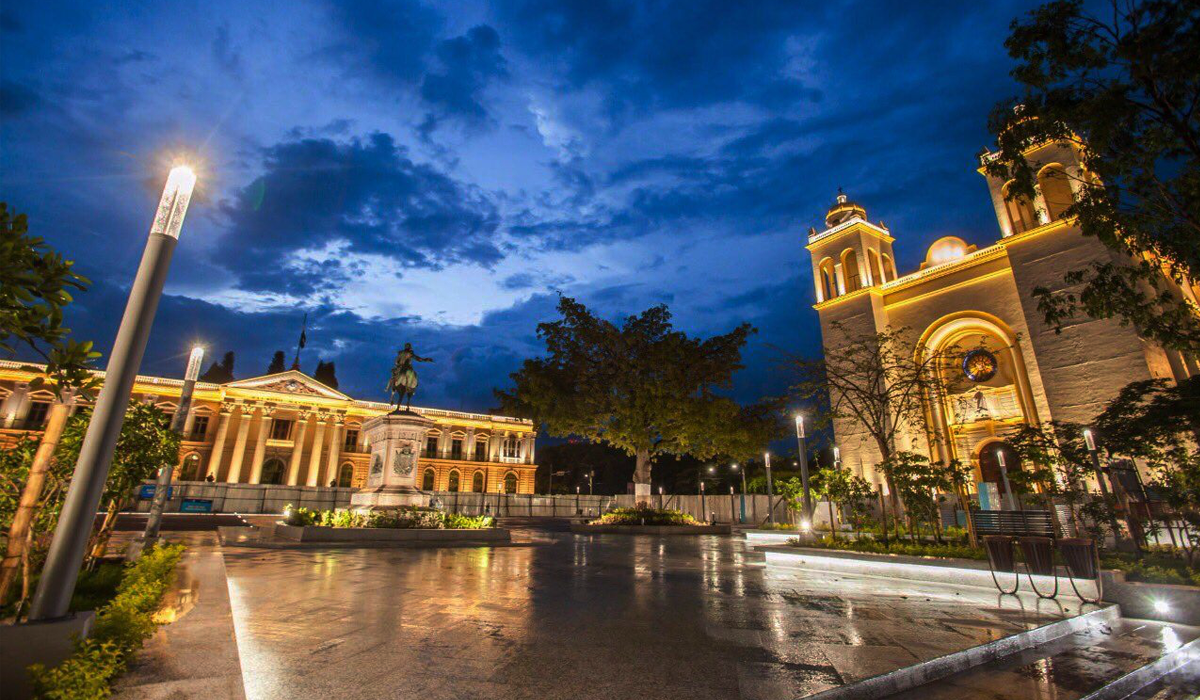
Historic Downtown San Salvador
The Spaniards called it the Valle de las Hamacas -- the Valley of the Hammocks -- because the ground never stopped moving. When the Pipil settlement of Zalcuatitan was rechristened as the new site of San Salvador in 1545, the colonists laid out their grid of streets and plazas over a valley that would shake itself apart again and again across the centuries. Nearly every original colonial building is gone, destroyed by one earthquake or another. What survives is the grid itself, the stubborn geometry of Plaza Libertad and the streets radiating outward, rebuilt in stone and iron and concrete each time the earth reminded its inhabitants who was really in charge.
A Palace Paid in Coffee
The National Palace that stands today is the second one. The first, built between 1866 and 1870, burned to the ground on December 19, 1889. Its replacement, constructed between 1905 and 1911 by engineer Jose Emilio Alcaine, was financed through a tax of one colon on every quintal of coffee exported from El Salvador. The materials came from Germany, Italy, and Belgium, and the finished building contained four main halls, each named for its color. The Red Room hosts foreign ministry receptions. The Yellow Room serves as the president's office. The Blue Room -- the Salon Azul -- housed the national legislature from 1906 and is distinguished by its Ionian, Corinthian, and Roman architectural elements. Government offices occupied the palace until 1974, when it was declared a National Historic Landmark. The 101 secondary rooms once bustled with bureaucrats; today, they are quieter, preserved as a monument to the era when coffee was king and El Salvador's ambitions were measured in imported marble.
The Weight of the Cathedral
No building in San Salvador carries more history than the Metropolitan Cathedral. Its site has been sacred ground since the colonial era, when the Temple of Santo Domingo stood here. The first cathedral was established in 1842. An 1873 earthquake destroyed it. The second, made of wood, burned in 1951 as crowds watched helplessly. The current cathedral was completed in 1999, its facade adorned with a vibrant tiled mural by the Salvadoran artist Fernando Llort. But the cathedral's significance runs deeper than architecture. Archbishop Oscar Romero, assassinated on March 24, 1980, is entombed here. His funeral on Palm Sunday drew thousands -- and ended in horror when gunfire erupted, triggering a stampede that killed 44 people. The gunmen were never identified. Twelve years later, the square in front of the cathedral became a place of celebration when the Chapultepec Peace Accords ended the Salvadoran Civil War. Pope John Paul II knelt before Romero's tomb during visits in 1983 and 1996, calling the cathedral "intimately allied with the joys and hopes of the Salvadoran people."
Plazas That Remember
Downtown San Salvador is a city of plazas, each one a compressed layer of national memory. Plaza Libertad marks the spot where the original Plaza Mayor was laid out in 1545 according to the Spanish Grid -- the Cuadricula Espanola -- and where the Monumento de los Heroes commemorates the First Cry of Independence of 1811. An angel of freedom stands at its pinnacle, holding laurel wreaths in both hands. A few blocks away, Plaza Gerardo Barrios honors a 19th-century president with a bronze statue unveiled in 1909, designed by the Italian-Genoese sculptor Francisco Durini. This plaza is the heart of public life: the site of political rallies, religious processions, and the annual feast day celebrations of the Divine Savior on August 5 and 6. Plaza Morazan holds a marble statue of Francisco Morazan, the former president of the Federal Republic of Central America, erected in 1882 on the 40th anniversary of his death. Morazan's son attended the inauguration on behalf of the Honduran government.
Ghosts and Guest Lists
Among the downtown's quieter landmarks is Casa Duenas, built in the 1920s by coffee farmer Miguel Duenas and confiscated by the government in 1922 to settle his debts. From 1935 to 1957, the United States leased it as the ambassador's residence. Six consecutive American ambassadors lived there, and the guest list over those decades reads like a roll call of mid-century power: Richard Nixon, Lyndon B. Johnson, Robert Kennedy, Clark Gable, and Tony Curtis all stayed under its roof. After the diplomats left, the house drifted through decades of institutional use before being declared a Cultural Asset in 1986. Restoration began in 2001 under Dr. Alfredo Martinez Moreno, former director of the Salvadorean Language Academy. The building endures as a reminder that even in a city constantly shaken apart, some structures survive through sheer reinvention -- changing purpose each generation while the walls hold firm.
Rebuilding in the Valley of Hammocks
The 1986 earthquake severely damaged the downtown core, and the aftermath brought a different kind of transformation. As unemployment rose, informal traders and street vendors filled the damaged streets. Mayor Morales Ehrlich closed roads to create a pedestrian mall that year, but the result was chronic traffic congestion. Since 2009, the Rescate del Centro Historico has pushed to relocate vendors into purpose-built markets and restore the district's historic buildings. The work has not been easy -- riots accompanied the relocation efforts -- but the project has given the downtown a new direction. Today, the tallest structure in the historic center is not a skyscraper but the cathedral's bell tower, standing approximately 80 meters high, because continuous seismic activity has kept high-rise construction at bay. The financial center migrated northwest decades ago, leaving downtown as the keeper of collective memory rather than commerce. In a valley that never stops trembling, that may be the most resilient role of all.
From the Air
Located at 13.697N, 89.190W in San Salvador, the capital of El Salvador. The historic center is identifiable from the air by the Metropolitan Cathedral's bell tower (approximately 80m tall) and the surrounding cluster of plazas. The city sits in a valley flanked by the San Salvador Volcano to the northwest. Nearest major airport is El Salvador International (MSLP), approximately 40 km to the south. Expect volcanic haze and afternoon thermals; best visibility in early morning.