Historic Monuments and Sites of Hiraizumi
The idea sounds audacious, even by the standards of medieval ambition: build paradise. Not a painting of it, not a prayer for it, but the actual Buddhist Pure Land -- Amida Buddha's western realm of infinite light -- rendered in ponds, gardens, temples, and mountain slopes in a river valley in northeastern Japan. That is precisely what the Northern Fujiwara clan attempted across four generations in Hiraizumi, Iwate Prefecture. In 2011, UNESCO recognized the results by inscribing five of these sites as a single World Heritage group under criteria ii and vi, acknowledging their outstanding demonstration of how Buddhist cosmology could be translated into landscape architecture. The official name is a mouthful: "Hiraizumi -- Temples, Gardens and Archaeological Sites Representing the Buddhist Pure Land." The reality is more concise. These are the ruins, the gardens, and the one shimmering golden hall that survived nearly a thousand years of fire, war, and neglect.
Four Generations of Paradise Builders
The story begins around 1087 when Fujiwara no Kiyohira, fresh from the devastation of the Gosannen War, moved his headquarters south to Hiraizumi and began constructing a new kind of power center. Rather than fortifications and arsenals, Kiyohira built temples. His vision drew on Pure Land Buddhism's promise of a western paradise beyond death, but the Fujiwara intended something more radical: paradise now, paradise here, carved into the landscape of the Kitakami River valley. Four generations of the Northern Fujiwara -- Kiyohira, Motohira, Hidehira, and Yasuhira -- expanded the project across roughly a century. They funded it with gold from local mines, horses from Tohoku's vast pastures, and maritime trade that connected this remote region to the broader Japanese economy. By the mid-twelfth century, Hiraizumi rivaled Kyoto in wealth and cultural sophistication.
The Five Sacred Components
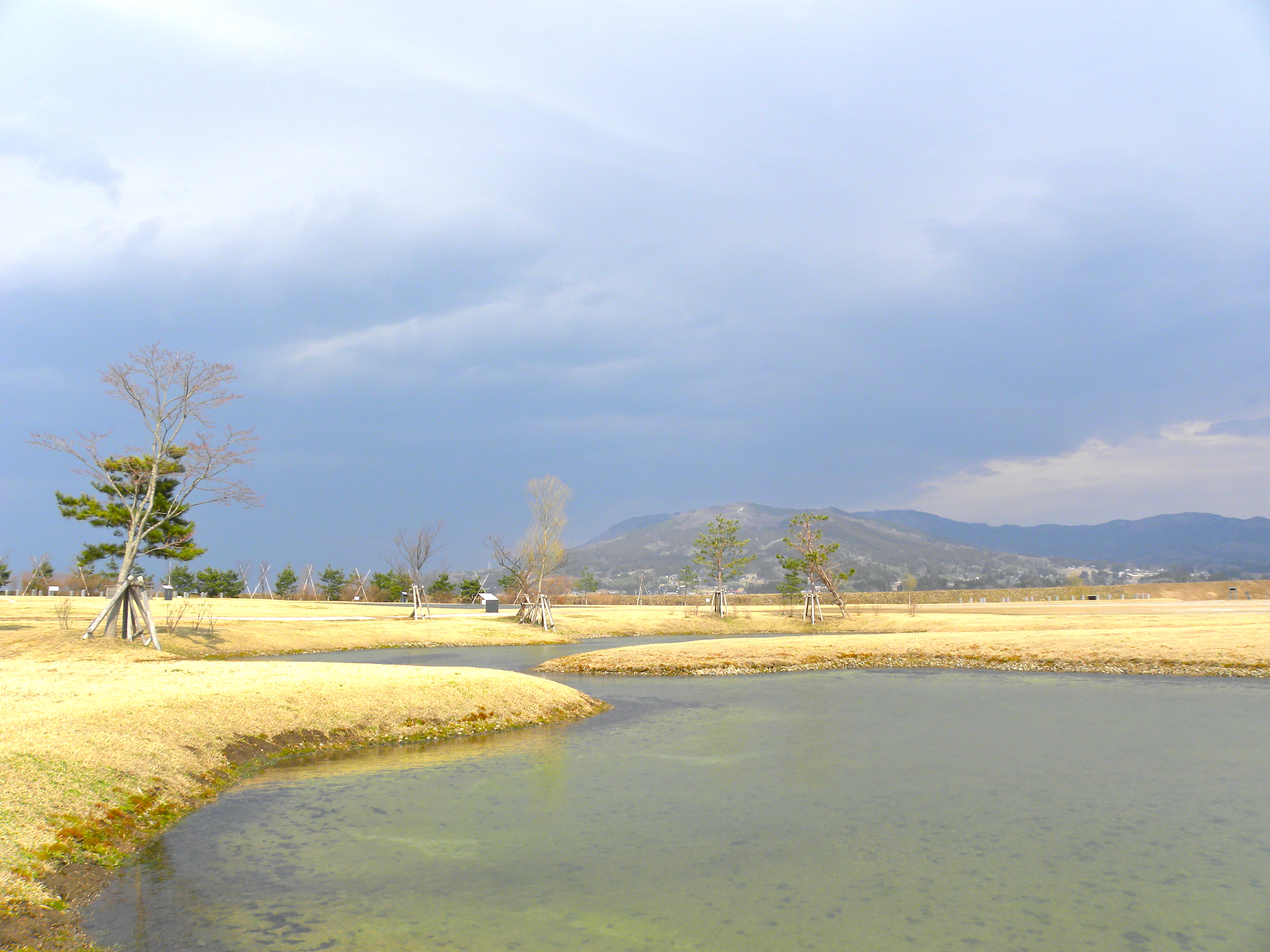
The World Heritage designation encompasses five distinct sites, each contributing a piece to the Pure Land vision. Chusonji is the most famous, home to the Konjikido -- a small Amida hall completed in 1124 and covered inside and out with gold leaf, its interior inlaid with mother-of-pearl and decorated with Silk Road treasures. It is the first structure ever designated a National Treasure in Japan. Motsuji preserves the best-surviving example of a Heian-era Pure Land garden, its central pond reflecting the surrounding hills in an arrangement that follows the principles of the Sakutei-ki, Japan's oldest gardening manual. Kanjizaio-in, founded by the wife of the second Fujiwara lord Motohira, offers the ruins of a quieter, more contemplative garden complex. Muryoko-in, now mostly archaeological foundations, once mirrored the famous Byodoin temple near Kyoto. And Mount Kinkeisan provides the sacred mountain backdrop against which the entire ensemble was designed to be viewed.
Destruction and the Poet's Tears
The Northern Fujiwara's paradise lasted barely a century. In 1189, the army of Minamoto no Yoritomo -- founder of the Kamakura shogunate -- swept through Hiraizumi and destroyed the clan. The great temple complexes fell into decline. Fires in 1198 consumed much of Motsuji and Kanjizaio-in. Over the following centuries, the buildings crumbled, the gardens returned to rice paddies, and Hiraizumi shrank to a small rural town. When the poet Matsuo Basho visited in 1689, five hundred years after the fall, he found only summer grass growing where palaces had stood. His famous haiku -- "summer grass, all that remains of warrior dreams" -- captured the melancholy of impermanence that would define Hiraizumi's identity for centuries. It took modern archaeology, beginning with excavations in the 1950s, to reveal the full scope of what the Fujiwara had built beneath those quiet fields.
Reading the Landscape from Above
The original 2006 UNESCO nomination included additional sites and a broader cultural landscape framework, but the committee initially deferred inscription. The revised 2011 nomination focused more tightly on the five core components and their Pure Land Buddhist significance, successfully securing World Heritage status. One site from the original submission, the Yanagi Palace archaeological complex, was excluded but remains a candidate for future extension. What makes the Hiraizumi designation unusual is its emphasis on absence as much as presence. Apart from the Konjikido, no original buildings survive. The heritage lies in the spatial relationships -- the carefully planned distances between ponds and temple platforms, the alignment of buildings with Mount Kinkeisan, the way garden ponds were shaped to evoke the lotus pools of paradise. From the air, the pattern becomes legible: a string of green spaces following the western hills above the town, each one marking where a Fujiwara lord once tried to make heaven visible on earth.
From the Air
The World Heritage sites of Hiraizumi are clustered at approximately 39.00N, 141.10E in the Kitakami River valley, southern Iwate Prefecture. The nearest airport is Iwate Hanamaki Airport (RJSI), roughly 50 km north. Sendai Airport (RJSS) lies approximately 120 km to the south. From the air, the component sites are visible as a chain of forested and gardened areas along the western edge of Hiraizumi town, with the Kitakami River to the east and Mount Kinkeisan rising behind. Recommended viewing altitude: 3,000-5,000 feet to see the spatial relationship between the five sites. The Konjikido shelter building at Chusonji is identifiable on the wooded hillside.