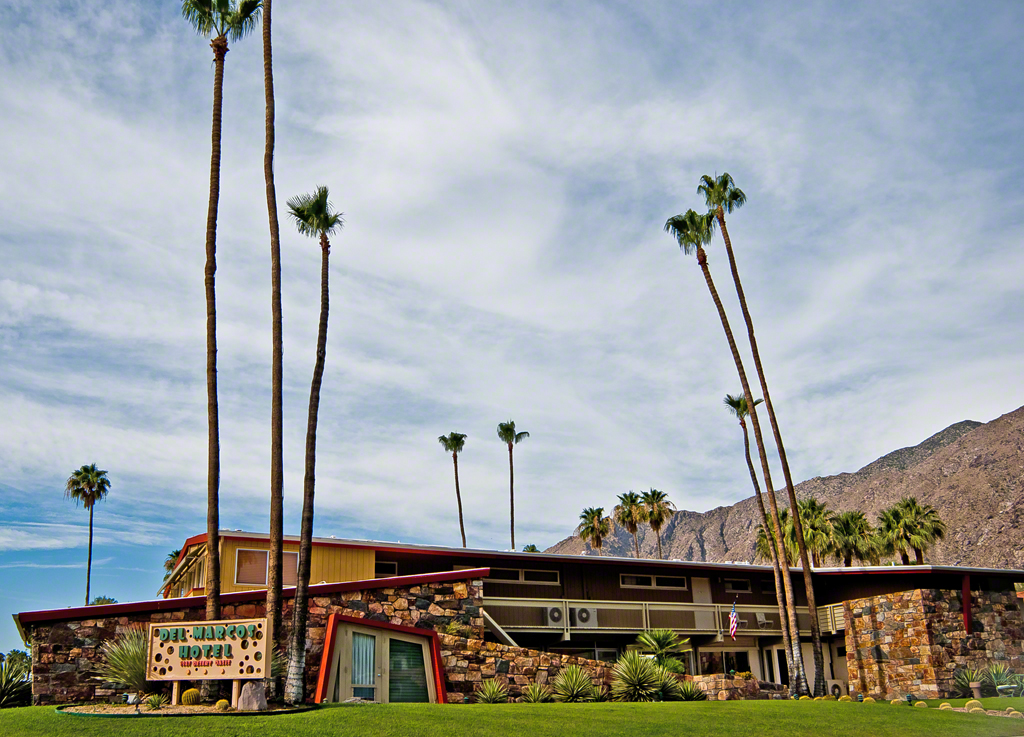
Historic Tennis Club
John Guthrie McCallum didn't come to Palm Springs for the architecture or the celebrity scene. He came in 1884 because his son was sick. Tuberculosis was consuming the boy, and doctors believed dry desert air might slow its advance. McCallum became the first non-indigenous permanent settler in what would become Palm Springs, and the neighborhood that grew up west of downtown — today known as the Historic Tennis Club district — carries that origin story in its bones: a place built not on ambition alone, but on the most human of imperatives, the hope of saving someone you love.
The Father Who Founded a City
McCallum's arrival in 1884 set in motion the development of Palm Springs as a place where Anglo-American settlers would build lives alongside the Cahuilla people who had called the valley home for roughly two thousand years. The district that bears the Tennis Club name grew up at the base of the San Jacinto Mountains, on land that rises gently westward from downtown. McCallum built an adobe home and an irrigation system, laying practical foundations for a town. His story — a father's determination to save a child — became part of the city's founding mythology, repeated in local histories and heritage tours as evidence that Palm Springs was built on more than leisure, though leisure would eventually define it.
Where the Famous Came to Rest
By the early twentieth century the district had evolved into one of Palm Springs' most fashionable residential addresses, and the visitors it attracted were not always who you might expect. Albert Einstein stayed at The Willows, a historic inn in the neighborhood, in 1932. The Tennis Club Resort itself opened in 1937, offering courts and bungalows to guests who wanted exercise alongside escape. Casa Cody, founded in the early 1920s and still operating, claims the title of Palm Springs' oldest continuously operating hotel. The district's combination of convenient location — walking distance to downtown — and intimate scale made it appealing to those who wanted Palm Springs without the more theatrical aspects of the resort world.
Fifteen Layers of History
The Historic Tennis Club neighborhood contains fifteen Class 1 Historic Sites, a density that reflects how much of early Palm Springs development concentrated in this compact western district. The buildings range from the early twentieth century through the mid-century modernist period that gave the city its architectural reputation, creating a layered streetscape where different eras of aspiration stand side by side. The district is bounded roughly by the mountain escarpment to the west and by downtown Palm Springs to the east, a geography that kept development relatively contained and helped preserve the neighborhood's historic fabric even as the wider city grew and transformed around it.
Tennis, Time, and the Mountain Wall
The San Jacinto Mountains rise abruptly behind the neighborhood — one of the most dramatic fault-scarp escarpments in North America, lifting from the valley floor to more than ten thousand feet within a few miles. That wall of rock gives the Historic Tennis Club district its particular character, a sense of being sheltered and contained, the mountain acting as a backdrop so massive it functions almost as architecture. The afternoon shadow it casts defines the neighborhood's rhythm in summer, offering shade hours before the rest of Palm Springs cools. It is a neighborhood shaped by geology as much as by history, where the mountain is not scenery but participant.
From the Air
Located at 33.82°N, 116.55°W at the base of the San Jacinto Mountains escarpment in Palm Springs, California. The abrupt mountain front is a prominent landmark from cruising altitude. Palm Springs International Airport (ICAO: KPSP) is approximately 2 miles to the east.