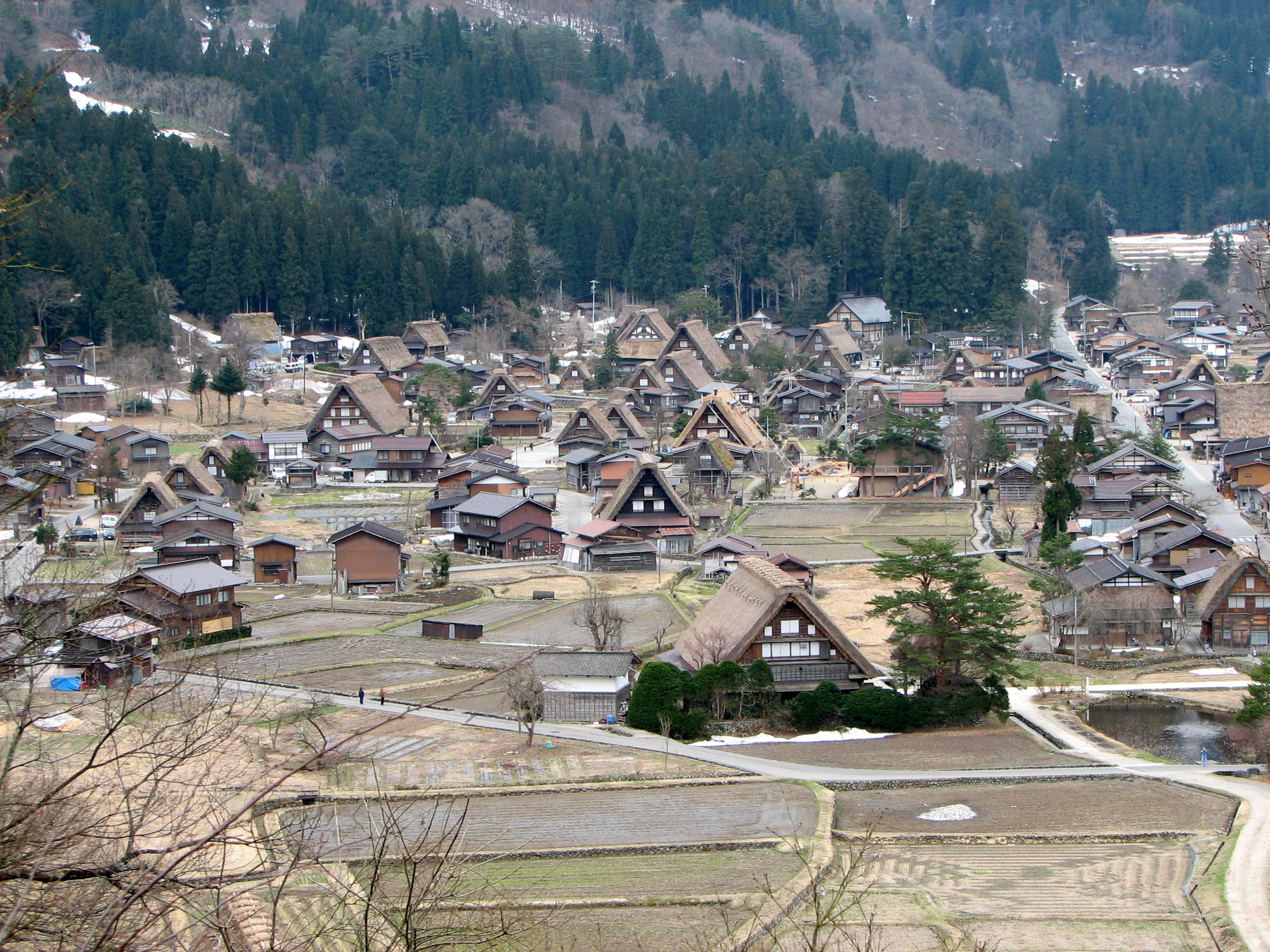
Historic Villages of Shirakawa-go and Gokayama
Every 30 to 40 years, an entire village drops what it is doing and climbs onto a roof. The tradition is called yui -- cooperative labor -- and in the three gasshō-zukuri villages straddling the border of Gifu and Toyama Prefectures, it is how communities have maintained their extraordinary thatched farmhouses for generations. UNESCO recognized these settlements in 1995 not merely as architectural specimens but as living proof that traditional building and communal social structures can persist deep into the modern era. The three villages -- Ogimachi in the Shirakawa-go region, and Ainokura and Suganuma in Gokayama -- sit along the Shō River in one of Japan's snowiest mountain valleys, where the architecture is inseparable from the climate that shaped it.
The Geometry of Survival
The gasshō-zukuri style -- "prayer-hands construction" -- earns its name from roofs pitched at roughly 60 degrees, steep enough to resemble palms pressed together in devotion. That angle is not spiritual but structural: when four meters of snow pile onto a mountainside in a single winter, a roof must shed the load or collapse. The massive thatched gables are supported by stout oak beams lashed together with rope and Japanese witch-hazel rather than nails, creating a flexible skeleton that absorbs the shifting weight of snowpack. Beneath these towering roofs, the houses rise three to four stories, with the upper floors historically devoted to sericulture. Trays of silkworms and mulberry leaves filled the warm attic spaces, heated by smoke rising from the open irori hearths below -- the same smoke that dried the thatch and repelled insects.
Three Villages, One Designation
Ogimachi is the largest of the three. When it was inscribed as a World Heritage Site in 1995, it held 152 households and a population of 634. Records from 1876 show 99 households, already the biggest of 23 villages in the Shirakawa-Muri district. The central village sits on a terrace along the eastern bank of the Shō River, stretching roughly 1,500 meters in length and 350 meters wide, at an altitude of about 500 meters. The oldest house here dates to the late 17th century. Ainokura, in the Gokayama region, preserves 20 gasshō-zukuri houses, most between 100 and 200 years old. Suganuma is the smallest, a tight cluster of 12 houses on a natural peninsula nearly encircled by the river. Despite their modest scale, these villages represent one of the most complete surviving ensembles of vernacular Japanese mountain architecture.
Rooms Without Nails
Inside these farmhouses, the floor plan follows a logic dictated by daily life and social hierarchy. A compacted earth floor -- the doma -- served as the working entrance, while a raised timber floor about 50 centimeters higher formed the living area. Room arrangements typically followed a four-room or six-room square layout. The irori hearth sat at the center of family life: a sunken pit filled with ash where a kettle hung from the ceiling on an adjustable hook, often carved into the shape of a fish. There was no chimney. Smoke drifted upward through the thatch, preserving the roofing material and keeping pests at bay. A Shinto shrine occupies high ground near the center of Ogimachi, surrounded by Japanese cedars, while a Jodo Shinshu Buddhist temple forms the spiritual anchor of the community. Sacred and domestic architecture coexist within a few hundred meters.
Preservation as a Living Practice
Japan classifies these villages as Important Preservation Districts for Groups of Historic Buildings under its Law for Protection of Cultural Properties. This designation requires formal preservation plans that restrict activities capable of damaging properties or altering the landscape. Each homeowner bears direct responsibility for the management and repair of their house, supervised to ensure that traditional methods and materials are used. The Agency for Cultural Affairs of the Government of Japan oversees the effort in coordination with the Ministry of the Environment, the Ministry of Agriculture, and the prefectural and municipal governments of Toyama, Gifu, Shirakawa Village, and Nanto City. The result is unusual: a World Heritage Site where the principal preservationists are the people who live and sleep inside the protected structures, maintaining them not as artifacts but as homes.
Snowbound and Standing
What separates these villages from heritage parks or reconstructions is continuity. The houses were not relocated or rebuilt for tourists. They stand where families raised children, tended silkworms, and manufactured washi paper and saltpeter for the Kaga Domain. Snow still falls in the same quantities. The yui tradition of communal roof repair still functions. Visitors who stay overnight in a gasshō-zukuri guesthouse sleep beneath the same structural beams that have held through centuries of Toyama winters, hearing the creak of timber settling under the cold. The villages endure because the people inside them never stopped doing the work.
From the Air
The three villages are spread along the Shō River valley at approximately 36.40°N, 136.88°E, between the Gifu and Toyama prefectural border. Ogimachi (Shirakawa-go) is the southernmost at approximately 36.26°N, 136.91°E; Ainokura and Suganuma sit to the northeast. The villages occupy a narrow valley at about 500 meters elevation, surrounded by mountains rising to 1,500+ meters. Best observed at 3,000-5,000 feet AGL. The nearest airport is Toyama Airport (RJNT), roughly 50-80 km north. In winter, heavy snow blankets the valley, making the dark thatched roofs highly visible against white terrain. The winding Shō River serves as a clear navigational reference through the mountain gorge.