Historical Presidential Palace, Kaunas
On the night of June 14, 1940, the government of the Republic of Lithuania met for the last time in a neo-baroque building in Kaunas with a cast-iron fence around its garden. They had been given an ultimatum from Moscow that afternoon and were trying to decide whether to fight a war they could not win or to allow the Red Army across the border. They chose the border. By the next evening the Republic that had operated from this address since 1919 had ceased to exist. The building had been the Presidential Palace of an entire interwar nation - because Lithuania's actual capital, Vilnius, had been seized by Poland and the country had spent two decades governing itself from its second city.
A Provincial Mansion
The first version of the building went up in 1846 - a two-story Russian-Imperial-era residence built by a local nobleman who had received authorization for a structure with seven rooms on the ground floor and nine above. It was symmetrical, brick, classical in temper, and unremarkable for its period. In 1866 a garden was laid out in front. Two years later the Russian Imperial government acquired the building as a residence for the Kovno Governor - the Tsar's appointed administrator of this corner of the empire - and in 1876 they purchased it outright. They expanded the wings, added a gallery, and reworked the facade in the neo-baroque manner that gives the building its present silhouette. In 1915, during the German occupation of the Eastern Front, Kaiser Wilhelm II briefly stayed here while inspecting his armies.
The Capital Without Its Capital
Lithuania declared independence on February 16, 1918. Within two years, Polish forces under General Lucjan Żeligowski had seized Vilnius - the historical capital - and incorporated it into a short-lived Republic of Central Lithuania, which was then absorbed by Poland. The Lithuanian government refused to accept the loss but could not reverse it militarily. So Kaunas became the temporary capital. Government ministries, the Seimas, the diplomatic corps, the university, and the presidency all moved to Kaunas and made do. The Kovno Governor's old residence was remodeled and designated as the Presidential Palace. For the next twenty years - 1920 to 1940 - this building was where Lithuania's three interwar presidents lived and worked: Antanas Smetona, Aleksandras Stulginskis, and Kazys Grinius. From the balcony, Smetona addressed crowds in the square. Inside, three constitutions were signed, two coups were planned, and the slow drift from parliamentary republic to authoritarian regime was negotiated.
The Coup of 1926
On December 17, 1926, the Lithuanian military overthrew the elected government of Kazys Grinius. The conspirators arrested ministers, dissolved parliament, and installed Antanas Smetona as president - the same man who had served as Lithuania's first president after 1919 and had since lost power. Grinius resigned under pressure. Smetona ruled, in increasingly authoritarian style, for the next thirteen years. The Presidential Palace witnessed all of it: the palace gardens, the cast-iron fence still surviving today, the second-floor study where decrees were signed, the meeting room where ministers argued about whether to call elections that the regime had no intention of holding. The 1926 coup is one of the formative traumas of modern Lithuanian political memory, and the rooms in which it played out are now open to visitors.
The Last Meeting
On June 14, 1940, Soviet Foreign Minister Vyacheslav Molotov delivered an ultimatum to the Lithuanian government: admit Red Army units to Lithuanian territory, or face invasion. That night the cabinet met in this building to decide. The deliberation ran into the early hours of June 15. The decision, in the end, was to comply. Within days the Soviets were across the border, the Smetona regime had collapsed, and Lithuania had been absorbed into the USSR as the Lithuanian Soviet Socialist Republic. Smetona himself fled across the German border. The Presidential Palace was repurposed under Soviet rule - parts of the first floor were gutted to install a movie theater, the garden was reduced, several adjacent buildings demolished. Later it became headquarters for Kaunas teachers' organizations. The presidential function did not return.
Restored, Re-Opened, Remembered
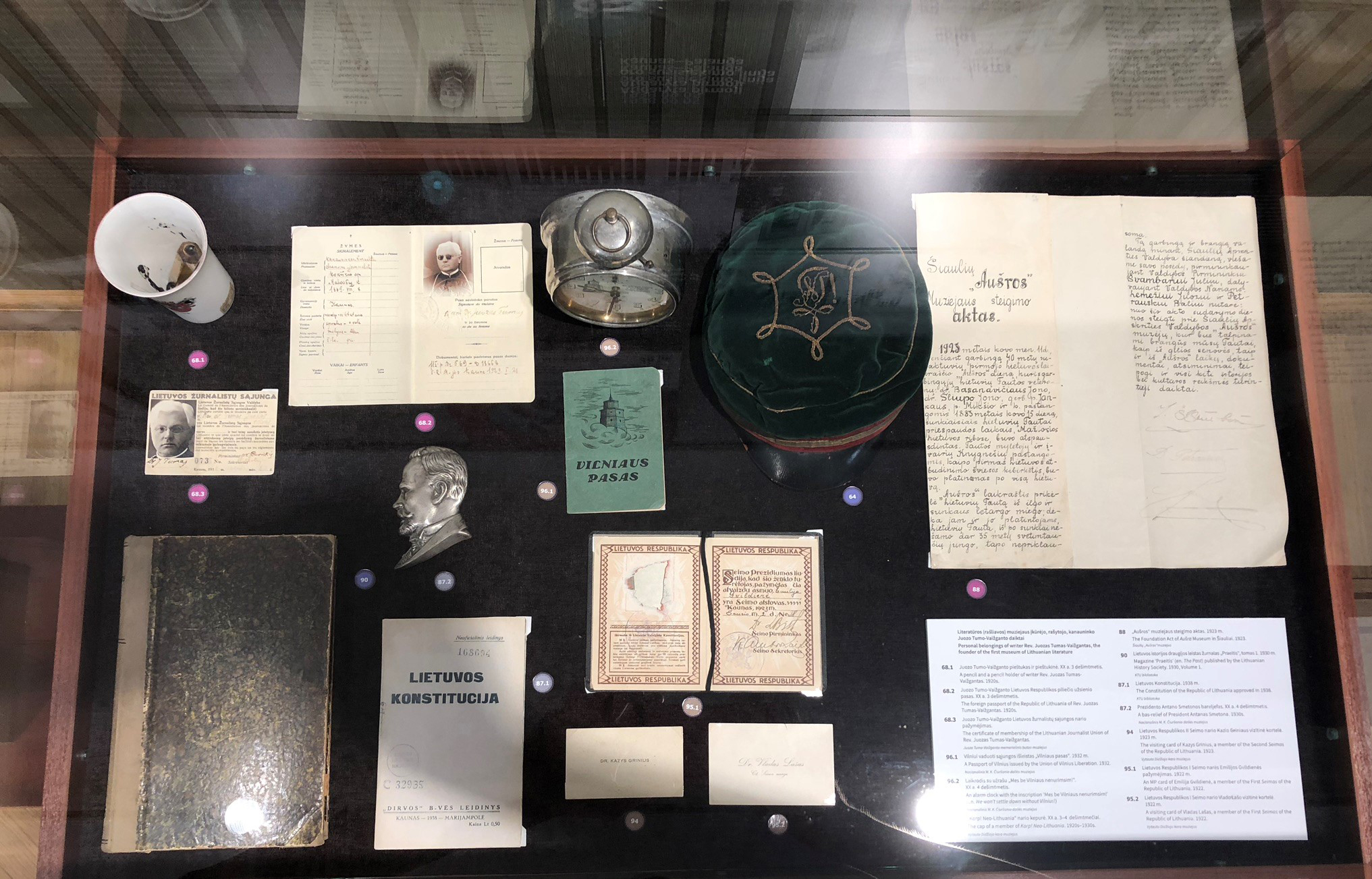
Lithuania regained independence in 1991. The palace was designated a historical landmark and transferred to the Vytautas the Great War Museum's administration. Three statues of the interwar presidents - Smetona, Stulginskis, and Grinius - were placed in the garden. Renovations begun in 1997 dragged on for six years for lack of funds; in 2003, on the 85th anniversary of Lithuanian Independence, the restored palace re-opened to the public. Total cost ran above five million litas. Since 2005 it has been a branch of the M. K. Čiurlionis National Art Museum. Today the rooms display the workaday objects of an interwar republic: the cipher typewriter used by the Lithuanian Army's diplomatic missions, presidential umbrellas with monogrammed handles, the gold trophy from the 1937 EuroBasket championship that Lithuania won. The cast-iron fence still encloses the same garden. Inside, the rooms are arranged the way the last cabinet would have known them on the night of June 14, 1940.
From the Air
The Historical Presidential Palace sits at 54.90°N, 23.90°E in the Old Town (Senamiestis) of Kaunas, Lithuania, near the confluence of the Nemunas and Neris rivers. View from 2,000-4,000 feet for the historic Old Town silhouette, including Vilnius Street and the Town Hall Square. Nearest airport is Kaunas (EYKA), 12 km north of the city; Vilnius (EYVI) is about 105 km east. The Old Town is well-preserved and easy to identify from the air on a clear day.