History of Jamestown, Virginia (1607-1699)
Three ships left Blackwall, London, in December 1606 carrying 105 men and boys -- no women -- on a four-month voyage to a place they had never seen. On May 14, 1607, they chose a swampy island in the James River for reasons of military defense and called it Jamestown. Within two years, most of them were dead. Within a decade, tobacco had turned the settlement into a boomtown. Within a generation, the colony had hosted America's first representative legislature, received its first enslaved Africans, and survived a coordinated massacre that killed a third of its population. Over ninety-two years, Jamestown burned, was rebuilt, burned again, hosted rebellion, and finally watched its own government pack up and move twelve miles inland to Williamsburg. It was never a comfortable place. It was never supposed to last. But every American institution -- democracy, slavery, capitalism, religious freedom -- passed through this swamp on the James River first.
Fools' Gold and Starving Men
The Virginia Company of London funded Jamestown as a profit-making venture. The investors wanted gold, a passage to Asia, or at minimum some exportable commodity. What they got were gentlemen who refused to dig wells, a peninsula infested with malarial mosquitoes, and brackish river water that poisoned those who drank it. Captain John Smith imposed discipline -- 'he that will not work shall not eat' -- and traded with the Powhatan Confederacy for corn, sometimes at swordpoint. When Smith was injured in a gunpowder accident and shipped back to England in 1609, the colony fell apart. Chief Powhatan cut off trade. The third supply fleet, led by the flagship Sea Venture, was wrecked on Bermuda in a hurricane. The winter of 1609-1610 became the Starving Time: of five hundred colonists, only sixty survived. They ate horses, rats, shoe leather, and each other. By June 1610, the survivors had abandoned Jamestown entirely -- and were intercepted on the James River by the newly arrived Governor Lord De La Warr, who forced them back to try again.
The Weed That Changed Everything
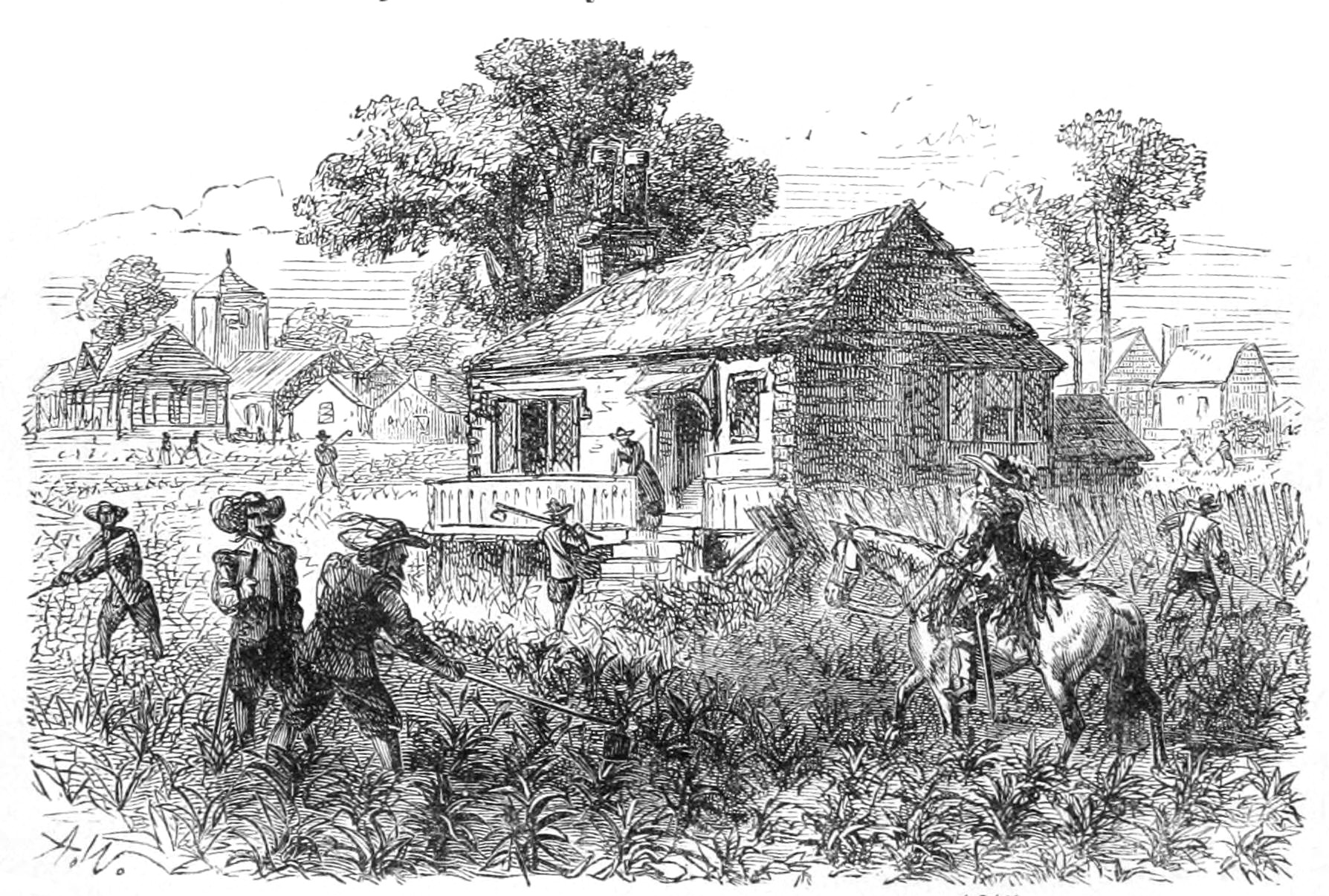
John Rolfe arrived in Jamestown after surviving the Sea Venture shipwreck, carrying seeds of Nicotiana tabacum from Bermuda. The native Virginia tobacco, Nicotiana rustica, was too harsh for European tastes. Rolfe's Caribbean variety was not. By 1612, he was exporting successfully. By the late 1610s, tobacco had triggered something like a gold rush: colonists planted it in the streets, in the cemetery, everywhere they could turn earth. The crop demanded land and labor on a scale the colony could barely supply. Indentured servants poured in from England. Colonists pushed into Powhatan territory along the James River, seizing land for tobacco fields. Rolfe married Pocahontas in 1614, briefly easing tensions. But when she died in England in 1617 during a public relations trip to attract investors, the fragile peace began to crack. Tobacco had given Jamestown an economic reason to exist. It had also set in motion the land hunger and labor exploitation that would define Virginia for centuries.
First Assembly, First Africans, First Strike
The year 1619 proved transformative. In July, the General Assembly -- the first elected representative legislature in the New World -- met in the choir of the Jamestown Church. That body continues today as the Virginia General Assembly. In August, a Dutch warship delivered 'twenty and odd Negroes' to Point Comfort, several miles south of Jamestown. These first Africans were likely treated as indentured servants rather than chattel property, but by 1640, court records show at least one African, John Punch, sentenced to lifelong servitude for running away -- the legal seed of hereditary slavery. That same year, Slovak and Polish artisans in Jamestown organized the first labor strike in American history, demanding democratic voting rights. They won. In 1621, fifty-seven unmarried women sailed to Virginia under the Company's auspices to marry colonists, the transport costs to be repaid by their future husbands. Democracy, slavery, labor rights, immigration policy -- all took their earliest American form along this single stretch of the James.
Blood on the River
On the morning of March 22, 1622, Chief Opechancanough launched coordinated surprise attacks along both sides of the James River. Three hundred and forty-seven colonists died, including men, women, and children. Entire communities -- Henricus, Wolstenholme Towne at Martin's Hundred -- were wiped out. Jamestown itself was spared only because an Indian boy named Chanco warned colonist Richard Pace, who paddled a canoe across the river in time to alert the town. The massacre ended any pretense of coexistence. A decade of brutal war followed. In 1644, the aged Opechancanough tried again, killing nearly five hundred colonists in a second coordinated attack. He was captured in 1646, reportedly between ninety and one hundred years old, and shot in the back by his guard. The treaties that followed established some of the oldest Indian reservations in America and imposed English tribute requirements on the surviving Powhatan people.
Burning Down and Moving On
Bacon's Rebellion of 1676 burned Jamestown to the ground. Nathaniel Bacon, a young planter at odds with Governor William Berkeley over Indian policy, led armed colonists in a chaotic uprising that ended with Bacon's forces besieging the statehouse and torching the capital on September 19, 1676. Bacon died of dysentery weeks later. Berkeley hanged twenty-three rebel leaders before King Charles II, displeased by the severity, recalled him to England. Jamestown was rebuilt, but its days were numbered. The statehouse burned again in 1698 -- the fourth time fire had gutted it. The legislature convened at the College of William and Mary in nearby Middle Plantation, where five students submitted a persuasive proposal: move the capital permanently to higher ground, away from the mosquitoes and swamp. In 1699, the House of Burgesses agreed. The town was renamed Williamsburg. Jamestown, Virginia's capital for ninety-two years, slid back into marsh and farmland, its wooden buildings rotting, its brick foundations sinking into the soil that would conceal them for three more centuries.
From the Air
Located at 37.209°N, 76.778°W on the James River in southeastern Virginia. The Jamestown Island site is visible from the air as a peninsula extending into the wide James River, connected to the mainland by a narrow isthmus. The Colonial Parkway traces a scenic route connecting Jamestown to Williamsburg (12 miles NW) and Yorktown. The Chesapeake Bay lies to the east. Williamsburg-Jamestown Airport (KJGG) is approximately 8 nm northeast. Newport News/Williamsburg International (KPHF) is about 20 nm east-southeast. Best viewed at 2,000-3,500 ft AGL to see the island's relationship to the river and surrounding marshlands.