History of Seattle
On June 6, 1889, a glue pot in a cabinet shop ignited a fire that burned 29 city blocks of wooden buildings in downtown Seattle. Within a single year, the population surged from 25,000 to 40,000 as construction workers flooded in to rebuild. This pattern -- catastrophe followed by reinvention on a grander scale -- has repeated itself at least five times in Seattle's history, each cycle leaving the city stronger, stranger, and more ambitious than before.
Before the Denny Party
Human habitation around Elliott Bay stretches back at least 10,000 years to the end of the last glacial period. By the mid-1850s, the Coast Salish people of the Duwamish and Suquamish tribes occupied some 13 villages within what are now Seattle's city limits, with evidence of continuous settlement on the Duwamish River dating to the 6th century. George Vancouver became the first European to visit the area in May 1792, but settlement would wait another six decades. The founding of Seattle is conventionally dated to September 25, 1851, when scouts of the Denny Party arrived at Alki Point. Arthur Denny soon abandoned that exposed site for the protected harbor of Elliott Bay, and by the time Henry Yesler built the region's first steam sawmill on the waterfront, Seattle had staked its claim as the dominant lumber port. A climax forest of ancient trees, some towering nearly 400 feet and up to 2,000 years old, covered the land. The loggers felled them all.
Fire, Gold, and Mud
The Great Fire leveled Seattle's wooden downtown, but banker Jacob Furth arranged credit, and a new zoning code mandated brick and stone. The rebuilt city was barely established when the steamer Portland docked at Schwabacher's Wharf on July 17, 1897, carrying a literal ton of Klondike gold. A publicity campaign led by Erastus Brainerd made Seattle the supply center and jumping-off point for the Yukon, ending the depression of the 1890s overnight. The gold rush brought massive immigration, and city engineer R.H. Thomson reshaped the very topography to accommodate the growth. The Denny Regrade sluiced entire hills into Elliott Bay to create the waterfront and build Harbor Island at the mouth of the Duwamish River. The Lake Washington Ship Canal, completed between 1911 and 1917, carved the Montlake and Fremont Cuts, dropped the level of Lake Washington, and dried up the Black River entirely. Seattle was not merely growing; it was literally remaking itself.
Wings of War and the Boeing Bust
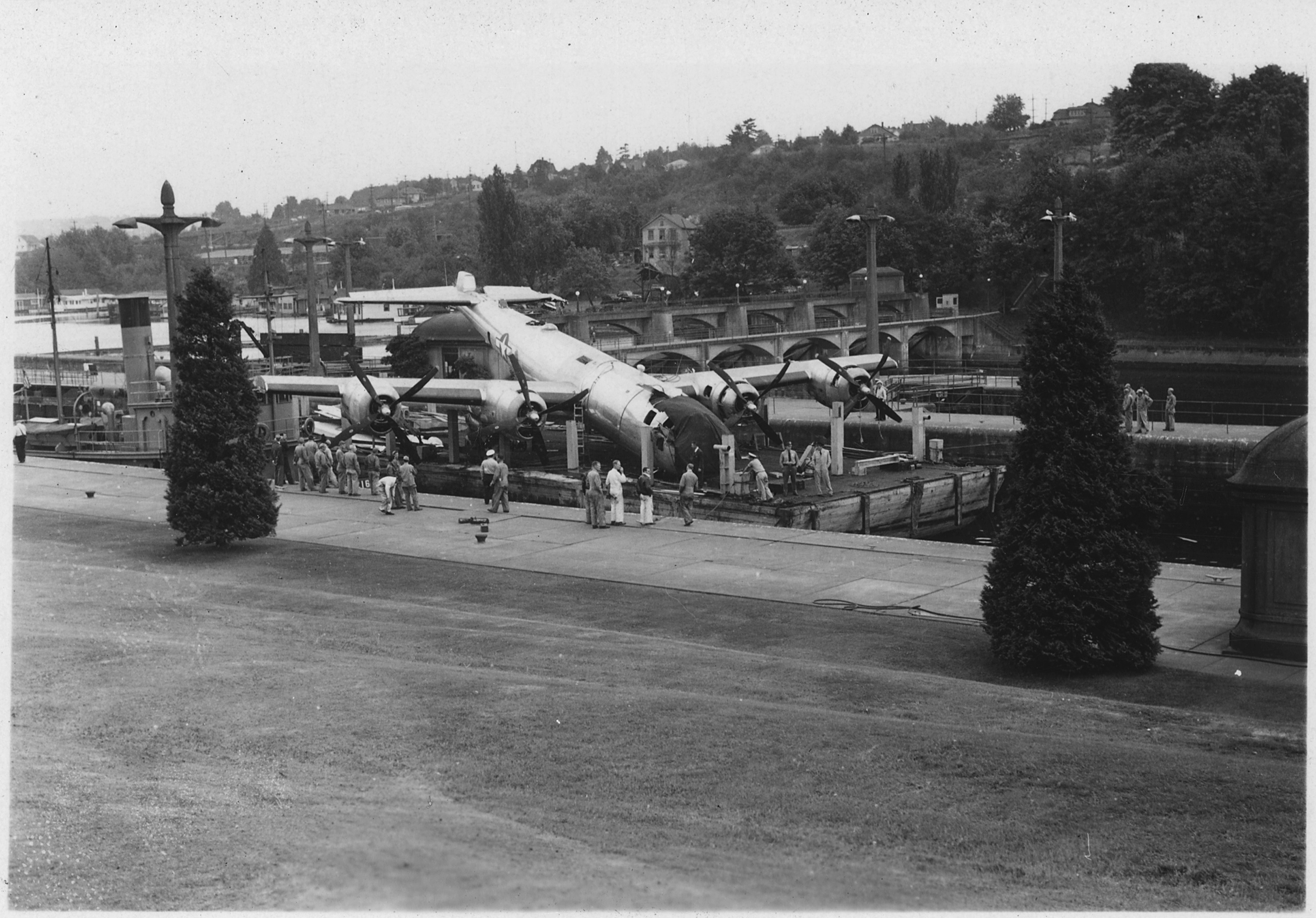
World War II transformed Seattle into an arsenal of democracy. Boeing became the city's largest employer, and Seattle and Renton together produced 8,200 aircraft, including 6,981 B-17 Flying Fortresses and more than 1,000 B-29 Superfortress bombers. Puget Sound shipyards employed tens of thousands building destroyers, escort carriers, and freighters. The war also displaced Seattle's Japanese American community -- 7,000 people relocated to internment camps, emptying Japantown, then the second largest in the nation. After the war, Boeing pivoted to commercial jet aircraft, and the company's dominance defined the city for another generation. Then it collapsed. Between 1968 and 1971, Boeing's Commercial Airplane Group shrank from 83,700 employees to 20,750. Unemployment hit 14 percent. Housing vacancy soared to 16 percent. U-Haul ran out of trailers. A famous billboard near the airport read: 'Will the last person leaving Seattle turn out the lights?'
Reinvention on Repeat
But Seattle did not die. The 1962 World's Fair left behind Seattle Center, the Space Needle, and the Pacific Science Center, reenergizing a flagging downtown. Pioneer Square and Pike Place Market -- saved from demolition by architect Victor Steinbrueck's 1971 preservation initiative -- became anchors of a new urban identity. The market, which had lost 80 percent of its wet-stall vendors to Japanese American internment during the war, now draws over 10 million visitors per year. Then came Microsoft. In 1979, Bill Gates and Paul Allen moved their small company from New Mexico to the suburbs of their native Seattle. By 1995, Microsoft was the world's most profitable corporation, and thousands of employees were millionaires who went on to seed an entire technology ecosystem. Amazon, Starbucks, and Nordstrom extended Seattle's reach worldwide. Paul Allen, for his part, pushed through a football stadium for the Seahawks and founded the Experience Music Project as a tribute to Jimi Hendrix.
The Emerald City from Above
Seattle's story is written in its geography. From the air, the Olmsted-designed parks and boulevards that lace the city trace back to the early 1900s boom. The Ship Canal connecting Puget Sound to Lake Washington is visible as a straight scar through the urban grid, with the Hiram Chittenden Locks marking the threshold between salt and fresh water. The dark cluster of downtown glass towers gives way to neighborhoods of single-family homes spreading across seven hills. Harbor Island sits at the Duwamish mouth, an entirely artificial landmass built from the spoils of hills that no longer exist. Every feature tells a chapter of the boom-and-bust cycle that has defined Seattle for 170 years.
From the Air
Located at 47.60N, 122.33W on the eastern shore of Puget Sound. Seattle-Tacoma International Airport (KSEA) lies 13 miles south; Boeing Field/King County International Airport (KBFI) is just south of downtown. The Space Needle and downtown skyline are prominent visual landmarks from 3,000-5,000 feet AGL. Elliott Bay, Lake Union, and the Lake Washington Ship Canal provide excellent geographic orientation. Mount Rainier dominates the southern horizon in clear weather.