Hitachi Seaside Park: From Bombing Range to Blue Flower Fields
Every April, a hill in Ibaraki Prefecture turns the color of the sky. Four and a half million nemophila -- baby blue-eyes -- bloom across Miharashi no Oka at Hitachi Seaside Park, their translucent petals so closely matched to the spring sky above that the horizon line dissolves. Visitors climbing the hill appear to walk into the atmosphere itself. It is one of the most photographed landscapes in Japan, and also one of the most unlikely. The ground beneath those flowers was once the Mito-Higashi Airbase, a Japanese military installation during World War II. After Japan's surrender in 1945, the United States military confiscated the land and used it as a bombing practice range. For decades, this hilltop held ordnance craters, not flower beds. The transformation from military ruin to botanical spectacle is the central story of Hitachi Seaside Park.
From Airbase to Bombing Range to Parkland
The land that became Hitachi Seaside Park carries the scars of the twentieth century. During World War II, the site served as the Mito-Higashi Airbase, a military installation for the Japanese armed forces. After Japan's surrender, the U.S. Air Force confiscated the property and converted it into a bomb-training ground. For nearly three decades, the land sat under foreign military control. Local campaigns to reclaim the site persisted, and after more than ten years of demanding reversion, the land was finally returned to the Japanese government in 1973. Planning for the park began in 1979, construction started in 1984, and the first 70 hectares opened to the public on October 5, 1991. The decision to build a flower park on a former bombing range was deliberate -- a symbol of peace and renewal on land that had known only military purpose.
The Blue Hill
The nemophila display is the park's signature. Each spring, during the event called Nemophila Harmony, 4.5 million baby blue-eyes flowers bloom simultaneously on Miharashi no Oka -- the park's main hill. Nemophila (Nemophila menziesii) is an annual wildflower native to North America, with small five-petaled blooms so pale and translucent they seem to glow. Planted densely across the hillside, they create an unbroken field of blue that merges with the Pacific sky at the crest. The effect is disorienting and beautiful: depth perception fails where flowers meet horizon. The bloom typically runs from mid-April through early May, drawing hundreds of thousands of visitors from across Japan and beyond. What makes the display remarkable is its scale -- not a garden bed, not a cultivated border, but an entire hillside engineered to disappear into the color blue.
Four Seasons of Transformation
Hitachi Seaside Park does not rest between nemophila seasons. The 190-hectare park cycles through color all year. Spring opens with a million daffodils and 170 varieties of tulips before the nemophila take over. Summer brings roses and zinnias. But autumn delivers the park's second visual spectacle: the kochia. Thousands of Bassia scoparia -- round, bushy plants that look like green puffballs through summer -- begin their transformation in October, turning from vivid green to blazing crimson. The kochia fields on Miharashi no Oka glow red against the autumn sky, a dramatic counterpoint to the cool blue of spring. Cosmos flowers bloom alongside the kochia, adding purples and pinks to the hillside. The park is a landscape designed to be perpetually in the act of becoming something else.
Music, Wheels, and Coastal Air
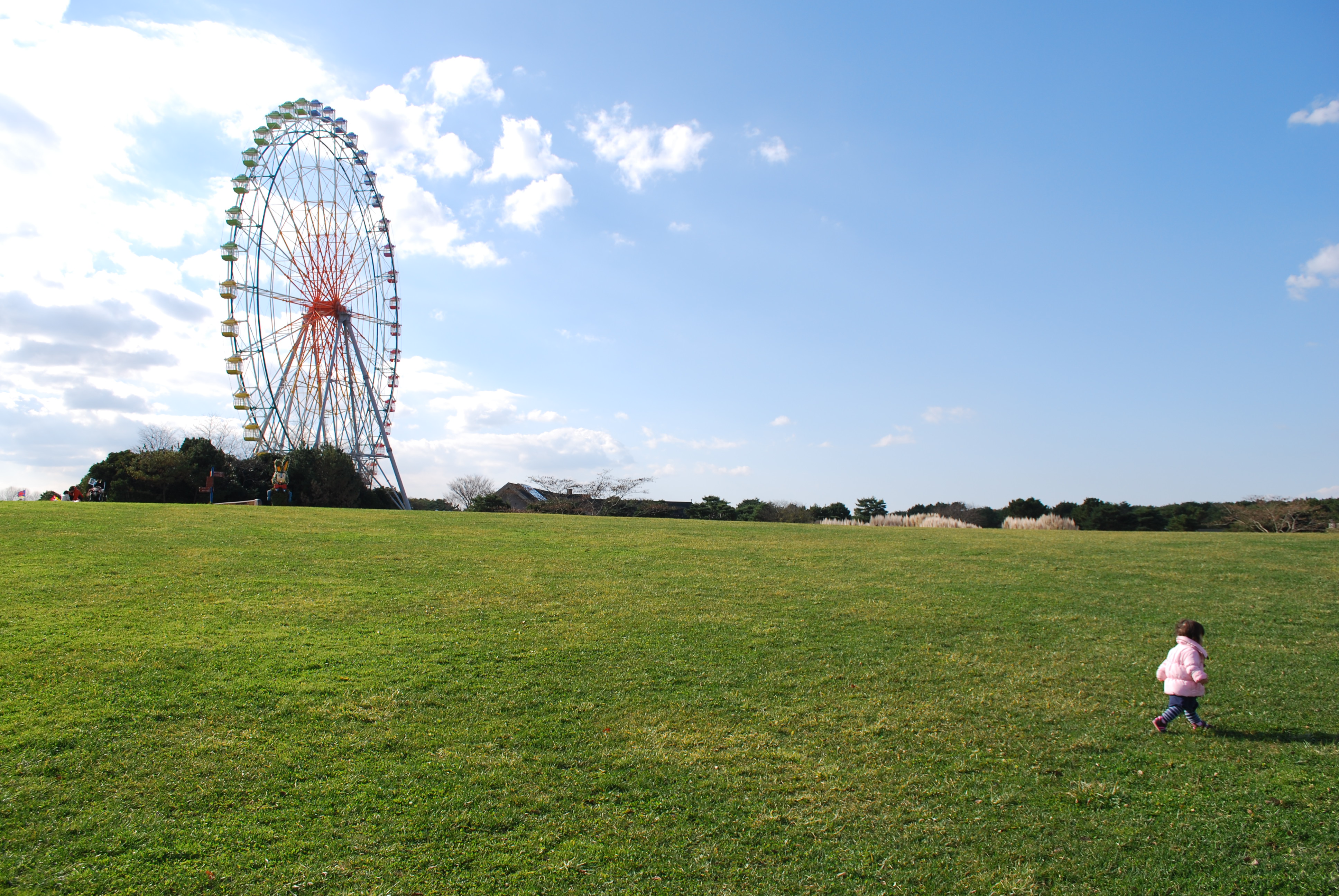
Beyond the flower fields, Hitachi Seaside Park holds a small amusement area with a Ferris wheel that offers elevated views across the plantings and out to the Pacific coastline. Cycling trails thread through the park's seven distinct zones, covering terrain that ranges from forest groves to open meadows. The park previously hosted the Rock in Japan Festival, one of the country's largest music festivals, held each August with stages set among the greenery. The nearest railway station is Ajigaura Station on the Minato Line of the Hitachinaka Seaside Railway, reached via Katsuta Station on the JR Joban Line. The coastal setting means salt air and sea breezes are constant companions to the flower viewing -- a reminder that this botanical park sits at the edge of the Pacific, on land that has traveled a long road from airstrip to bombing range to one of the most beautiful public gardens in Japan.
From the Air
Located at 36.40°N, 140.59°E on the Pacific coast of Ibaraki Prefecture, just north of Hitachinaka city. From altitude, the park's 190 hectares are visible as a large green expanse along the coastline, distinct from the surrounding urban grid. During nemophila season (mid-April to early May), the blue flower fields on Miharashi no Oka hill are potentially visible as a color anomaly from lower altitudes. During autumn, the red kochia fields create a similar effect. Ibaraki Airport / Hyakuri Air Base (RJAH) lies approximately 20 nautical miles to the south. The park sits adjacent to the Pacific coast, with Ajigaura Beach to the north. Best viewed at 2,000-4,000 feet AGL for the color contrast between the flower fields and surrounding landscape.