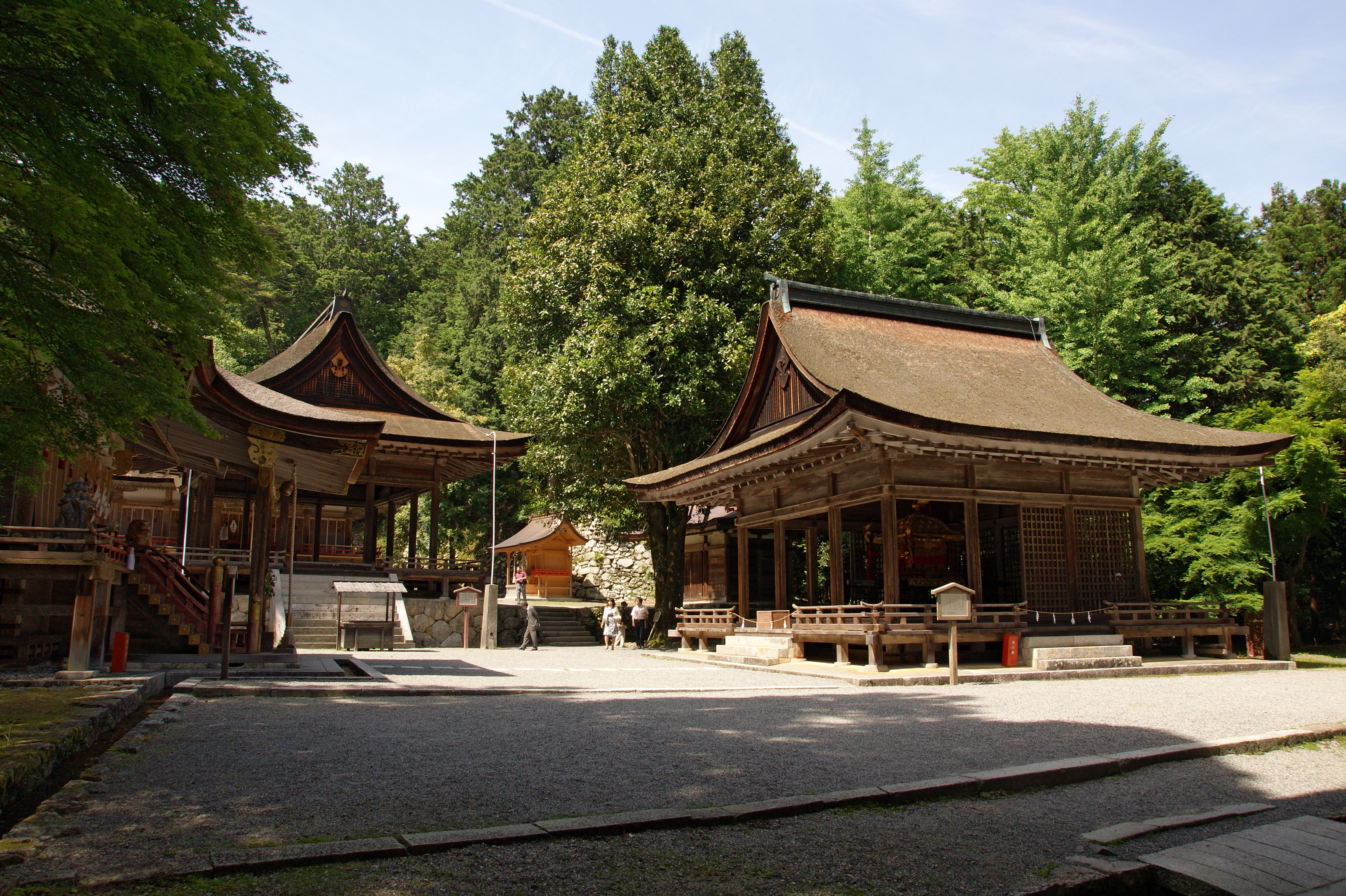
Hiyoshi Taisha: The Mountain God's Shrine at the Foot of Hiei
The Kojiki, Japan's oldest surviving historical text, records a god named Oyamakui residing on Mount Hiei. That mention, written in the eighth century, points to a tradition already ancient by the time brush met paper. According to the shrine's records, the kami was relocated from the mountain's summit to its present location at the base during the reign of the semi-legendary Emperor Sujin -- a date the traditional calendar places at 90 BC. Whether or not that precise year can be verified, Hiyoshi Taisha's claim to antiquity is not contested. This is one of the oldest sacred sites in Japan, the head of a network of approximately 3,800 shrines spread across the country, all sharing the distinctive Sanno torii -- a gate unlike any other in the Shinto world, crowned by a triangular gaggle above the main crossbeam.
A Capital's Guardian
In 668 AD, Emperor Tenji moved the imperial capital to Omi Province and built the Otsu Palace near the shores of Lake Biwa. A capital needed spiritual protection, and the kami of Omiwa Shrine in Yamato Province -- the traditional protector of the imperial dynasty -- was relocated and installed in a new sanctuary, the Nishi Hongu (West Main Hall). The original sanctuary housing Oyamakui became the Higashi Hongu (East Main Hall). This dual structure defines Hiyoshi Taisha to this day: two main halls, two principal deities, two strands of spiritual authority woven together at the foot of one mountain. When the capital moved again to Heian-kyo in 794, the shrine's role only intensified. Enryaku-ji, the massive Tendai Buddhist complex on the summit of Mount Hiei, made Hiyoshi Taisha the guardian of the northeast quadrant -- the direction from which, in traditional cosmology, evil spirits approach.
When Buddha and Kami Merged
The relationship between Hiyoshi Taisha and Enryaku-ji is one of the most remarkable in Japanese religious history. In 788 AD, the monk Saicho -- who would introduce the Tendai sect of Mahayana Buddhism to Japan from China -- erected his temple complex on the slopes of Mount Hiei directly above the shrine. As Enryaku-ji grew into one of the most powerful religious institutions in the country, commanding at its peak as many as 3,000 sub-temples and an army of warrior monks, Hiyoshi Taisha was gradually absorbed into its orbit under the Shinbutsu-shugo policy of Buddhist-Shinto amalgamation. The shrine's kami came to be worshipped as Sanno Gongen -- a Buddhist manifestation. As Enryaku-ji missionaries built temples across Japan, they spread the Sanno faith with them. Each new temple brought a new affiliated Hie shrine. That is how a single sanctuary at the base of a mountain in Shiga Prefecture became the mother shrine of nearly 3,800 worship sites nationwide.
Imperial Messengers and Sacred Rank
In 965, Emperor Murakami ordered that Imperial messengers carry reports of important national events to the guardian kami of Japan. Hiyoshi Taisha was not among the original sixteen shrines receiving these dispatches -- but its importance was growing. In 1039, Emperor Go-Suzaku added Hie Taisha to the list, bringing the total to the number enshrined in the system of Twenty-Two Shrines. That number has never been altered since. The shrine's 400,000-square-meter precincts are today designated a National Historic Site. Both the east and west main shrine buildings -- the Higashi Hongu and Nishi Hongu -- are designated National Treasures, rebuilt in 1586 in their present form. Numerous other structures within the grounds, including the subsidiary shrines of Usa-gu, Juge Jinja, Sannomiya-gu, and Shirayama-gu, carry the designation of National Important Cultural Properties.
The Torii That Sets Hiyoshi Apart
Every Shinto shrine has a torii gate, but visitors to Hiyoshi Taisha immediately notice something different. The Sanno torii is unique in Japanese shrine architecture: a standard torii frame topped by a triangular element -- the gaggle -- rising above the main crossbeam like a small gable. This distinctive form became the visual signature of the entire Hiyoshi-Hie-Sanno shrine network. Across Japan, from Hokkaido to Kyushu, nearly 3,800 shrines share this design, making it one of the most widely replicated architectural features in the country. At Hiyoshi Taisha itself, the torii takes on particular beauty during the annual Momiji Matsuri -- the Maple Festival -- when autumn leaves frame the gate in crimson and gold. The shrine grounds, thick with Japanese maples, become a corridor of color each November, drawing visitors who come for the foliage as much as for the sacred.
Two Millennia at the Mountain's Foot
Hiyoshi Taisha occupies a position that is both geographically precise and spiritually vast. It sits at the eastern foot of Mount Hiei, in the city of Otsu on the western shore of Lake Biwa -- Japan's largest lake. The mountain rises directly behind the shrine, its forested slopes still home to the temples of Enryaku-ji. The lake stretches out to the east. Between mountain and water, the shrine holds its ancient ground. Its two main halls house two lineages of divine authority: the original mountain kami and the relocated protector of emperors. Its network of nearly 3,800 affiliated shrines reaches into every corner of Japan. Its torii gates, with their distinctive peaked crowns, stand as markers of a faith that has been continuous -- through the rise and fall of warrior monks, through the separation of Buddhism and Shinto in the Meiji era, through two world wars -- for what may well be more than two thousand years.
From the Air
Located at 35.07N, 135.86E at the base of Mount Hiei in Otsu, Shiga Prefecture, on the western shore of Lake Biwa. From altitude, the shrine's 400,000-square-meter precincts are visible as a large forested compound at the mountain's eastern foot, with Lake Biwa -- Japan's largest lake -- stretching to the east. Mount Hiei (848 meters) rises directly behind the shrine, with the rooftops of Enryaku-ji visible on its slopes. Best viewed at 3,000-5,000 feet AGL from the east, with Lake Biwa in the foreground and the mountain behind. Nearest major airport is Osaka Itami (RJOO), approximately 25 nautical miles southwest. Kansai International (RJBB) lies approximately 55 nautical miles south. The city of Kyoto is on the opposite (western) side of Mount Hiei.