HMAS Torrens (DE 53)
The most famous image of HMAS Torrens is the one that shows her dying. A torpedo strikes amidships, the hull buckles, and the bow and stern rise toward each other like a closing book before the Indian Ocean swallows the whole vessel. That footage, filmed off the Western Australian coast in June 1999, was so dramatic that the producers of the 2001 film Pearl Harbor digitally edited it into a black-and-white newsreel sequence. Hezbollah later used a still photograph of the explosion on a propaganda website, claiming it showed an Israeli warship destroyed by a missile strike. In both cases, the real ship and her 27-year career vanished behind the spectacle of her end.
Built from a Collision's Shadow
Torrens existed because of disaster. She and her sister ship were ordered in 1964 as replacements for HMAS Voyager, a destroyer lost in a collision with the aircraft carrier HMAS Melbourne that same year -- one of the Royal Australian Navy's worst peacetime tragedies. The original plan called for ships identical to the previous River-class destroyer escorts, themselves based on the British Type 12 frigate. But from 1965 onward, the design evolved to incorporate improvements from the British Leander class, and the changes kept coming even as construction was underway. Work began at the Cockatoo Docks and Engineering Company in Sydney on 18 August 1965, without finalized specifications or a formal contract. The evolving design caused delays and cost overruns that planners had not anticipated. Dame Zara Holt launched the ship on 28 September 1968, and Torrens was commissioned into the RAN on 19 January 1971. She would be the last major warship built in an Australian shipyard until 1985.
A Career Spanning Oceans
Torrens spent most of her early years based in Sydney, conducting exercises along Australia's eastern coast in the Eastern Australia Exercise Area and Jervis Bay. Her deployments took her throughout Southeast Asia -- Singapore, Malaysia, Thailand, Hong Kong, the Philippines -- on the training exercises and port visits that define peacetime naval life. But she also touched the edges of conflict. In late February 1972, barely a year after commissioning, Torrens escorted a troopship on its twenty-fourth and final voyage in support of the Vietnam War. The ships arrived in Vung Tau on 28 February, collected 457 Australian soldiers, and departed the next day for home. In September 1975, she sailed to Rabaul for Papua New Guinea's independence celebrations, marking the peaceful end of Australia's colonial administration. And in August 1976, she and HMAS Melbourne interrupted work-up exercises to assist a vessel in distress off Bundaberg, Queensland -- the kind of unglamorous rescue work that fills far more of a warship's logbook than combat ever does.
Westward and Down
In the later part of her career, Torrens transferred to HMAS Stirling on Garden Island in Western Australia, shifting her home port from one coast to the other. She was decommissioned in 1998 after 27 years of service. The Navy decided to put her to one final use: as a torpedo target. In June 1999, a submarine fired the weapon that broke her back off the Western Australian coast. The footage captured that day became her most enduring legacy, though not in ways anyone at the Navy had planned. Michael Bay's production team spliced digitally altered versions of the sinking into Pearl Harbor's faux-newsreel montage. Then, in July 2006, a Hezbollah-operated website published a photograph of the explosion, claiming it proved that a Hezbollah missile had sunk an Israeli warship. The image of an Australian destroyer escort, decommissioned and deliberately scuttled as target practice, had been repurposed as propaganda in a Middle Eastern conflict.
What Remains
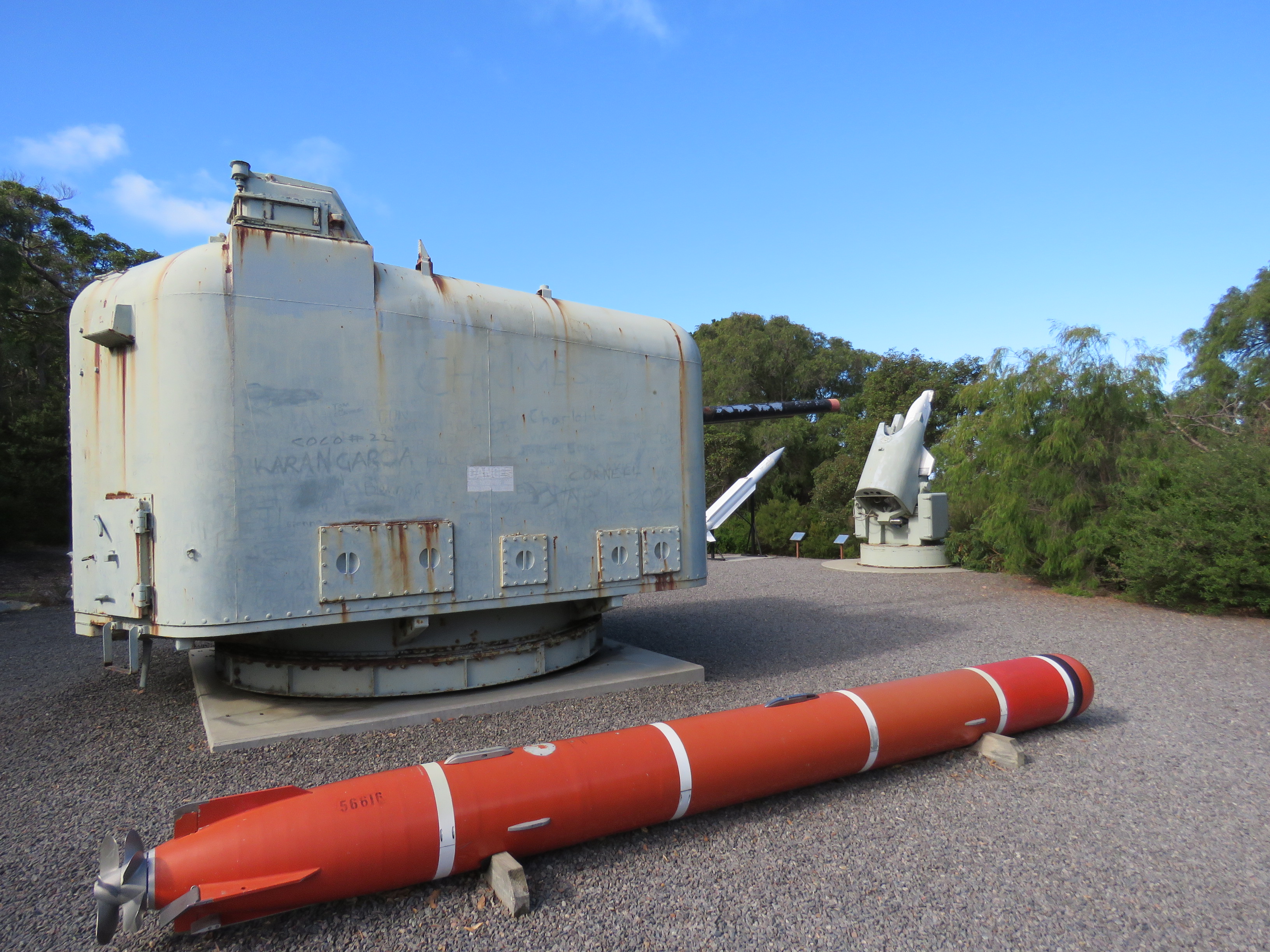
Torrens now rests on the seabed off Western Australia, her hull split where the torpedo struck. She has become an artificial reef, her steel framework colonized by marine growth in the quarter century since her sinking. One piece of her survives above the waterline: her 4.5-inch Mk V gun turret, preserved at the Princess Royal Fortress in Albany, Western Australia -- a military museum in a town that has served as a point of departure for Australian troops since the First World War. The gun sits silent in a fortress overlooking King George Sound, the last tangible fragment of a ship whose story spans the aftermath of a peacetime collision, the end of the Vietnam War, the birth of a new Pacific nation, and an afterlife in Hollywood special effects and Middle Eastern propaganda. It is a strange and layered legacy for a vessel that spent most of her career doing exactly what navies mostly do: training, patrolling, and showing the flag.
From the Air
HMAS Torrens was sunk off the Western Australian coast near 31.78S, 114.78E, northwest of Perth. The wreck site lies in open water west of Garden Island and HMAS Stirling naval base. From the air, Garden Island and the Fremantle coastline are the nearest visible landmarks. Perth Airport (YPPH) is the major airport to the east; RAAF Base Pearce (YPEA) lies to the north. The Princess Royal Fortress where her gun turret is preserved is in Albany (YABA), approximately 400 km to the southeast. Best viewed at low altitude over the coast, though the wreck itself is submerged.