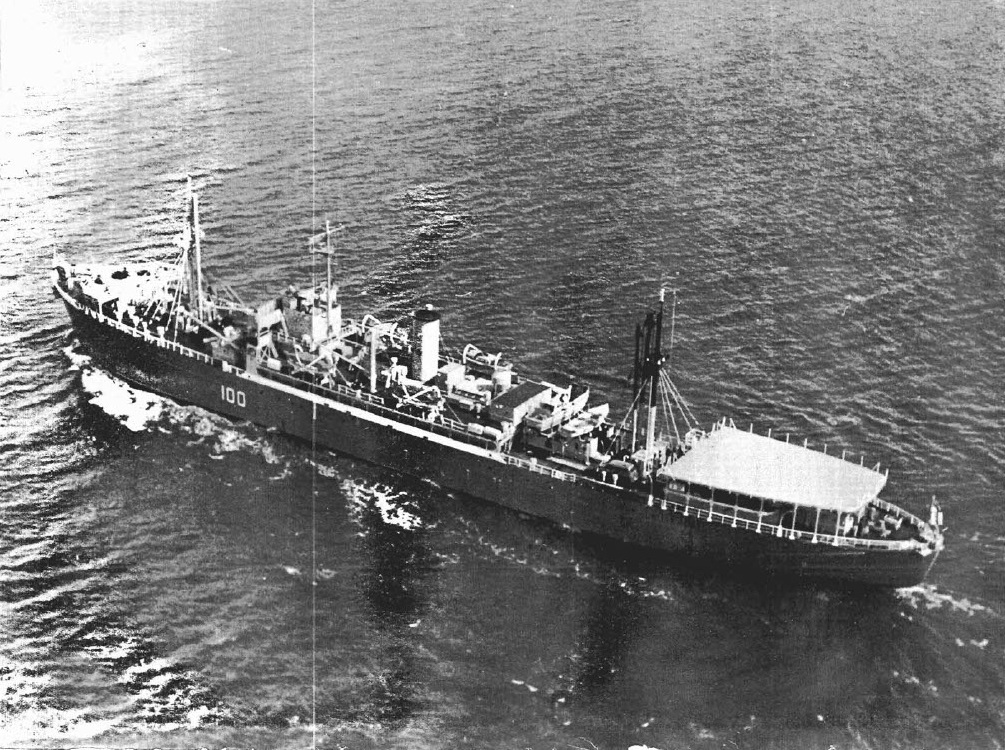
HMCS Cape Breton: From Warship to Reef
Forty feet below the surface of Nanaimo Harbour, the crow's nest of HMCS Cape Breton reaches toward daylight. One hundred feet down, her main deck stretches into the green darkness. At 145 feet, her keel rests on the seafloor near Snake Island, exactly where the Artificial Reef Society of British Columbia placed her on October 20, 2001. She sank upright - a final act of dignity for a ship that spent 57 years in service under two navies, two names, and at least three entirely different careers.
Born as Flamborough Head
She was laid down on July 5, 1944, at Burrard Dry Dock in Vancouver, one of 21 Beachy Head-class maintenance ships built for the Royal Navy during World War II. Launched on October 7 that same year as HMS Flamborough Head, she was a modified Victory-design vessel: 441 feet long, 57-foot beam, displacing 11,270 long tons fully loaded. A single triple-expansion steam engine powered by two Foster Wheeler boilers gave her a modest top speed of 11 knots - she was never built for speed. In British service, she carried sixteen Oerlikon 20mm cannons. Her purpose was not to fight but to fix: she was a mobile repair ship, designed to keep other vessels in the war.
A Second Life in Canadian Service
Transferred to the Royal Canadian Navy in 1952 and rechristened HMCS Cape Breton, the ship was converted into something remarkable - a floating industrial complex. Engineers installed a decompression chamber, a helicopter landing pad for Sikorsky H04S helicopters, and workshops for every conceivable trade: engineering, diesel repair, sheet metal, welding, coppersmithing, and electronics. She carried an eight-berth hospital with an X-ray room, medical lab, dental clinic, and laboratory. With a complement of 270, she was a self-contained repair facility that could sail to wherever the fleet needed her. Her ship's bell served double duty: between 1959 and 1971, it was used for the baptism of babies born aboard - a tradition now documented by the Christening Bells Project at CFB Esquimalt.
Paid Off and Put to Pasture
On February 10, 1964, Cape Breton was paid off into the reserve as part of cost-cutting measures. But the navy was not finished with her. For the next three decades, she served as a towed support facility and accommodation vessel at Esquimalt, sitting quietly in the harbor while the world changed around her. In 1993, a shore building finally replaced her, and the ship was sold to the Artificial Reef Society of British Columbia. The transition from warship to reef required extensive cleaning to meet Environment Canada's environmental standards - every trace of hazardous material had to be stripped from the hull before she could be allowed to sink.
A Ship Finds Her Final Purpose
On October 20, 2001, everything but a short section of her stern and her engines went to the bottom near Snake Island in Nanaimo Harbour. She settled upright, creating one of British Columbia's premier scuba diving sites. Divers can explore her decks at multiple depths, from the crow's nest at 40 feet to the main deck at 100 feet to the deepest sections at 145 feet. The stern section was donated to North Vancouver, placed on the waterfront with plans for a maritime museum. Those plans collapsed in 2007 for lack of funding, and in September 2013 the city council voted to dismantle it. The ship's legacy lives on underwater, in the CFB Esquimalt museum where her christening bell is held, and in the name of Fleet Maintenance Facility Cape Breton, formed at Esquimalt in 1996.
From the Air
The HMCS Cape Breton reef site is at approximately 49.21°N, 123.88°W, near Snake Island in Nanaimo Harbour. From altitude, Snake Island is visible as a small rocky islet northeast of Protection Island. The reef itself is not visible from the air, but the dive boats that frequent the site often are. Nanaimo Harbour Water Aerodrome (CAM9) is nearby in downtown Nanaimo. Nanaimo Airport (CYCD) is approximately 15 km south. The harbour is sheltered by Newcastle, Protection, and Gabriola Islands.