HMHS Glenart Castle
John Hill, a fisherman on the Swansea Castle, saw her in the small hours of 26 February 1918, lit up in the darkness of the Bristol Channel. Green lights ringed the saloon. Red sidelights burned at the port and starboard. A Red Cross lamp glowed from the mast. There was no mistaking what she was. But sometime before four in the morning, a torpedo from the German submarine UC-56 struck the No. 3 hold of HMHS Glenart Castle, and within minutes the hospital ship that had survived a mine strike the year before was going down. Of the 182 people aboard, only 29 would survive.
A Ship with Nine Lives
The vessel had been built in 1900 as the Galician, a steamship for the Union-Castle Line. When Britain entered the First World War on 4 August 1914, she was intercepted the very next day west of the Canary Islands by a German-flagged ship. Officers boarded her, searched her papers, took two Army passengers prisoner, and let her go. By October 1914 she had been requisitioned, refitted as a hospital ship, and renamed Glenart Castle. For three years she carried the wounded across the English Channel and beyond. Then, on 1 March 1917, she struck a mine northwest of the Owers Lightship. The explosion near the rear starboard warped the watertight doors so badly they could not seal. The boiler room and No. 4 hold flooded. Captain Day ordered evacuation. All 708 people aboard -- 115 crew, 68 medical staff, and 525 patients -- were saved, and the crippled ship was towed into Portsmouth. After eight months of repair, Glenart Castle returned to service in November 1917.
The Last Voyage
On 25 February 1918, Glenart Castle departed Newport in South Wales, heading for Brest, France, to collect patients. She was empty of wounded, carrying only her crew and medical staff. Under the Hague Convention, hospital ships were to be clearly marked and immune from attack. Glenart Castle was ablaze with identification lights. None of it mattered. Kapitanleutnant Wilhelm Kiesewetter, commanding UC-56, fired anyway. The torpedo struck the forward hold. Captain Bernard Burt gave the order 'Every Man For Himself' before he was last seen retiring to the chart room. He went down with his ship. Ninety-five of 120 crew died. Both chaplains perished. Forty-eight of 52 Royal Army Medical Corps personnel were killed. All eight nurses of the Queen Alexandra's Imperial Military Nursing Service drowned, including Matron Kate Beaufoy, a veteran of the Boer War and the Gallipoli campaign who had nursed at hospitals in Cairo and Alexandria before joining Glenart Castle.
Evidence in the Water
What happened after the torpedo hit may have been even more damning than the attack itself. Newspaper reports at the time suggested that the submarine fired on survivors in the water, attempting to eliminate witnesses to the sinking of a protected vessel. The body of a junior officer recovered near the wreck site bore two gunshot wounds -- one in the neck, one in the thigh -- despite wearing a life vest, indicating he had been shot while floating. Whether Kiesewetter ordered the shooting or whether it occurred at all remains debated, but the British Admiralty took the allegation seriously enough to pursue the UC-56 commander after the war. Kiesewetter was arrested on his voyage home to Germany and interned in the Tower of London, though he was ultimately released. The wreck of Glenart Castle lies in 240 feet of water approximately ten miles west of Lundy Island, at 51 degrees 7 minutes north, 5 degrees 3 minutes west.
Remembering the Lost
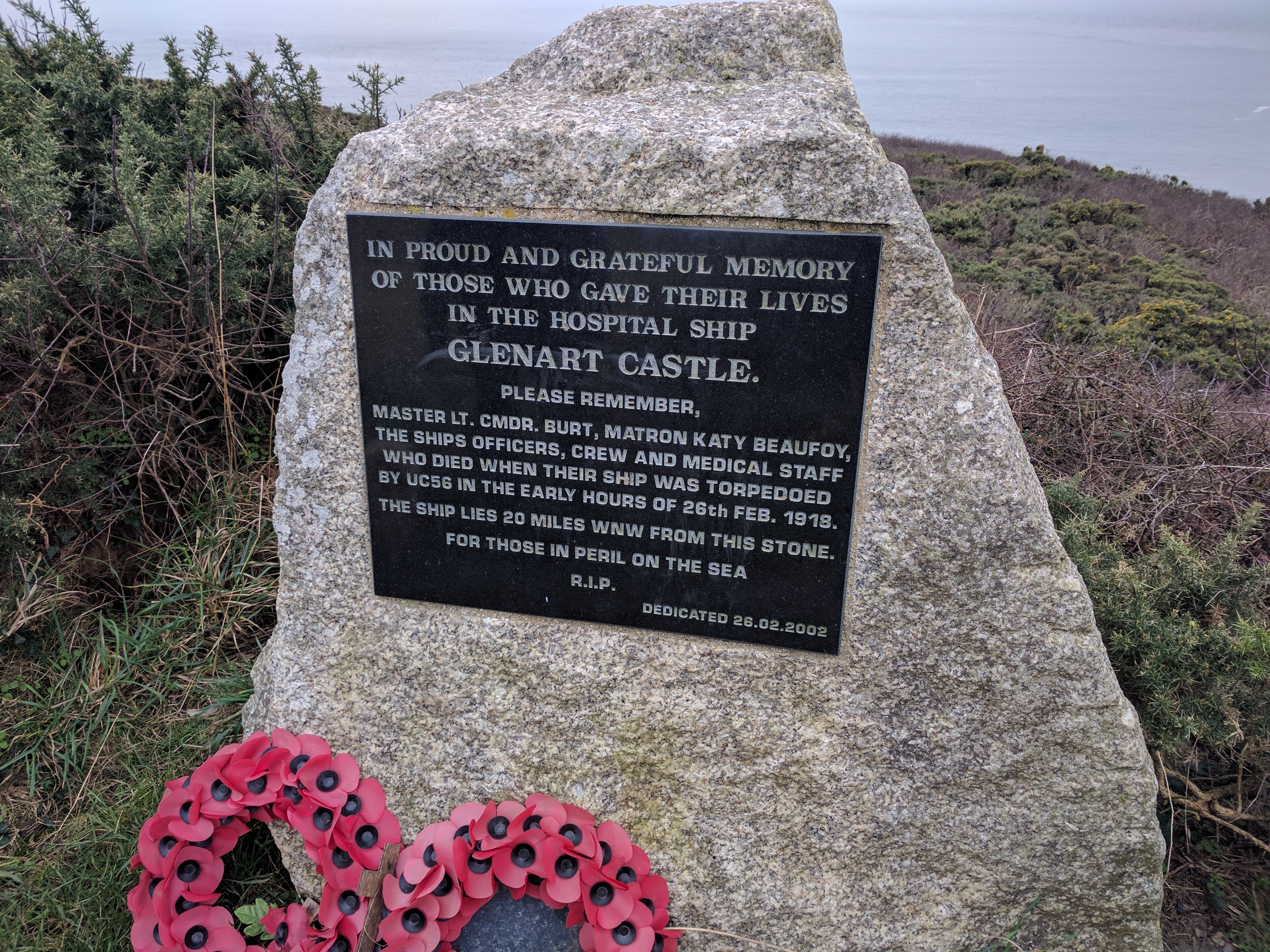
For decades the sinking receded into the long catalog of wartime losses. Then, on the 84th anniversary of the attack, 26 February 2002, a memorial plaque was dedicated near Hartland Point, facing the stretch of sea where Glenart Castle went down. The inscription names Captain Burt, Matron Beaufoy, the officers, crew, and medical staff, and closes with the seafarer's prayer: 'For those in peril on the sea.' In 2013, Fiona MacDonald founded the Scottish military charity Glen Art in honor of her great-aunt, nurse Mary McKinnon, who died aboard the ship. On the centenary of the sinking in February 2018, Glen Art held a memorial concert in Arisaig, Scotland, to remember McKinnon and every life lost in the Bristol Channel that night. Kate Beaufoy's family preserved her diary and letters home, documents that describe not just the sinking but the daily texture of wartime nursing -- the exhaustion, the compassion, the constant proximity to death. She nursed wounded soldiers, and she nursed German prisoners. The torpedo made no such distinctions.
From the Air
The wreck lies at approximately 51.12N, 5.05W in the Bristol Channel, about 10 miles west of Lundy Island. The memorial plaque is near Hartland Point on the North Devon coast. Nearest airports: Chivenor (decommissioned RAF, EGDC area) and Exeter (EGTE). Best viewed at low altitude over the Bristol Channel for a sense of the open water where the sinking occurred.