HMHS Llandovery Castle
"Sergeant, do you think there is any hope for us?" Matron Margaret Fraser asked the question calmly, even as the lifeboat drifted helplessly toward the sinking stern of the hospital ship. Seconds later, the suction pulled fourteen Canadian nurses into the Atlantic. Not one resurfaced. The sinking of HMHS Llandovery Castle on the night of 27 June 1918, off the southern coast of Ireland, was not merely a maritime disaster. It was a deliberate act of violence against a vessel protected by international law, and the machine-gunning of survivors in the water afterward made it one of the most reviled atrocities of the First World War.
A Ship Marked for Mercy
Built by Barclay, Curle & Co. in Glasgow and completed in January 1914, Llandovery Castle first sailed between London and Africa for the Union-Castle Line. The war changed everything. Commissioned as a hospital ship on 26 July 1916, she was assigned to the Canadian Forces, equipped with 622 beds and a medical staff of 102. Her hull bore the Red Cross markings required by international law, illuminated at night so that no submarine commander could mistake her purpose. Firing on a hospital ship violated both international law and the standing orders of the Imperial German Navy. On her final voyage, she carried no weapons, no troops, no contraband -- only the wounded and the people who cared for them.
The Attack
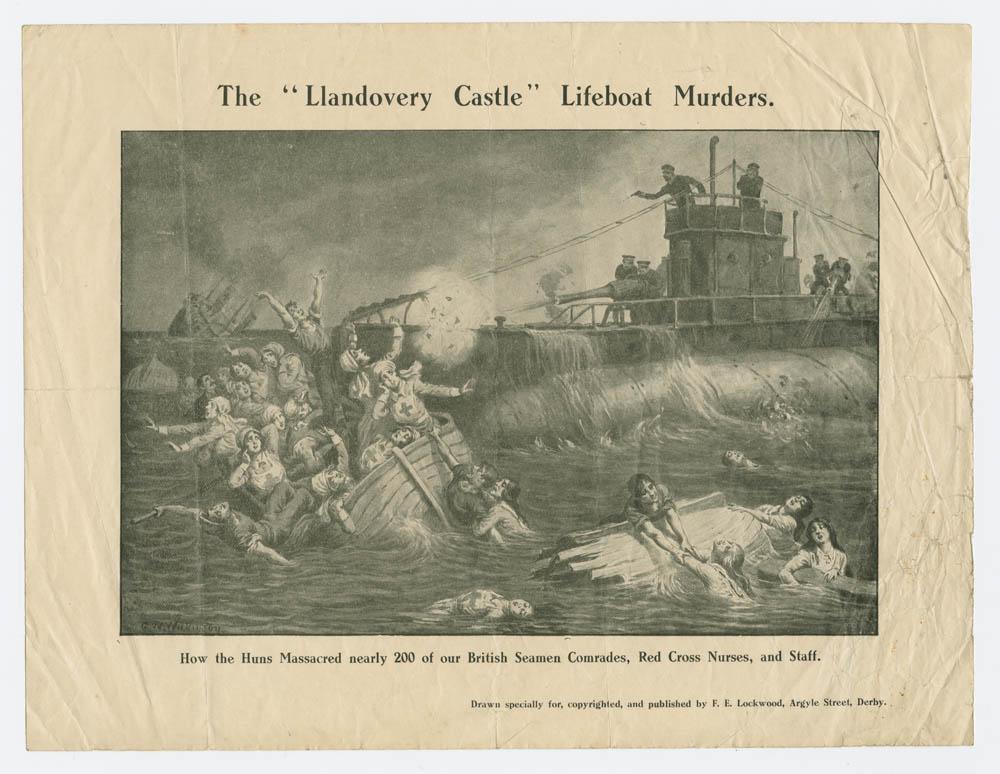
Llandovery Castle was returning from Halifax, Nova Scotia, to Liverpool when U-86, commanded by Kapitanleutnant Helmut Brummer-Patzig, fired a torpedo into her hull approximately 116 miles southwest of Fastnet Rock. The ship began to sink. What followed turned a war crime into a massacre. As 234 passengers -- doctors, nurses, soldiers, and seamen -- struggled into lifeboats, U-86 surfaced. Rather than offer assistance, the submarine deliberately rammed all but one of the lifeboats and machine-gunned the survivors in the water. Brummer-Patzig was trying to eliminate witnesses to what he had done. Of the 258 people aboard, only 24 survived, all clinging to a single lifeboat. A destroyer found them 36 hours later. Among the dead were fourteen nursing sisters from the Canadian Army Medical Corps, including Matron Fraser, the daughter of the Lieutenant Governor of Nova Scotia.
Bodies in the Bristol Channel
Afterward, other ships passed through the wreckage. Kenneth Cummins, an eighteen-year-old midshipman on his first voyage, never forgot what he saw. "We were sailing through floating bodies," he recalled decades later. "We were not allowed to stop -- we just had to go straight through." What haunted him most were the nurses, their aprons and skirts billowing in the water, the fabric dried stiff by the sun so that it looked almost like sails. Sergeant Arthur Knight, who had been in lifeboat number five with the nurses, survived only because he was thrown clear when the boat capsized and managed to cling to debris. He testified that the fourteen women showed no outward evidence of fear, not a single cry for help, during the eight minutes before they were pulled under.
A Verdict Without Justice
After the armistice, three officers from U-86 were charged with war crimes. Brummer-Patzig fled to the Free City of Danzig and was never prosecuted. His subordinates, Ludwig Dithmar and John Boldt, were convicted at the Leipzig War Crimes Trials in July 1921 and sentenced to four years each -- sentences later overturned on the grounds that they were following orders. Outside Germany, the trials were widely condemned as a travesty. The leniency infuriated Canadians. Brigadier George Tuxford, a former homesteader from Moose Jaw, Saskatchewan, had already channelled that fury into battle. Before the assault at Amiens on 8 August 1918, he ordered his men to make "Llandovery Castle" their battle cry -- "that cry should be the last to ring in the ears of the Hun as the bayonet was driven home."
The Name That Endures
Memorial plaques for Matron Fraser and her thirteen fellow nurses stand at CFB Halifax, Montreal General Hospital, and the former Elizabeth Garrett Anderson Hospital in London. In 2018, on the centenary of the sinking, an opera composed by Stephanie Martin premiered in Toronto, its nine scenes following the final hours aboard ship and in the lifeboats before the chorus steps out of time to reflect on what it has witnessed. The wreck itself lies in the Atlantic southwest of Ireland, in waters that still carry the weight of its story. The Llandovery Castle sinking remains the deadliest Canadian naval disaster of the First World War, and a reminder that the laws of war exist precisely for moments when the temptation to violate them is strongest.
From the Air
The sinking site lies at approximately 51.30N, 9.90W, roughly 116 miles southwest of Fastnet Rock off the coast of County Cork, Ireland. The nearest major airport is Cork Airport (EICK), about 130 km to the northeast. Kerry Airport (EIKY) is closer at about 100 km north-northwest. At cruising altitude, the open Atlantic below offers little visual reference, but Fastnet Rock and the Old Head of Kinsale along the Cork coastline serve as prominent landmarks. Best viewed at lower altitudes in clear conditions over the Celtic Sea.