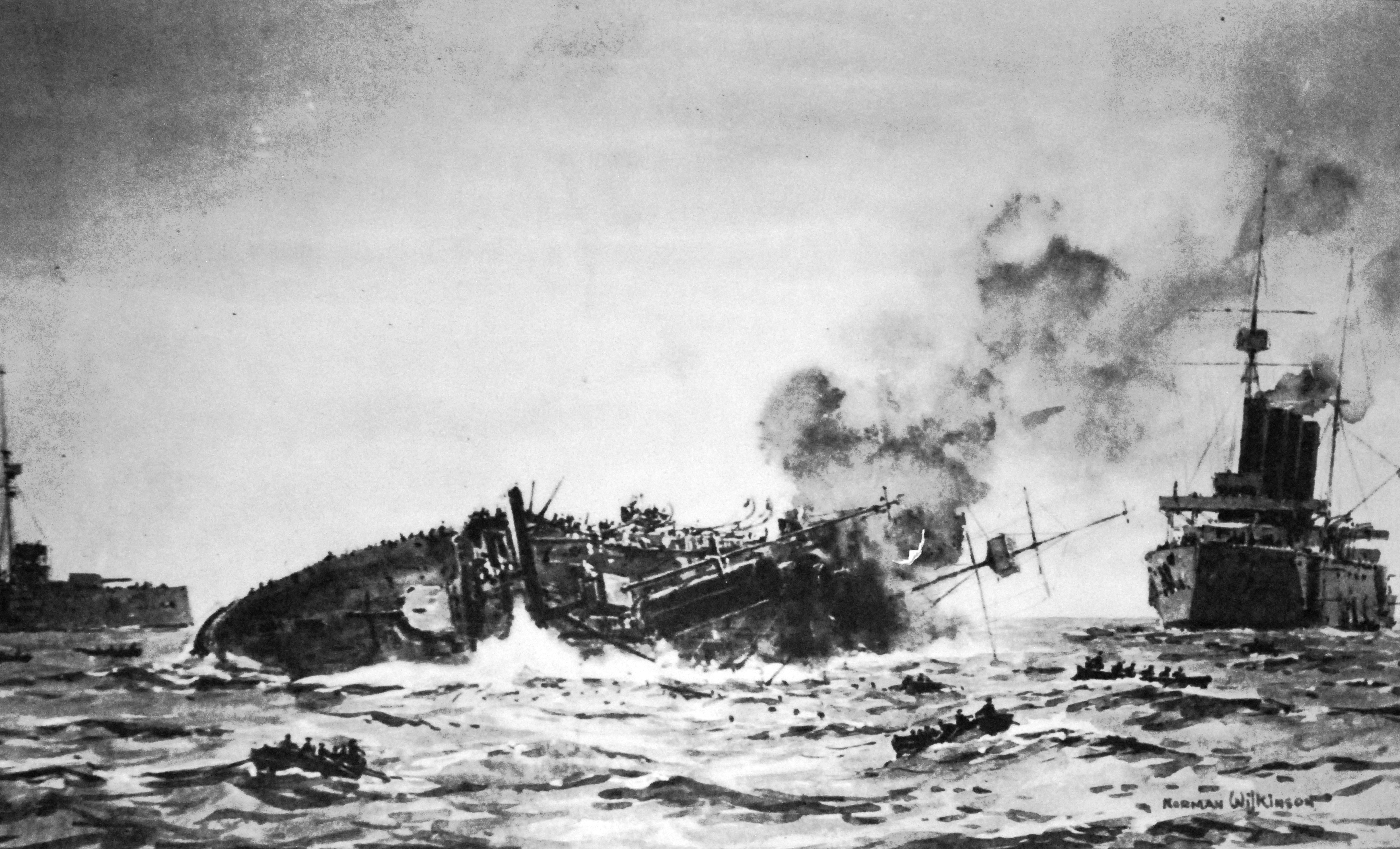
HMS Aboukir
Captain John Drummond had perhaps thirty seconds to make sense of the explosion. Something had struck Aboukir's port side at 06:20 on 22 September 1914 hard enough to flood her engine room instantly and bring her to a dead stop in the southern North Sea. He had not seen a periscope. There had been no torpedo wake. The instructions in his head said the threat in these waters was mines. So he made the order any reasonable senior officer would have made on the evidence in front of him: he signalled the other two cruisers - Hogue and Cressy - to close in and help take off his wounded. It was the wrong order. It was also, in those moments, the only one that the past fifty years of naval doctrine had prepared him to give. The cost of being wrong arrived in seventy-five minutes.
The Senior Ship
Aboukir was one of six Cressy-class armoured cruisers - 12,000 long tons, 472 feet long, 69 in the beam, designed for 21 knots and built around the turn of the century. She had two breech-loading 9.2-inch Mark X guns in single turrets fore and aft, twelve 6-inch guns in casemates amidships - eight of those on the main deck and only useable in calm weather - plus a dozen quick-firing 12-pounders for keeping torpedo boats at a distance, three Hotchkiss 3-pounders, and two submerged 18-inch torpedo tubes. She fitted out at Portsmouth Dockyard in March 1901, commissioned on 3 April 1902, and went to Malta with the Mediterranean Fleet. She served there in two long deployments - 1902 to 1905 and 1907 to 1912 - then returned home and was reduced to reserve. In her years on the Mediterranean Station the world had moved past her: oil fuel, turbine engines, and dreadnought-grade armament were all coming in. By 1914 she was, in a real sense, obsolete; what she had to recommend her was that she existed and was available.
Reserve to Patrol
At the outbreak of war in August 1914 Aboukir was recommissioned into the 7th Cruiser Squadron and sent to patrol the Broad Fourteens, supporting the Harwich Force destroyers and submarines that protected the eastern English Channel from German raiders. During the Battle of Heligoland Bight on 28 August she was part of Cruiser Force C, in reserve off the Dutch coast, and saw no action. By the second week of September, two of her sisters - Hogue and Cressy - were patrolling alongside her under Drummond's command. Their escorting destroyers, which would normally have screened them against submarines, had been driven into port by gales. The Admiralty had ordered the cruisers to keep the Broad Fourteens covered until the weather abated. They did. They steamed slowly back and forth, line abreast, 2,000 yards apart, ten knots.
Mine, He Thought
At 06:20 on 22 September 1914 Otto Weddigen's U-9 fired a single torpedo from periscope depth. It struck Aboukir on the port side and opened her up. The engine room flooded; she stopped almost at once and started to list. Drummond had been at sea a long time. He knew how a ship felt when it had taken a torpedo - and he had no warning, no wake, no submarine in sight, no precedent in his career for a U-boat strike in these waters. He concluded he had hit a mine. He signalled Hogue and Cressy to close. The two sister ships did exactly what they had been trained to do: they came to help. Aboukir capsized at 06:55, thirty-five minutes after she was hit. Counterflooding the opposite compartments could not right her. Only one boat could be launched - the rest were either smashed by the explosion or could not be lowered, because there was no steam left to drive the winches. By the time Drummond himself gave the order to abandon ship there was almost nothing left to abandon ship into. He survived; 527 of his men did not.
The Captain's Verdict
The Court of Inquiry was generous and harsh at once. Drummond was criticised for failing to take the anti-submarine precautions the Admiralty had recommended; he was praised for his personal conduct under fire and the way he had organised the abandonment of his ship. The honest reading of that morning is that Drummond was an experienced officer reading a situation that had no precedent in his service - and that his orders failed his men because the navy as a whole had not yet caught up to what submarines could do. The Imperial German Navy itself had been slow to take the U-boat arm seriously: in the first six weeks of the war it had sent ten boats to sea, sunk no warships, and lost two boats. After 22 September that calculation changed on both sides of the North Sea.
The Wreck Off the Hook
Aboukir lies on the seabed of the Broad Fourteens, in roughly thirty metres of water, around 30 nautical miles northwest of the Hook of Holland - in essentially the same patch of sea where she stopped that morning. She is a designated war grave, holding 527 sailors who went down with her or died in the cold sea afterwards. Some were career Royal Navy ratings; many were Royal Naval Reservists - men called from civilian life into service that had killed them within weeks. Salvage operations have worked the three wrecks since 2011, and the families of the dead have repeatedly asked for them to stop. The view from above - flat grey water, the wind coming off the Dutch flats - shows nothing. But Aboukir is the first of three quiet graves down there, and it was the first signal flag that morning that drew the other two on top of her.
From the Air
HMS Aboukir's wreck lies in the southern North Sea near 53.00 N, 3.75 E, in the Broad Fourteens about 30 miles off the Dutch coast. Cruise at FL080-FL100. Amsterdam Schiphol (EHAM) and Rotterdam (EHRD) lie east; Norwich (EGSH) lies west. The wreck is a designated war grave under the UK Military Remains Act - maintain distance from any working vessels on the site.