HMS Blanche (1800)
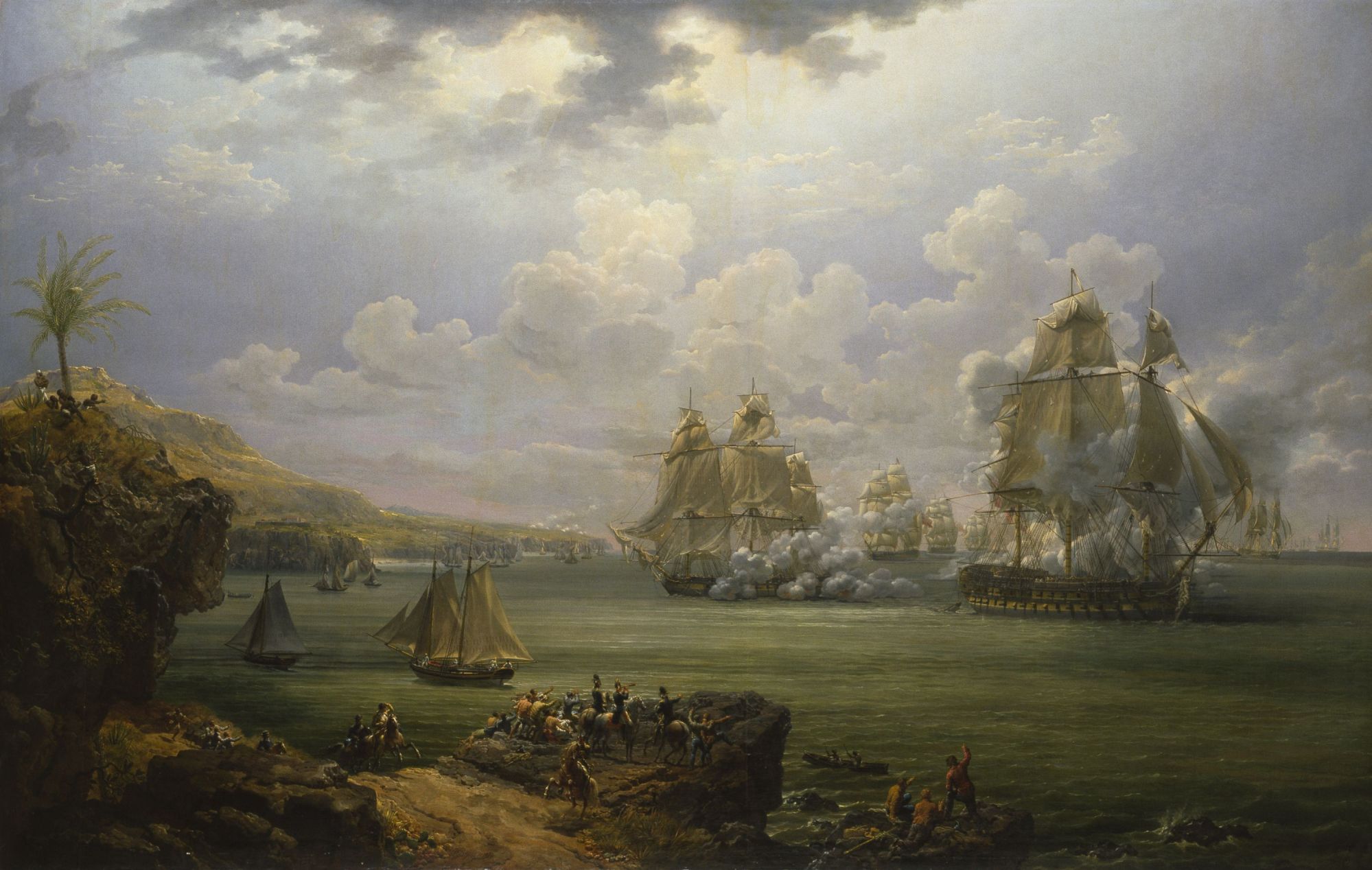
On the morning of 19 July 1805, Captain Zachary Mudge mistook four French warships for a friendly British convoy and sailed toward them. By the time he realized his error, it was too late to run. HMS Blanche had lost almost all her copper sheathing over nine months of hard Caribbean service, and her fouled hull could not outpace the French frigate Topaze bearing down on her. Within forty-five minutes the battle was over, eight of Blanche's crew were dead, and the ship herself was sinking. The French set her ablaze that evening rather than try to save her. A week later, the American schooner Sally found Blanche's mainmast floating on the open ocean, a battle ensign still visible beneath the waves -- a small, defiant flag marking the grave of a ship whose five-year career had taken her from the frozen waters off Copenhagen to the sun-bleached Caribbean.
Baptism at Copenhagen
Blanche was built at Deptford Dockyard, launched on 2 October 1800, and commissioned under Captain Graham Hamond that November. She was an Apollo-class frigate, 145 feet along the upper deck, carrying thirty-six guns and a crew of 264. Her class was prized for speed and balance -- trials showed they could make twelve knots -- though they pitched badly in heavy seas. Blanche's first test came quickly. In March 1801 she was sent ahead of the British Baltic Fleet to Elsinore, delivering an ultimatum to Denmark. When negotiations failed, she helped escort bomb ships into position to threaten the fortress of Kronborg. On the night before the Battle of Copenhagen, Blanche grounded off Amager. Her exhausted crew spent the night refloating her and went into battle on 2 April without sleep. Stationed between HMS Amazon and HMS Alcmene as part of a five-frigate reserve under Captain Edward Riou, Blanche attacked Danish ships of the line and endured punishing fire from the Trekroner Fort. Seven of her men were killed, nine badly wounded. After the battle, the recalled Admiral Hyde Parker chose Blanche to carry him home to Yarmouth.
A Midshipman, a Stomach Wound, and Thirty Seasick Soldiers
In late 1803, under Captain Mudge, Blanche sailed to the West Indies to join the Blockade of Saint-Domingue. The Caribbean service produced episodes that read like fiction. Off Monte Christi on the night of 3-4 November, Marine Lieutenant Edward Nicolls was sent with just thirteen men in a boat to capture the French privateer L'Albion sheltering under shore batteries. A second boat under Lieutenant Warwick Lake, carrying twenty-two reinforcements, went off in the wrong direction entirely, leaving Nicolls to board alone. Despite being shot through the stomach during the assault, Nicolls captured the vessel and had his men keep firing their muskets to fool the shore batteries into thinking the fight was still raging, buying time to sail the prize away. When Lake finally appeared and ordered the firing stopped, the batteries promptly opened up and killed two of his men. Naval historian William Laird Clowes called Lake "a thoroughly worthless officer." Days later, Midshipman Edward Henry a Court was out gathering sand with eight men and five muskets when he encountered a French schooner carrying over thirty soldiers. He boarded anyway. Every soldier turned out to be seasick, and a Court captured the ship without difficulty.
The Privateer Hunter
Blanche's Caribbean service was not all confusion and comedy. In a single month off San Domingo, Mudge captured or destroyed twenty-four vessels, effectively severing communications between the blockaded islands. An attempted invasion of Curacao in early 1804 ended badly -- sickness and skirmishing forced a British withdrawal in February -- but Blanche continued patrolling and seizing enemy ships. She took the French 14-gun privateer La Gracieuse in October 1804, the Dutch schooner Nimrod at some point that year, and two more French privateers in early 1805: the 6-gun Le Hansard and the 14-gun L'Amitie. By mid-1805 Blanche was worn down from constant service. Her copper sheathing, which protected the wooden hull from marine growth and worms, had largely fallen away. The ship that had once made twelve knots was now sluggish and vulnerable, sailing on borrowed time through waters thick with French squadrons.
Forty-Five Minutes North of Puerto Rico
Blanche was carrying dispatches from Jamaica to Barbados for Vice-Admiral Lord Nelson when the French found her at daybreak on 19 July 1805, a hundred miles north of Puerto Rico. Captain Francois-Andre Baudin commanded the 40-gun frigate Topaze, the 22-gun sloop Departement des Landes, the 18-gun corvette Torche, and the 16-gun brig Faune. Topaze alone outgunned Blanche. Mudge tried to flee, but his fouled hull made it hopeless. The battle began around 11 a.m. when Topaze drew alongside and exchanged broadsides. Departement des Landes closed on Blanche's stern. When Mudge tried to cross Topaze's bow and rake her, the French vessel luffed up behind and raked Blanche instead, destroying her sails and rigging. After forty-five minutes, with eight dead and fifteen wounded, her masts disabled and the ship taking on water, Mudge surrendered. By 6 p.m. the French found Blanche unsalvageable -- her timbers riddled with dry rot that had shattered under the cannonade -- and set her on fire. She burned to the waterline and sank into the Caribbean.
A Contested Legacy
Mudge was court-martialed at Plymouth that October and honourably acquitted, with Rear-Admiral John Sutton praising the defense of the outnumbered ship. But naval historian William James told a different story. He noted that Mudge had greatly exaggerated the strength of his opponents in his reports and inflated casualty figures. French officers confirmed that only Topaze had truly engaged Blanche; the other vessels fired mostly at rigging, contributing little to the fight. James and the later historian E. V. E. Sharpston concluded that Blanche's defense was lacklustre. The truth may lie in the dry rot that hollowed out her timbers long before Baudin's guns found her. A ship that breaks apart under ordinary gunnery is a ship that was already lost -- to the slow, invisible decay of neglect rather than to any single morning's cannonade. Two of the four French warships, Faune and Torche, were captured within a month. Fifty-two of Blanche's crew were recovered from Torche, and Mudge himself was released from Lisbon. The ship was gone, but most of her people came home.
From the Air
Blanche was lost approximately 100 miles north of Puerto Rico at roughly 20.00N, 66.00W, in open Caribbean waters. The wreck site is in deep ocean with no surface features visible from the air. Nearest airports: Luis Munoz Marin International Airport (TJSJ/SJU) in San Juan, Puerto Rico, approximately 150 nm to the south-southeast. Rafael Hernandez Airport (TJBQ/BQN) in Aguadilla is also nearby. From cruising altitude, the area is open Atlantic Ocean between Puerto Rico and the eastern Bahamas. The Battle of Copenhagen (Blanche's first major engagement) took place in the harbor at Copenhagen, Denmark.