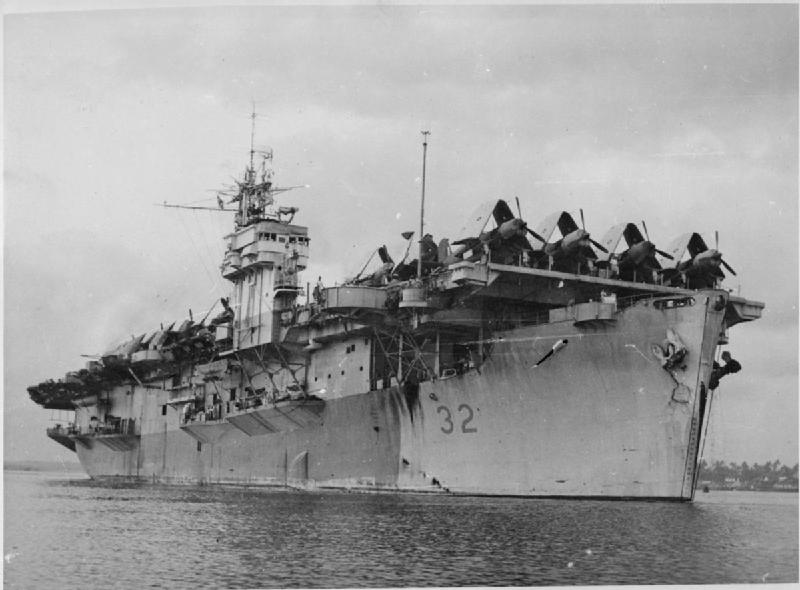
HMS Chaser
On 4 March 1944, somewhere in the Arctic Ocean northwest of Hammerfest, Norway, a Fairey Swordfish biplane -- an aircraft that looked obsolete before the war even started -- caught a German submarine on the surface. U-472's anti-aircraft guns were iced solid, useless. The Swordfish attacked with bombs and rockets, crippled the submarine, then called in a destroyer to finish the job. Over the next two days, aircraft from the same carrier would sink two more U-boats. That carrier was HMS Chaser, a small, unglamorous escort carrier built in Mississippi, and her Arctic patrol in early 1944 would prove one of the most effective anti-submarine operations of the war.
Mississippi to Murmansk
Chaser began life as Mormacgulf, a merchant hull laid down at Ingalls Shipbuilding in Pascagoula, Mississippi, on 28 June 1941. Renamed Mormacdove, then acquired by the US Navy and redesignated Breton (CVE-10), she was transferred to the Royal Navy under the Lend-Lease program on 9 April 1943 and commissioned as HMS Chaser. She was one of eleven Attacker-class escort carriers -- workmanlike vessels built to fill the desperate need for air cover over convoys. Her crew of 646 men lived in accommodations that were distinctly American: cafeteria-style dining instead of individual messes preparing their own food, three-tier bunk beds instead of hammocks, a modern laundry, even a barber shop. For British sailors accustomed to more spartan arrangements, it was a revelation.
The U-Boat Hunter's Routine
Chaser could operate up to 24 aircraft, typically a mix of Fairey Swordfish or Grumman Avenger torpedo bombers for submarine hunting and Grumman Wildcat fighters for air defense. The anti-submarine patrols followed a relentless rhythm: from dawn to dusk, one aircraft flew ahead of the convoy while another patrolled astern, each sortie lasting two to three hours before the crew returned to the pitching deck, landed on one of nine arrestor wires, and was replaced by the next team. The aircraft searched using both radar and eyeball, looking for the telltale feather of a periscope or the silhouette of a surfaced U-boat. When they found one, they could attack with torpedoes, depth charges, bombs, or RP-3 rockets. Chaser also served as a floating fuel depot, pumping oil to her escorting destroyers while underway -- a process that took nearly three hours from first line to final disconnect for 98 tons of fuel.
Three Kills in Three Days
Chaser's Arctic service began in January 1944 when she joined Convoy JW 57, becoming the first escort carrier assigned to protect large convoys on the Murmansk run. Her Wildcats drove off shadowing German aircraft while her Swordfish probed for submarines. None of the 43 merchant ships in that convoy was hit, despite 14 U-boats deployed against them. It was on the return trip with Convoy RA 57 in March 1944 that Chaser's aircraft achieved their extraordinary three-day killing streak. On 4 March, a Swordfish caught U-472 with her anti-aircraft guns frozen. On 5 March, another Swordfish sank a second U-boat with rockets northwest of Hammerfest. On 6 March, radio signals detected by HF/DF -- the convoy's secret weapon for locating submarine transmissions -- sent a Swordfish to investigate, and a third submarine was destroyed with rockets northwest of Narvik. Open-cockpit biplanes, flying in Arctic conditions, armed with rockets -- it was warfare from two different centuries happening simultaneously.
From the Arctic to the Pacific
After her Arctic triumphs, Chaser's luck faltered briefly. Returning to Loch Ewe in Scotland on 10 March, she proceeded to Scapa Flow where she dragged her anchor and ran aground on 13 March. After hull repairs and a refit at Rosyth, she was modified for a new role: ferry carrier for the British Pacific Fleet. In February 1945, Chaser sailed for Sydney, where she joined the 30th Aircraft Carrier Squadron. Her task was less dramatic but equally vital -- ferrying replacement aircraft to forward areas so they could be transferred to operational carriers supporting the invasion of Okinawa and operations off Japan. A shortage of tankers meant she also spent time refueling other ships. After the Japanese surrender in August 1945, she carried Allied prisoners of war home.
Three Lives, Three Names
Chaser was returned to the US Navy at Norfolk, Virginia, on 12 May 1946 and struck from the Navy list that August. Sold to the Waterman Steamship Company in December, she was later resold to the Netherlands and renamed Aagtekerk, beginning a second career as a civilian merchant vessel. She would eventually be renamed again, becoming E Yung, trading in Far Eastern waters. On 4 December 1972, nearly thirty years after her Swordfish had hunted U-boats through Arctic ice, the former warship foundered. She was salvaged and scrapped in Taiwan -- an unremarkable end for a ship that had once been the most effective U-boat killer on the Murmansk run.
From the Air
HMS Chaser's Arctic operations centered on the convoy routes through the Norwegian Sea, approximately 72.17°N, 14.73°E, northwest of Narvik and Hammerfest. This is open ocean with no land nearby. Nearest airports include Tromsø (ENTC), Hammerfest (ENHF), and Bardufoss (ENDU). Weather conditions along the Arctic convoy routes remain severe, with frequent gales, fog, and icing. The fjords of northern Norway along the coast provide dramatic scenery at lower altitudes.