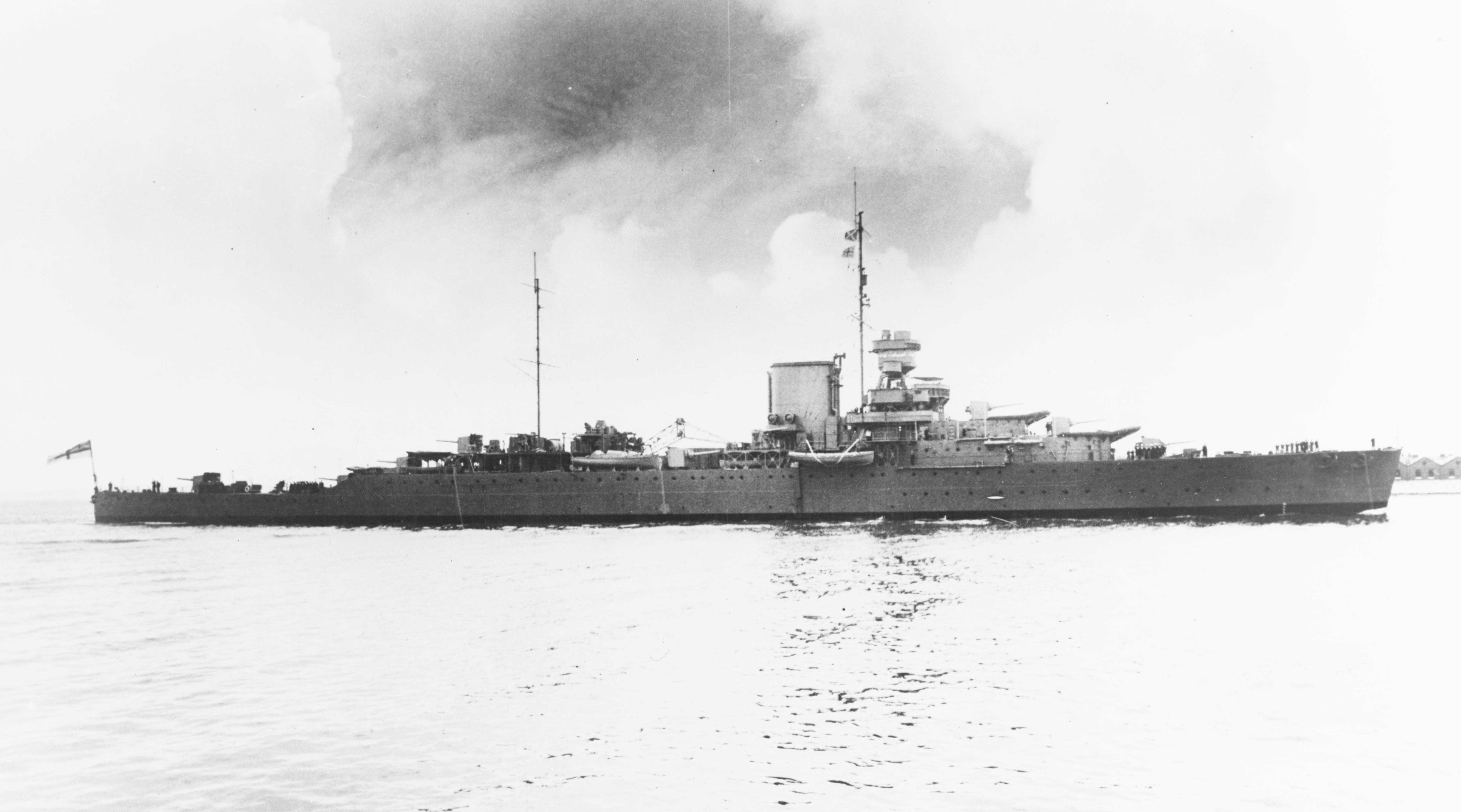
HMS Effingham
The ship was cursed from the start, or close enough. Laid down at Portsmouth in 1917 to hunt German commerce raiders, HMS Effingham was not completed until 1925, seven years after the war she was built for had ended. Her engines would torment every captain who commanded her. But Effingham's final misfortune was not mechanical. On the evening of May 17, 1940, carrying 1,020 British and French troops, ten Bren Carriers, and a French general to reinforce the defense of Bodø, she struck Faxsen Shoal in a narrow strait and sank in Norwegian waters. Every person aboard survived. The cruiser did not.
Built for One War, Delivered to Another
HMS Effingham was a Hawkins-class heavy cruiser, one of five designed to chase down commerce raiders across open ocean. She measured 604 feet overall, displaced nearly 10,000 tons at standard load, and carried seven 7.5-inch guns. Named for Lord Howard of Effingham, who led the English fleet against the Spanish Armada in 1588, she was the only Royal Navy ship ever to bear the name. Construction at HM Dockyard, Portsmouth began on April 6, 1917, but the ship was not launched until June 1921 and not completed until July 1925. By then, the Imperial German Navy had ceased to exist. Effingham was assigned to the East Indies Station, where Captain Bruce Fraser, later First Sea Lord, assumed command in 1929. Her crew attended the coronation of Emperor Haile Selassie in Ethiopia in 1930, her Royal Marine band providing the entertainment.
The Engine Problem
Effingham returned home in 1933 and spent the next several years as flagship of the Reserve Fleet before undergoing a major rearmament in 1937-1938. Her seven 7.5-inch guns were replaced with nine 6-inch guns, her anti-aircraft suite was upgraded, and two boilers were removed to make room for an aircraft catapult. When war came in September 1939, she was assigned to the Northern Patrol intercepting German ships attempting to break into the Atlantic. Her first patrol lasted exactly one day before engine damage sent her to Devonport for repairs. This pattern repeated itself relentlessly. In November 1939, between dockyard visits, she transported two million pounds in gold bullion to Halifax, Nova Scotia. Sent to patrol the Caribbean, she managed three days before her engines failed again. By January 1940, she was back in Portsmouth having her boiler tubes replaced. The ship that could hunt commerce raiders across entire oceans could barely cross the North Sea without breaking down.
Norway, May 1940
Finally ready for action in April 1940, Effingham sailed to Scapa Flow and entered the Norwegian Campaign. Admiral of the Fleet Lord Cork, supreme commander of Allied forces in Norway, hoisted his flag aboard her on April 20. Over the following weeks, she bombarded German positions at Narvik, Ankenes, and Bjerkvik, and served as command ship for the landings at Bjerkvik on May 12-13, hosting Lord Cork, French Brigadier General Antoine Béthouart, and Lieutenant-General Claude Auchinleck. She ferried 750 men of the French Foreign Legion's 13th Demi-Brigade to the assault. It was the most consequential service of her career, and it lasted less than a month.
The Strait That Wasn't Wide Enough
On May 17, Effingham departed Harstad carrying over a thousand troops and supplies to reinforce Bodø. To avoid Luftwaffe attacks, the Admiralty chose a longer route around the outer islands rather than the direct passage through the Vestfjorden. As the squadron approached Bodø, Captain Howson suggested using a narrow strait between the island of Bliksvær and the Terra Archipelago to avoid potential submarines in the main channel. Effingham had a large-scale chart of the area; Rear-Admiral John Vivian in HMS Coventry did not, but agreed to follow Effingham's lead. Traveling at 23 knots around 19:47, the destroyer Matabele touched a submerged rock of the Faxsen Shoal, losing her port propeller. A minute later, Effingham struck the same shoal. The impact tore large holes in her hull and she quickly lost power.
Everyone Out, Then Sink Her
Captain Howson's priority was the 1,020 troops and his own crew. The destroyer Echo came alongside and took aboard all passengers and over 200 crew members, transferring them to Coventry. Boats from Matabele rescued additional men. By 22:10, every soul had been evacuated without a single casualty. The cruiser had grounded off Skjoldsh Island in about five fathoms of water, east of Bliksvær. Four Bren Carriers and some mortars were salvaged during the night, but the bulk of the supplies was lost. With Effingham sitting upright in shallow water where the Germans could potentially salvage her, Echo put two torpedoes into the cruiser at 08:00 the next morning, capsizing her. After the war, the wreck was dismantled by Høvding Skipsopphugging. Only a few steel plates and components remain on the seabed, the final traces of a ship that spent more time in repair yards than in action.
From the Air
Located at 67.28°N, 14.06°E off Skjoldsh Island, east of Bliksvær in the approaches to Bodø, Nordland county, Norway. The wreck site is in shallow water in the narrow strait between Bliksvær and the Terra Archipelago. Best viewed at 2,000-4,000 feet altitude to see the island-studded strait where the navigational error occurred. Nearest airport: Bodø Airport (ENBO) approximately 25 km east-northeast. The area features complex island channels and is subject to strong tidal currents and variable weather.