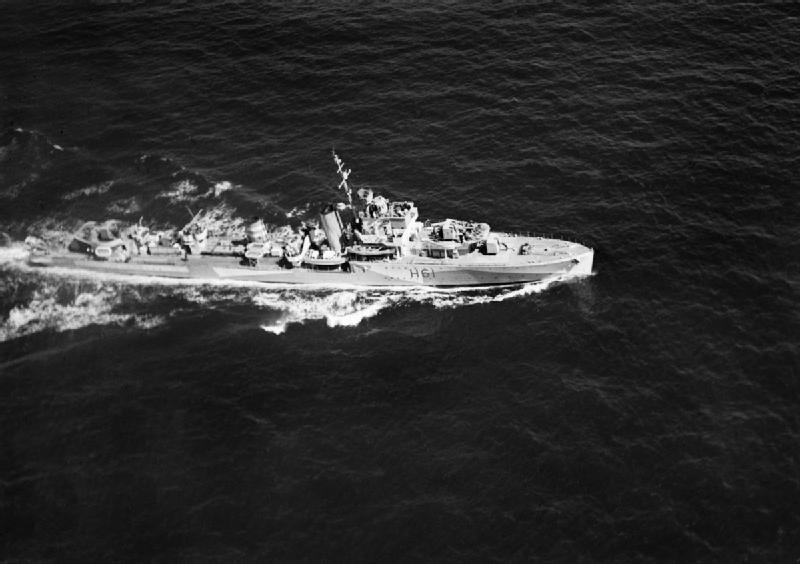
HMS Express: From Dunkirk to the Sinking of Force Z to a British Columbia Beach
On December 10, 1941, Japanese torpedo bombers sank HMS Prince of Wales and HMS Repulse off the coast of Malaya - the first time in history that capital ships under way at sea were destroyed solely by air power. As the battleship Prince of Wales rolled and went under, it was HMS Express that came alongside to pull survivors from the oil-slicked water. The destroyer that performed this rescue had already survived Dunkirk and lost her bow to a German mine. She would go on to serve Canada, hunt U-boats in the Atlantic, and support the D-Day invasion. Today, what remains of her hull lies half-buried in the mud off Royston, British Columbia, part of a breakwater made from retired warships.
Mines, Minefields, and a Missing Bow
Built by Swan Hunter and launched in 1934, Express was an E-class destroyer designed for minelaying - a dual role that kept her busy laying defensive minefields in British, Dutch, and German waters during the first year of the war. In May and June 1940, she joined the frantic evacuation of Allied soldiers from Dunkirk. But it was a few months later, off the Dutch coast, that Express entered five British destroyers into a German minefield. Two of her sister ships sank. Express had her entire bow blown off by the blast, a catastrophic wound that left her incapacitated for over a year of repairs. That she survived at all was a testament to her construction and her crew's damage control. When she emerged from the shipyard, the war had moved to new theatres, and Express was ordered east.
The Destruction of Force Z
In late 1941, Express escorted the battleship Prince of Wales and the battlecruiser Repulse to Singapore as part of Force Z, intended to deter Japanese aggression in the Far East. On December 8, following the attack on Pearl Harbor and Japanese landings in Malaya, Force Z put to sea to intercept invasion convoys. Spotted by Japanese reconnaissance, the force pressed on. On the morning of December 10, eighty-six bombers from the 22nd Air Flotilla struck with devastating precision, ignoring the four escorting destroyers to concentrate on the capital ships. Within two hours, both Prince of Wales and Repulse had capsized and sunk. Express moved alongside the stricken battleship and pulled hundreds of men from the water. Between the three rescue destroyers, 2,081 sailors were saved - a number that would have been far lower without the quick action of Express and her crew.
A Second Life Under a New Flag
After escaping the fall of Singapore and the Dutch East Indies, Express served in the Indian Ocean and participated in the Battle of Madagascar before returning to Britain in early 1943. There she underwent conversion into an escort destroyer and was transferred to the Royal Canadian Navy, rechristened HMCS Gatineau. Under her new flag, she joined the Mid-Ocean Escort Force guarding convoys across the Atlantic and helped sink a German submarine in March 1944. Transferred to Northern Ireland in May to prepare for the Normandy invasion, Gatineau then sailed to Canada for a lengthy refit. The war ended before she could see much more action. She was paid off in early 1946 and sold the following year - a ship that had served two navies, fought in two oceans, and earned three battle stars.
Beached at Royston
The Pacific Metal Salvage Company of Seattle bought the decommissioned destroyer in October 1946, stripped her of anything valuable, and towed the hull north to Royston, British Columbia. There, on the shore of the Comox Valley, Express joined a growing collection of old vessels deliberately grounded to form a breakwater protecting the harbour's logging operations. Parts of her hull were still visible as recently as 2009, though decades of tidal action and corrosion have progressively claimed what the salvagers left behind. It is a strange fate for a ship that survived Dunkirk, a minefield, the sinking of Force Z, and the fall of Southeast Asia - to spend eternity in a quiet bay on Vancouver Island, doing nothing more violent than breaking waves.
From the Air
Located at 49.654N, 124.948W off the shore of Royston, British Columbia, in the Comox Valley on Vancouver Island's east coast. The Royston breakwater - a line of deliberately sunk warships and vessels - is visible from altitude as an irregular dark barrier in shallow water along the shoreline, best seen at low tide. The breakwater sits just south of the Trent River mouth. Nearest airport: CFB Comox (CYQQ) approximately 8 km north. Approaching from the Strait of Georgia at 1,000-2,000 feet, the individual hull shapes can sometimes be distinguished. The Comox harbour and marina lie across the water to the northeast.