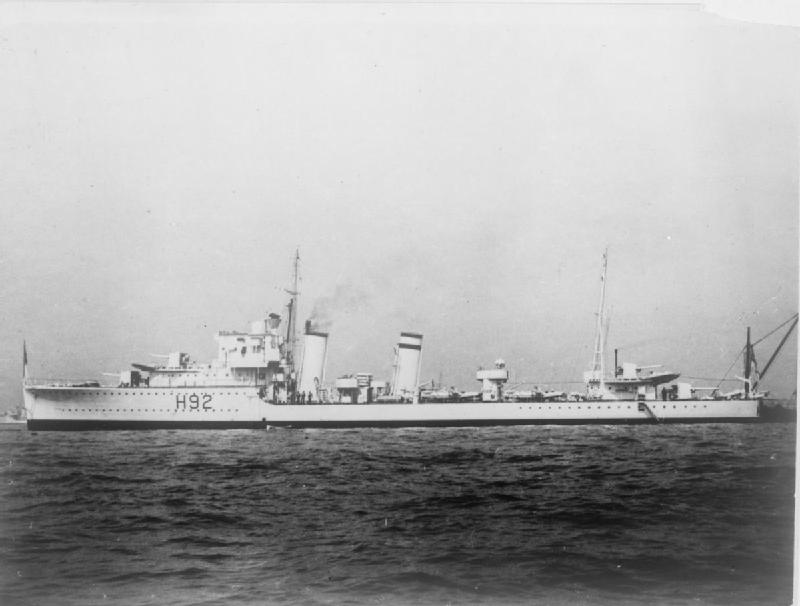
HMS Glowworm (H92)
The German captain watched the British officer lose his grip. Lieutenant Commander Gerard Roope, hauled from the freezing Norwegian Sea by ropes lowered from the heavy cruiser Admiral Hipper, could not hold on. He slipped back into the water and drowned, minutes after commanding the most audacious act of the young war. Earlier that morning, on 8 April 1940, Roope had ordered his battered destroyer HMS Glowworm to ram Hipper at full speed, tearing a gash along the cruiser's hull with a ship that was already on fire and breaking apart. Kapitan zur See Hellmuth Heye, the man who had just destroyed Glowworm, was so moved by what he witnessed that he wrote to the British Admiralty through the Red Cross recommending Roope for the Victoria Cross. It was granted posthumously, the first VC of the Second World War.
A Small Ship in a Big War
HMS Glowworm was a G-class destroyer, completed in January 1936 at Thornycroft's yard in Woolston, Hampshire, at a cost of 248,785 pounds. She displaced 1,350 tons, carried four 4.7-inch guns and ten torpedo tubes, and could make 36 knots. Her peacetime complement was 137 men. Before the war found her, Glowworm had already lived an eventful career: escorting King Edward VIII's yacht Nahlin through the Mediterranean in 1936, enforcing the arms blockade during the Spanish Civil War, surviving a collision with a sister ship during night exercises off Alexandria in 1939, and taking a hit from the Swedish merchant ship Rex in fog off Outer Dowsing in February 1940. She was a ship that kept getting knocked around and kept coming back to duty.
The Morning of 8 April
Glowworm had been detached from her task force the previous day to search for a man lost overboard. On the morning of 8 April, alone in thick fog off the Norwegian coast, she stumbled into German destroyers transporting troops to Trondheim as part of Operation Weserubung, the invasion of Norway. Glowworm opened fire. The German destroyers did not want a fight; they signaled for help and tried to disengage. What answered their call was Admiral Hipper, a heavy cruiser carrying 20.3-centimeter guns that outranged and outweighed anything Glowworm could bring to bear. Hipper spotted the destroyer at 09:50 and opened fire eight minutes later. By Hipper's fourth salvo, Glowworm was hit. Her smokescreen was useless against the cruiser's radar-directed guns.
Ramming Speed
What followed was desperation transformed into purpose. Glowworm's radio room, bridge, and forward gun were destroyed. Hits punched through the engine room and the captain's cabin. When the falling mast short-circuited the wiring, the ship's siren jammed on, screaming over the battle. At 10:10, Roope fired five torpedoes. They missed because Heye had kept Hipper's bow pointed at the destroyer, minimizing the target. Glowworm ducked back through her smoke to get the second torpedo mount working, but Heye followed, intent on finishing the job before more torpedoes could be launched. When Hipper burst through the smokescreen, the two ships were dangerously close. Roope ordered hard starboard. Glowworm struck Admiral Hipper just behind the anchor, sheering off her own bow in the impact. The wreckage of the destroyer scraped along the cruiser's side, ripping holes in the hull and destroying a torpedo mounting. Glowworm drifted clear, on fire, her siren still wailing. At 10:24 her boilers exploded. She took 109 of her crew with her.
Honor From the Enemy
Admiral Hipper hove to and began pulling survivors from the sea. Forty British sailors were recovered, though at least six later died of their wounds. Roope was among those hauled toward safety, but the cold and his injuries were too much. He lost his grip on the rescue rope and slipped beneath the surface. The senior surviving officer, Lieutenant Ramsay, told his German captors that neither the helm nor the emergency steering had been manned when the collision occurred, suggesting Roope had ordered the ram knowing full well no one was left to steer. After the war, Heye's letter reached the British authorities, and Roope was awarded the Victoria Cross. Ramsay received the Distinguished Service Order. Only twice more during the entire war would a VC be awarded on the recommendation of an enemy commander. Glowworm lies somewhere on the floor of the Norwegian Sea, roughly 64 degrees north, her exact position known only to the water that claimed her.
From the Air
HMS Glowworm sank at approximately 64.450N, 6.467E in the Norwegian Sea, west of the Trondelag coast of Norway. There are no visible surface remains, but the location is in open water roughly 100 km west-northwest of Kristiansund. Nearest airports include Kristiansund Airport, Kvernberget (ENKB) to the southeast and Orland Main Air Station (ENOL) to the east. This is open ocean with no visual reference points at the surface. Best observed from higher altitude (5,000-10,000 ft) to appreciate the isolation and exposure of the waters where the engagement took place. Frequent fog, as on the morning of the battle.