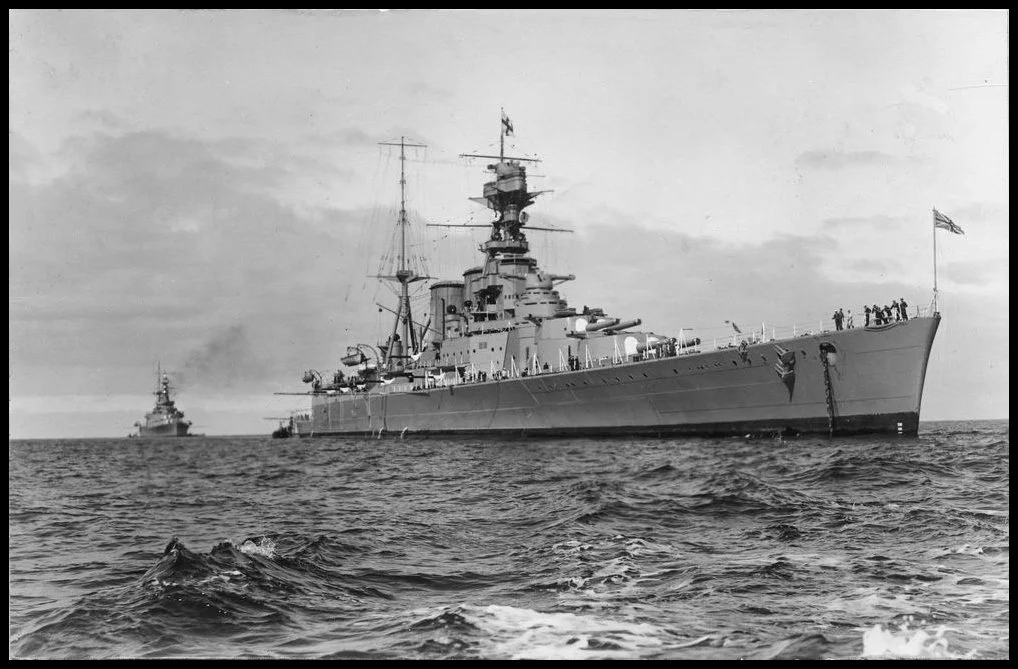

HMS Hood
Three sailors lived to tell what happened. Ted Briggs, Bob Tilburn, and Bill Dundas were the only men picked up from the freezing North Atlantic on the morning of 24 May 1941, after a single salvo from the German battleship Bismarck struck the battlecruiser HMS Hood and detonated her aft magazine. The ship that had symbolised British naval power for twenty years broke in two and sank in three minutes. Fourteen hundred and fifteen of her shipmates went down with her.
The Mighty Hood
Hood was launched on the Clyde in August 1918, the last and largest of an aborted class of four Admiral-class battlecruisers. Only she was finished — the others were cancelled when the First World War ended and the steel was needed elsewhere. Commissioned in May 1920 at 860 feet long and 42,670 long tons at load displacement, she was the largest warship in the world. She held that distinction for twenty years. Twin funnels, a low sweeping silhouette, eight 15-inch guns: she was widely considered the most beautiful warship ever built. The Royal Navy called her the Mighty Hood, and across the interwar empire she was the ship that showed the flag — Scandinavia, the Mediterranean, a 10-month world cruise in 1923 and 1924 that took her to South Africa, Australia, New Zealand, Canada, the United States. She was, in the language of the period, the Empire afloat.
An Old Ship in a New War
By 1939, Hood was tired. The improvements that should have brought her up to the standard of modernised contemporaries — new turbines, new deck armour, modern fire control — had been scheduled for 1941 and then postponed by the outbreak of war. The fundamental design flaw that the Battle of Jutland had exposed in 1916 had been partially addressed and never fully corrected: her deck armour, spread thinly across multiple decks, was vulnerable to the steep falling angle of long-range shellfire. The Royal Navy knew this. So did her crew. But she was the only fast capital ship the Atlantic Fleet could spare, and the war that was being fought needed her at sea. She steamed under Captain Ralph Kerr and Vice-Admiral Lancelot Holland into the worst possible match-up.
The Denmark Strait
The German battleship Bismarck and the heavy cruiser Prinz Eugen sailed for the Atlantic in May 1941 to attack convoys. British cruisers spotted them on 23 May in the strait between Greenland and Iceland; Hood and the newly commissioned battleship Prince of Wales raced to intercept. At 05:52 on the 24th, Hood opened fire. The Germans returned fire three minutes later, both ships concentrating on the British flagship. At about 06:00, while Hood was turning to bring her rear turrets to bear, a salvo from Bismarck — fired from approximately 16,650 metres, roughly ten and a third miles — struck her. A jet of flame burst from the vicinity of the mainmast. Then the aft magazine exploded. The blast broke the ship's back. Her bow rose nearly vertical out of the water, and she was gone in three minutes.
The Three Survivors
The destroyer HMS Electra reached the spot about two hours later. She found debris and three living men. Ted Briggs, an 18-year-old signalman, had been on the compass platform; he survived the suction of the sinking ship by some combination of luck and physics that he himself could never fully explain. Bob Tilburn, a 19-year-old able seaman, was on the boat deck and was washed clear as the ship rolled. Bill Dundas, a 17-year-old midshipman, kicked out a glass scuttle and swam free. Briggs lived until 2008, the last survivor, and spent decades giving interviews, attending memorials, and answering letters from families who had lost grandfathers and great-uncles aboard Hood. Tilburn died in 1995, Dundas in 1965. For 67 years it fell to those three men, and eventually to Briggs alone, to carry the testimony of 1,418.
Honouring the Dead
The first board of inquiry concluded within a fortnight that a German shell had penetrated to the aft magazine. A second board confirmed it in September 1941. Historians have argued ever since about the precise path the shell took — whether it pierced the deck or the belt, whether the 4-inch ammunition magazine ignited the 15-inch propellant or the other way around — but the conclusion has held: a magazine explosion, almost certainly initiated by Bismarck's fifth salvo, destroyed the ship. The wreck was found in 2001 by an expedition led by David Mearns, lying in three sections at 9,300 feet in the Denmark Strait. In 2002 the British government designated the site an official war grave. In 2015 the team returned to recover one of the ship's bells from a small debris field nearby. The bell was conserved and unveiled in 2016 — on the 75th anniversary of the battle — by Princess Anne at the National Museum of the Royal Navy in Portsmouth, where it became the centrepiece of the first permanent memorial to Hood's last crew. It rang eight bells at noon, before an audience of descendants. The Mighty Hood now has the memorial she should always have had.
From the Air
Coordinates 63.333°N, 31.833°W (approximate) mark the position in the Denmark Strait where Hood went down on 24 May 1941, about 300 miles west-southwest of Reykjavík. The wreck lies at roughly 9,300 feet and is a designated war grave under the Protection of Military Remains Act 1986. No overflight is appropriate as a casual itinerary point — this is sacred ground. Nearest civilian airfield: Reykjavík (BIRK) and Keflavík (BIKF), both on Iceland.
Nearby Stories
- The Northern Lights: The Sky Show That Vikings Thought Was Bridge to the Gods 457 km away
- Reykjavik 467 km away
- The Laki Eruption: The Volcano That Changed World History 666 km away
- St Kilda, Scotland 1367 km away
- Flannan Isles Lighthouse 1413 km away
- 1946 American Overseas Airlines Douglas DC-4 Crash 2263 km away
- Ernest Harmon Air Force Base 2288 km away
- Inuvik 4094 km away