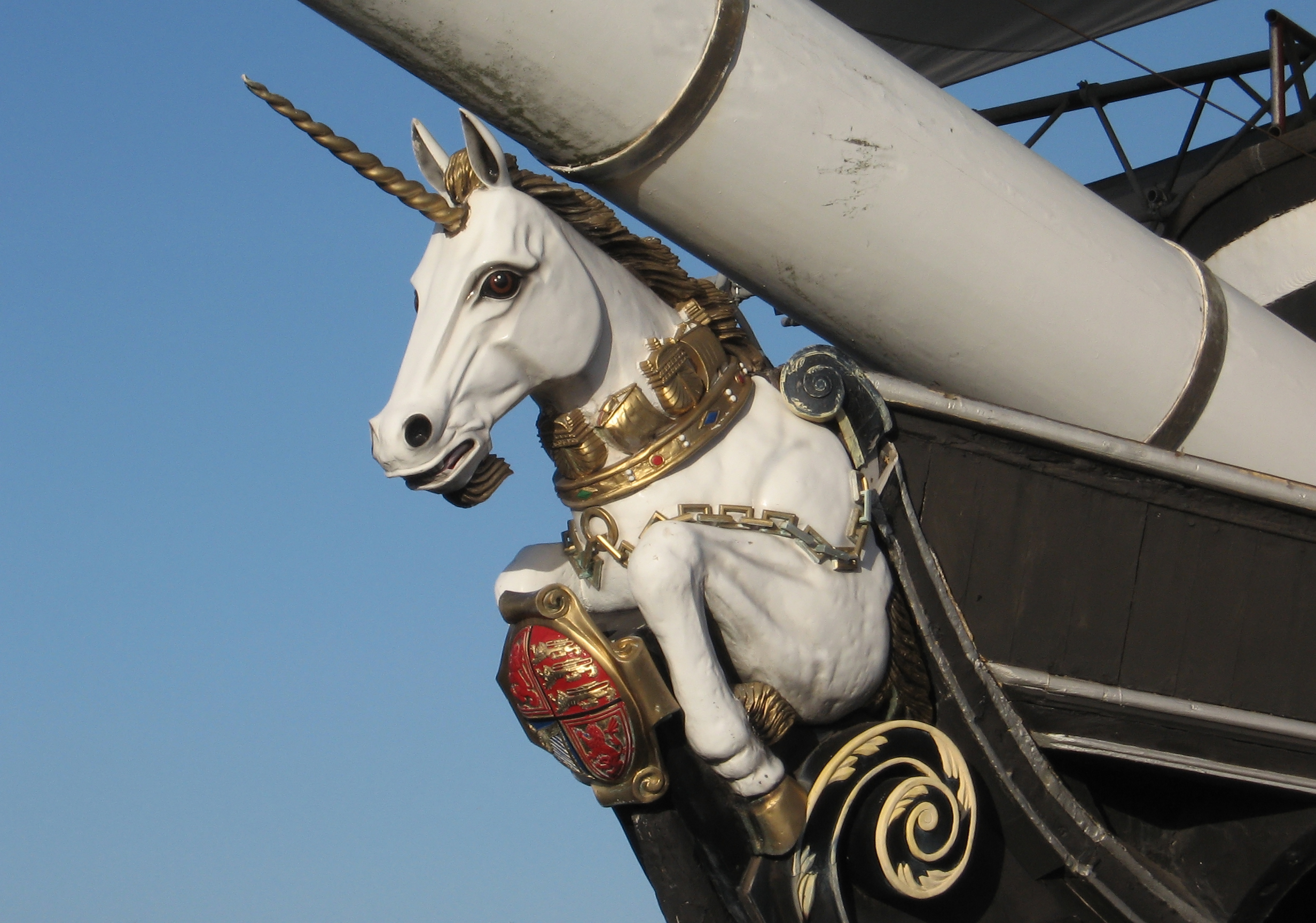
HMS Unicorn
She was built for a war that had already ended. Launched at Chatham Dockyard in 1824, HMS Unicorn was a 46-gun frigate designed to fight the battles of the Napoleonic era, but by the time her hull slid into the Medway, Napoleon was dead and the Royal Navy had more ships than it knew what to do with. So Unicorn was never rigged, never armed for combat, never sent to sea under her own power. Instead, a timber roof was built over her deck and she was placed "in ordinary" -- naval parlance for mothballed. That decision, made two centuries ago, is the reason she survives today as one of the most original warships from the age of sail anywhere in the world.
The Ship That Never Sailed
Unicorn was a product of transition. Under Sir Robert Seppings, then Surveyor of the Royal Navy, the frigate was built using innovative techniques for the era: diagonal iron riders and iron "knees" that reinforced the hull, a departure from the all-timber construction of earlier warships. She was a Leda-class frigate, a proven design, but modified to incorporate a circular stern and a "small-timber" system of construction that acknowledged the growing scarcity of large ship-building timbers. The irony of her engineering excellence is that it was never tested under fire. Without masts, without rigging, without a crew to work her guns, Unicorn spent her first decades as a hulk and depot ship at Sheerness. In 1857 she was loaned to the War Department as a floating gunpowder store at the Royal Arsenal at Woolwich. Her hull, unbattered by waves or cannonballs, remained in remarkably sound condition.
A Second Life on the Tay
In 1873, Unicorn made the only sea voyage of her existence -- towed by a steam sloop from Sheerness to Dundee, where she became a drill ship for the Royal Naval Reserve. The city that had built its fortunes on jute, jam, and journalism now had a warship in its harbour, though one that served as a floating classroom rather than a fighting vessel. She would remain in Dundee for over 150 years. During both World Wars, Unicorn served as area headquarters for the Senior Naval Officer in Dundee. More than 1,500 women trained aboard her for the Women's Royal Naval Service during the Second World War. On 14 May 1945, in one of her few moments of martial significance, Unicorn accepted the surrender of German submarine U-2326.
Preserving What Time Forgot
Because Unicorn was never rebuilt, never modernized for service, never subjected to the wear of ocean voyaging, she retains an authenticity that most surviving historic ships cannot match. According to restorers who surveyed her in 2021, "this one is probably the most original, certainly inside. Virtually all of what you see dates back to the day it was built." That assessment comes with a caveat: original does not mean pristine. The same survey found much of the planking in poor condition, even timber replaced in the 1850s showing deterioration. The Unicorn Preservation Society, whose patron is Anne, Princess Royal, has mounted an ambitious campaign to save her. The National Heritage Memorial Fund contributed over one million pounds in 2023, and the UK National Lottery provided approximately 796,000 pounds in January 2025. The plan is to relocate the ship to Dundee's restored East Graving Dock, where proper conservation work can proceed.
Scotland's Oldest Ship
HMS Unicorn holds the distinction of being the oldest ship in Scotland and one of the last intact warships from the age of sail. Her sister ship, HMS Trincomalee, is preserved at the National Museum of the Royal Navy in Hartlepool. Together, they represent a class of vessel that once formed the backbone of British naval power. Walking Unicorn's gun deck today, past the rows of cannon ports that never opened in anger, you encounter a peculiar kind of historical preservation: not the aftermath of battle or the patina of long service, but the suspended potential of a weapon never used. Listed as part of the National Historic Fleet, she sits in the same Dundee harbour where Discovery, the ship that carried Scott to Antarctica, was once built. In a city that has always had a complicated relationship with the sea, Unicorn is the survivor that endured by standing still.
From the Air
Located at 56.46N, 2.96W in Dundee harbour, Victoria Dock. The ship is visible along the waterfront near the V&A Dundee museum. Nearest airport: Dundee Airport (EGPN), 1.5nm west. The Tay Bridge and Tay Road Bridge are prominent visual references crossing the Firth of Tay to the south.