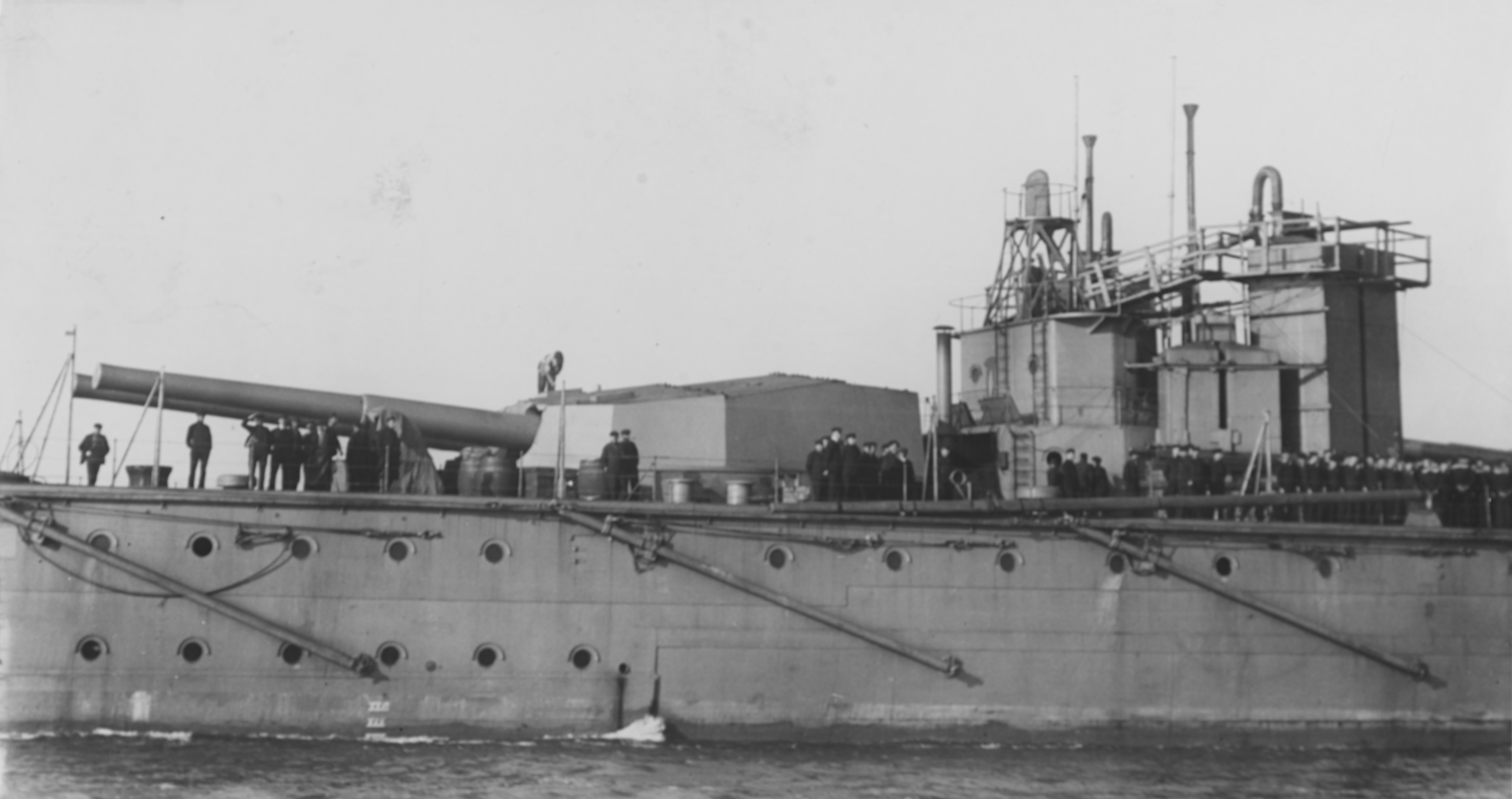
HMS Vanguard (1909)
On the evening of 9 July 1917, the crew of HMS Vanguard had no reason to expect anything but another quiet night at anchor. The St. Vincent-class battleship rode at her mooring in Scapa Flow, surrounded by the Grand Fleet, safe from U-boats and storms alike. Just before 11:20 p.m., two catastrophic explosions tore through the ship. She sank in seconds. Of roughly 845 men aboard, only two survived.
Built for a Dreadnought Age
HMS Vanguard entered service in 1910, the third and final ship of the St. Vincent class. She displaced over 19,000 tons and carried ten 12-inch guns in five twin turrets, a formidable concentration of firepower for her era. The Royal Navy had launched HMS Dreadnought only four years earlier, rendering every older battleship obsolete overnight, and the St. Vincent class represented the next step in that revolution. Vanguard spent her early years with the Home Fleet, running exercises in the North Sea and Atlantic. When war came in 1914, she joined the 1st Battle Squadron of the Grand Fleet, based at Scapa Flow in Orkney, the vast natural harbour that sheltered Britain's most powerful ships.
Eighty Shells at Jutland
On 31 May 1916, the Grand Fleet finally met the German High Seas Fleet in the waters off Denmark's Jutland peninsula. It was the largest naval battle of the First World War, and the only full-scale clash between the two fleets. Vanguard was in the thick of it. She fired eighty 12-inch shells during the engagement, targeting German battleships and battlecruisers through smoke and fading light. The battle proved inconclusive - both sides claimed victory, both sides suffered grievous losses - but the German fleet never again sought a major engagement. Vanguard returned to Scapa Flow intact, her crew among the lucky ones. Fourteen British ships had been sunk at Jutland, and over 6,000 sailors killed.
A Calm Evening, Then Nothing
Thirteen months after Jutland, with no warning and no enemy in sight, Vanguard destroyed herself. The explosion that ripped through her on that July night was almost certainly caused by the spontaneous ignition of unstable cordite propellant stored in one of her magazines. Cordite deteriorated over time, especially in the warm conditions near boiler rooms, and the Royal Navy had struggled with magazine temperature management throughout the war. The blast was so violent that it flung debris across the anchorage, damaging nearby ships. Witnesses described a column of flame and smoke rising hundreds of feet into the darkness. The battleship HMS Bellerophon, anchored nearby, was struck by falling wreckage. Of the 845 men aboard Vanguard, 843 died. Only two crew members survived, both blown clear of the ship by the force of the explosion.
The Weight of Names
The loss stunned the fleet. Coming during a war that had already consumed millions of lives, the sheer scale of the disaster - 843 men killed in a single moment, not by enemy action but by a flaw in their own ship's ammunition - carried a particular cruelty. Many of the dead were never recovered. The wreck settled in about 34 metres of water, broken and scattered across the seabed of Scapa Flow. In 1984, the site was designated a war grave under the Protection of Military Remains Act, making it an offence to disturb the wreck or remove artifacts. In 2002, it received additional protection as a controlled site. Divers may visit but must not enter or interfere with the remains. The dead of HMS Vanguard lie where they fell, in the anchorage they had trusted to keep them safe.
Scapa's Quiet Remembrance
Scapa Flow holds many wrecks - seven scuttled German warships, blockships sunk to seal the eastern approaches, and the scattered remains of vessels lost to accident and sabotage. But Vanguard's wreck carries a different weight. The German ships were deliberately sunk by their own crews. Vanguard's men had no choice and no chance. Today, the upturned hull and debris field are visible to divers in the clear Orkney waters, a shadow on the sandy bottom that grows more poignant with each passing year. Oil still seeps from the wreck. The anchorage that was once the nerve centre of British naval power is quiet now, home to fishing boats and dive charters. But the names of 843 men are carved into memorials across Britain, and the lesson of their deaths - that the most dangerous threats can come from within - remains as relevant as it was a century ago.
From the Air
Located in Scapa Flow, Orkney, at approximately 58.857°N, 3.108°W. The wreck lies in 34 metres of water within the sheltered natural harbour formed by Mainland Orkney, Hoy, Burray, and South Ronaldsay. Best viewed from above at 1,500-2,000 feet, where the outline of Scapa Flow and the positions of various wrecks become apparent. Nearest airport is Kirkwall Airport (EGPA). The Flow is visually distinctive from the air - a broad inland sea ringed by low green islands.