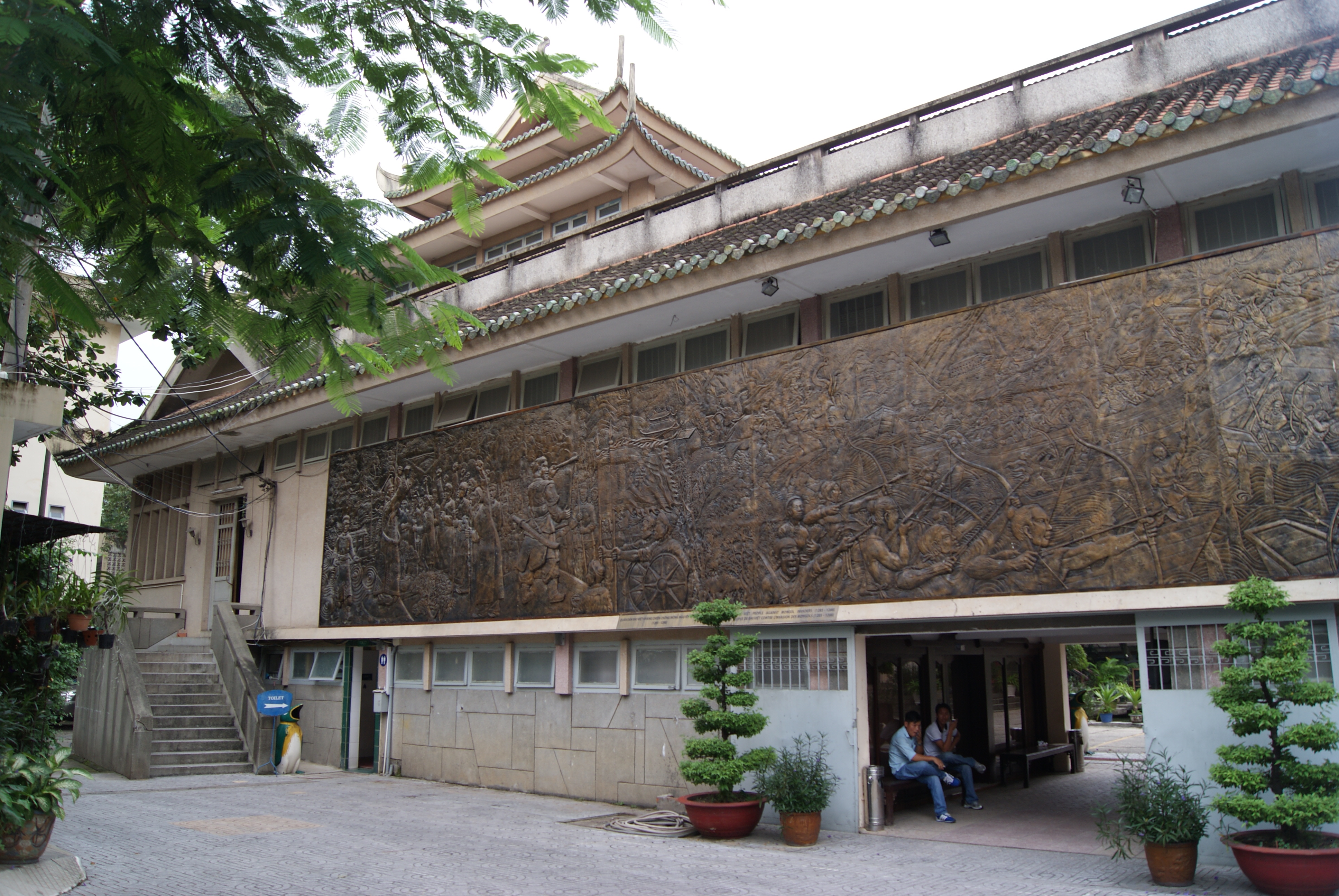
Ho Chi Minh City Museum of History
The building tells you something before you even step inside. Its rooflines curve upward in the Vietnamese style, but the proportions and symmetry are unmistakably French -- a colonial architect's attempt to dress European institutional design in local clothing. The Ho Chi Minh City Museum of History, designed by Auguste Delaval and inaugurated on January 1, 1929, was originally called the Musee Blanchard de la Brosse, named for a French colonial governor. It became the National Museum of Vietnam in Saigon, then received its current name in 1979, four years after reunification. The building has outlasted every regime that named it.
Half a Million Years Under One Roof
The collection begins 500,000 years ago. Prehistoric stone tools and fossils give way to artifacts from the Metal Age, spanning roughly 2879 to 179 BC, including pieces from two of Southeast Asia's most important ancient cultures: the Dong Son of northern Vietnam, famed for their bronze drums, and the Sa Huynh of the central coast, known for their distinctive jar burials and intricate earrings. The Oc Eo culture of the Mekong Delta region follows -- a trading civilization that maintained contact with the Roman Empire and left behind gold jewelry, coins, and Hindu religious objects. Stone and bronze sculptures from the Champa kingdom, which dominated central Vietnam for over a millennium, stand alongside Cambodian stone carvings from the 9th through 12th centuries. The effect is cumulative: room by room, century by century, the museum builds the case that Vietnam's history did not begin with the arrival of the French.
Dynasties in Sequence
The museum's chronological sweep through Vietnamese dynasties reads like a crash course in a civilization that was governing itself, waging wars, and producing art centuries before European contact. The Ngo, Dinh, Anterior Le, and Ly dynasties (939-1225) represent the forging of an independent Vietnamese state after a thousand years of Chinese domination. The Tran and Ho dynasties (1226-1407) defended that independence against Mongol invasions. The later Le through Nguyen periods (1428-1788) saw territorial expansion southward into the Mekong Delta. The Tay Son dynasty (1771-1802) united the country through peasant rebellion before the Nguyen dynasty (1802-1945) established the last imperial court at Hue. Each era receives its own gallery, its own artifacts, its own chapter in a story that stretches across more than a thousand years of sovereignty.
A Colonial Frame for Vietnamese Memory
There is an irony built into the museum's walls. The French constructed this institution to organize and display Vietnamese heritage during a period when France controlled Vietnamese politics, economics, and education. Delaval's architectural choice -- blending Vietnamese roof elements with French institutional planning -- was itself a statement about who got to frame whose history. The museum opened alongside the nearby Temple of Hung King within the Saigon Botanical Garden, linking the colonial institution to Vietnam's legendary founding monarchs in a single ceremonial gesture. After 1975, the museum was renamed and its collections reinterpreted through a post-colonial lens. The building remains a fascinating artifact of that transition: a French shell housing a Vietnamese narrative that has been rewritten, expanded, and reclaimed by the people whose ancestors made everything inside it.
District 1, Then and Now
The museum sits at 2 Nguyen Binh Khiem in Ben Nghe Ward, District 1 -- the historic heart of what the French called the Pearl of the Orient. The Saigon Botanical Garden surrounds it, offering shade trees and walking paths that buffer the museum from the city's relentless traffic. A French cannon cast in 1868, used during the conquest of Vietnam, stands in the courtyard -- a blunt reminder of the violence that brought French culture, French architecture, and French museums to this riverbank. Inside, however, the collection's message is different. The Dong Son bronze drums predate the cannon by two millennia. The Champa sculptures were old when Europe was young. The museum may wear a French face, but its contents belong entirely to Vietnam.
From the Air
Located at 10.785N, 106.708E in District 1, the historic core of Ho Chi Minh City, Vietnam. The museum is adjacent to the Saigon Botanical Garden and Zoo, identifiable from the air as a large green area in the otherwise dense urban center. Tan Son Nhat International Airport (VVTS) lies about 7 kilometers to the northwest. The Saigon River curves east of the district. Recommended viewing altitude: 2,000-4,000 feet for context with surrounding landmarks including the nearby Notre-Dame Cathedral Basilica and Independence Palace.