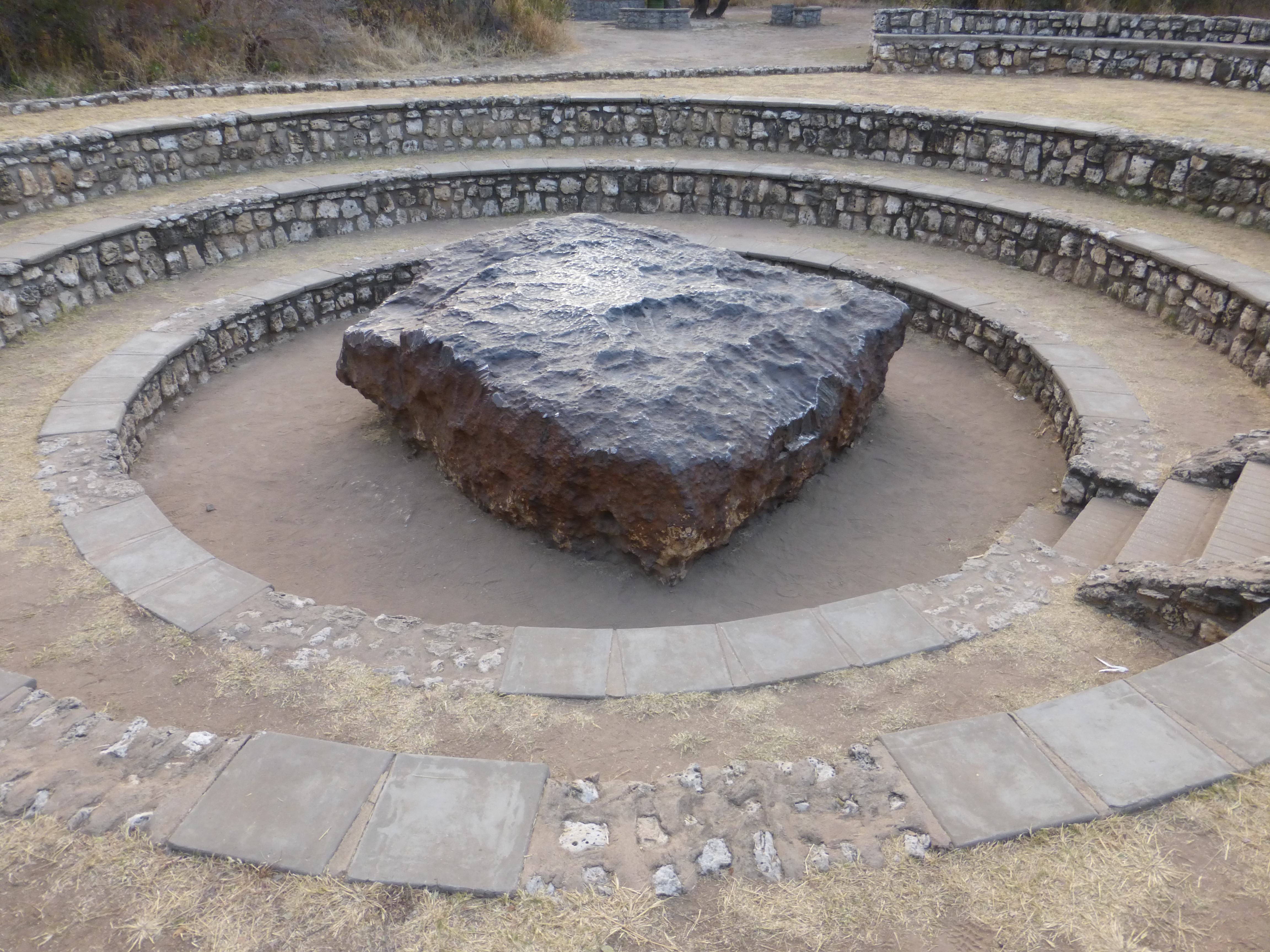
Hoba Meteorite
In Khoekhoegowab, the language of the Khoekhoe people, hoba means "gift." The name is apt. Somewhere between 80,000 and perhaps much less than 80,000 years ago, a slab of iron and nickel weighing more than 60 tonnes slammed into what is now a farm called Hoba West, near the town of Grootfontein in Namibia's Otjozondjupa Region. It left no crater. It has never been moved. And it remains, to this day, the largest known meteorite on Earth's surface -- roughly twice the mass of the next largest fragments, the 31-tonne Ahnighito of Greenland's Cape York meteorite and the 31-tonne Gancedo from Argentina's Campo del Cielo.
A Gentle Arrival
The absence of a crater is the first puzzle. A 60-tonne mass arriving from space should gouge the earth. But the Hoba meteorite is unusually flat on both major surfaces, shaped more like a thick tabletop than a boulder. Scientists believe Earth's atmosphere slowed this flat profile so effectively that the meteorite struck the surface at terminal velocity rather than at the hypersonic speeds typical of large impacts. The result was less an explosion and more a firm thud -- enough force to bury the object but not enough to excavate a crater. It simply settled into the soil and stayed. The physics are straightforward: a drag coefficient of about 1.3 bled away the entry velocity that would have otherwise been in excess of tens of kilometers per second. The meteorite arrived not as a catastrophe but, true to its name, as something gently placed.
The Accidental Discovery
For millennia, the meteorite lay undiscovered beneath the surface of the farm. In 1920, the landowner encountered it by chance -- the details of the discovery are sparse in the historical record, but the object would have been hard to mistake for anything local. Hoba is a tabular slab of metal measuring 2.7 meters across, composed of roughly 84 percent iron and 16 percent nickel, with traces of cobalt. It is classified as an ataxite iron meteorite of the nickel-rich chemical class IVB, a category that speaks to its deep-space origins in the core of a shattered protoplanet. A crust of iron hydroxides coats its exposed surfaces, the slow work of weathering and oxidation over the decades since it was uncovered. Erosion, scientific sampling, and vandalism have reduced its bulk over the years, but the main mass remains formidable.
Souvenirs and Salvation
The meteorite's very existence on Hoba West made it a target. Visitors wanted pieces. In 1968, one man and his friends spent three to four hours sawing off a large block with a hand saw as a souvenir -- a specimen that eventually surfaced at a Bonhams auction in Los Angeles. Relocation attempts also threatened the meteorite; at 60-plus tonnes, moving it was impractical, but that did not prevent people from trying to chip away at the prize. In 1955, the government of South West Africa declared the Hoba meteorite a national monument, with the farm owner's permission. The protected area was expanded to 425 square meters in 1979. Then in 1987, the farm owner donated the meteorite and its site to the state for educational purposes. The government built a visitor center with a circular stone seating area, transforming a vulnerable curiosity into a managed landmark.
The Largest Iron on Earth
What makes Hoba extraordinary is not just its size but what it represents. It is the most massive naturally occurring piece of ferronickel known on Earth's surface -- not merely a meteorite superlative but a geological one. Mineral collectors and planetary scientists have studied it for decades. The meteorite sits in open air, no museum wall between the visitor and an object forged in the collapse of a protoplanetary body billions of years ago, delivered to a Namibian cattle farm at precisely the angle and speed that allowed it to survive impact intact. Namibia gained independence in 1990 after its own long struggle, and the Hoba meteorite now belongs to the people of the republic. It draws visitors from around the world to an otherwise quiet stretch of farmland southeast of Tsumeb, a place where the deep history of the solar system lies exposed under the African sun, waiting to be touched.
From the Air
Located at 19.59S, 17.93E on the farm Hoba West, near Grootfontein in northern Namibia. The meteorite itself is not visible from the air, but the visitor center and circular stone seating area mark the site. Nearest airstrip is Grootfontein Airport (FYGF), approximately 20 km to the northwest. Tsumeb Airport (FYTM) is about 40 minutes' drive to the northwest. The site sits in flat to gently rolling farmland. Best viewed at low altitude in clear conditions.