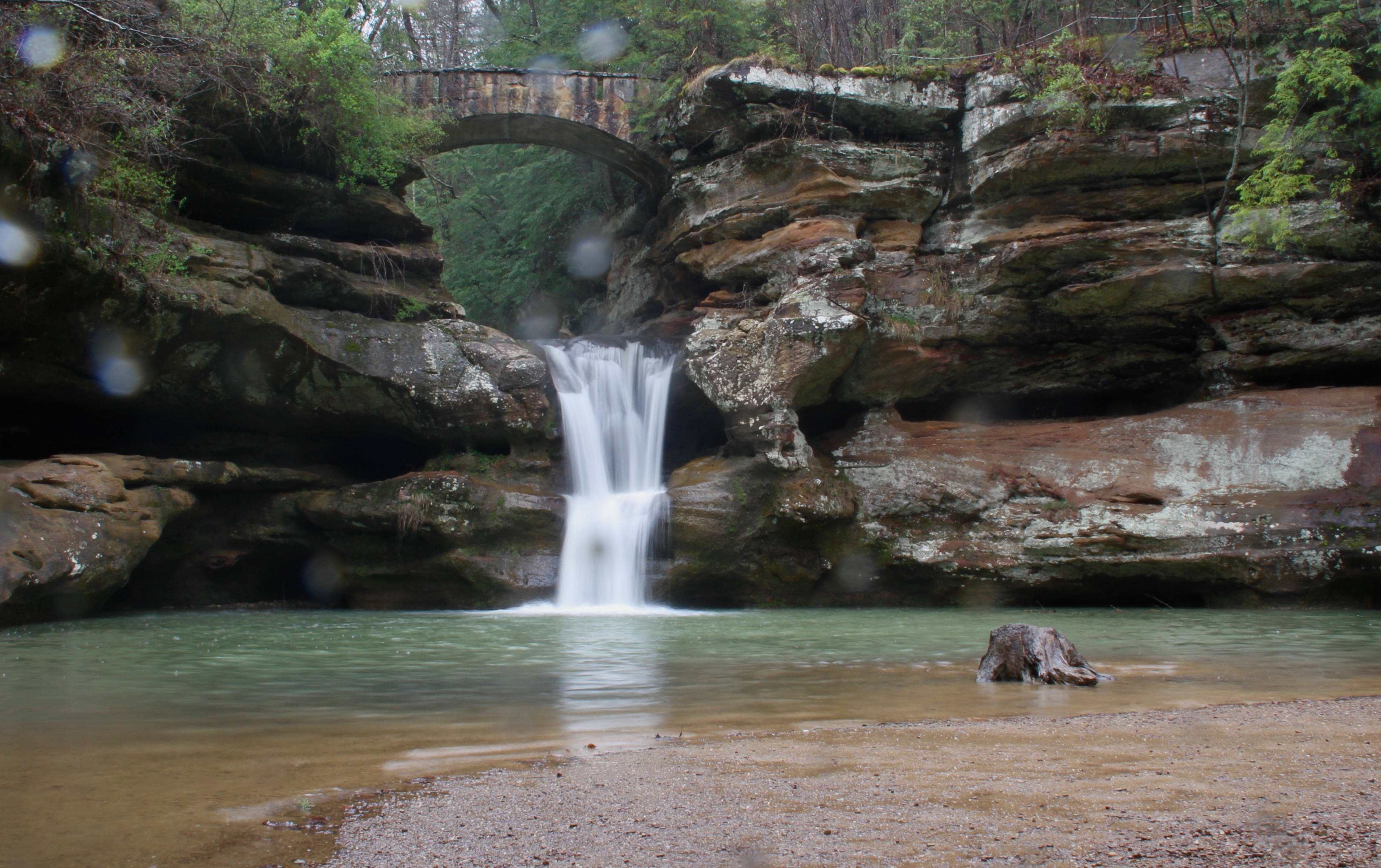
Hocking Hills State Park
In southeastern Ohio, where the unglaciated Appalachian foothills begin, ancient sandstone has eroded into a landscape of gorges, caves, and waterfalls. Hocking Hills State Park protects six separate areas where Black Hand sandstone - deposited as beach sand 350 million years ago - has been sculpted by water into dramatic formations. Old Man's Cave is a hemlock-filled gorge with a massive recess cave. Ash Cave is a 700-foot-long natural amphitheater, one of the largest caves in Ohio. Cedar Falls plunges into a rocky grotto. The hills hide these features; visitors descend from ordinary farm country into extraordinary geological worlds. Hocking Hills is Ohio's most visited state park, drawing over a million visitors annually to see what time and water carved from ancient stone.
The Geology
Black Hand sandstone was deposited approximately 350 million years ago, when this region was a river delta emptying into a shallow sea. The sand compressed into stone; geological uplift raised it above sea level. The unglaciated Allegheny Plateau escaped the glaciers that flattened much of Ohio, preserving the sandstone for erosion to sculpt. Water seeping through permeable rock layers dissolved weaker zones, creating the recess caves that define Hocking Hills. Unlike true caves formed in limestone, these are eroded alcoves - undercutting where water weakened the stone. The process continues; the caves grow imperceptibly larger each century.
Old Man's Cave
Old Man's Cave is the park's most famous feature - a hemlock-filled gorge with a massive recess cave named for hermit Richard Rowe, who lived there in the early 1800s. A trail descends into the gorge, following the stream past Upper Falls, Middle Falls, and Lower Falls. The main cave is a huge overhang where the hermit allegedly lived and is supposedly buried. The Devil's Bathtub is a cylindrical pothole carved by swirling water. The gorge is cool and shaded even in summer; hemlocks and rhododendrons create a forest more Appalachian than Midwestern. It's the most visited area in Hocking Hills, sometimes crowded, always impressive.
The Other Areas
Five other areas complete the park. Ash Cave is a 700-foot-wide recess cave with a 90-foot waterfall pouring over its lip - the largest cave of its type in Ohio. Conkle's Hollow is a box canyon with 200-foot cliffs; no streams, just a narrow slot of old-growth forest. Rock House is an actual tunnel through the cliff, with windows opening to the forest. Cedar Falls and Cantwell Cliffs offer additional waterfalls and rock formations. Each area requires a separate entrance and parking; together they reveal the variety of Hocking Hills geology. The Grandma Gatewood Trail connects several areas for through-hikers.
The Accessibility
Hocking Hills is remarkably accessible for dramatic scenery. Most features are reached by short trails - Ash Cave is a quarter-mile paved path, suitable for wheelchairs. Old Man's Cave requires stairs but is heavily developed with bridges and viewing platforms. The park is within three hours of Columbus, Cincinnati, and Cleveland; the Hocking Hills region has become a tourism economy of cabins, zip lines, and canoe rentals. Weekend crowds at popular areas can be significant; early morning and weekday visits offer more solitude. The popularity reflects both the scenery and the accessibility - these are geological wonders you can visit in a day trip.
Visiting Hocking Hills
Hocking Hills State Park is located in Hocking County, Ohio, centered around the town of Logan. The six areas are spread across several miles; each has separate parking. Old Man's Cave is the park headquarters with a nature center and campground. Ash Cave, Conkle's Hollow, Rock House, Cedar Falls, and Cantwell Cliffs each require separate stops. Trails range from easy to strenuous. The Grandma Gatewood Trail (6 miles) connects Old Man's Cave, Cedar Falls, and Ash Cave. Cabins, lodges, and campgrounds fill the surrounding area; book well ahead for weekends. Columbus is 55 miles north; the nearest airport is Columbus John Glenn International. Spring and fall offer fewer crowds and seasonal beauty; waterfalls are strongest after rain.
From the Air
Located at 39.44°N, 82.54°W in the unglaciated Appalachian foothills of southeastern Ohio. From altitude, the Hocking Hills region appears as forested hill country - more rugged than typical Ohio farmland. The gorges and caves are hidden beneath tree canopy, not visible from altitude; the terrain simply appears greener and more dissected than surrounding areas. Logan is the main town. Columbus is visible to the northwest. The terrain marks the edge of glaciation - flatter land to the north was smoothed by ice; this hill country escaped. The region is defined by U.S. Route 33 and State Route 664. The landscape hides its secrets; only from the trails do the gorges reveal themselves.