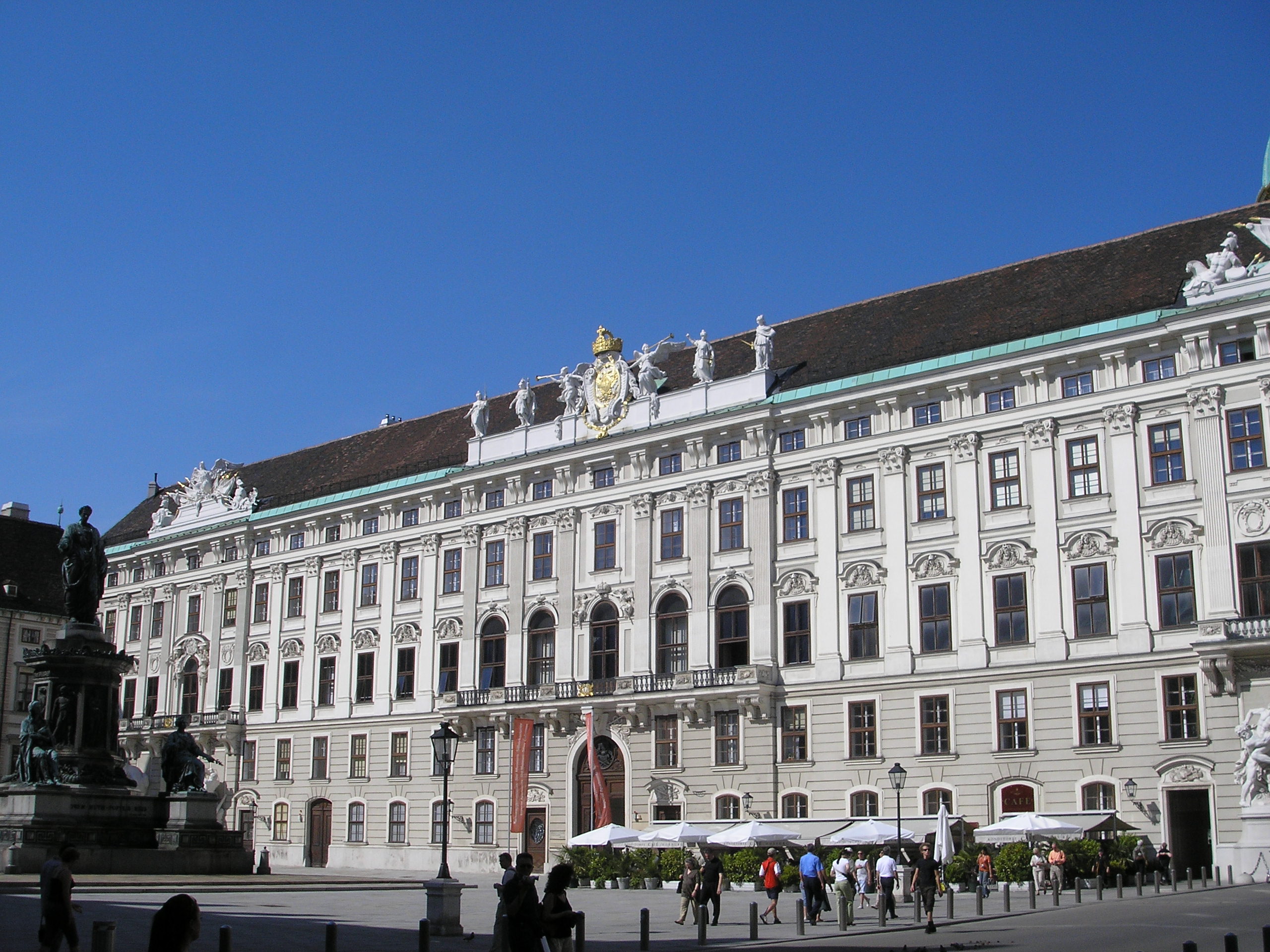
The Hofburg: Seven Centuries in One Address
Somewhere in the Swiss Wing of the Hofburg, behind a gothic chapel where the Vienna Boys' Choir still sings Sunday mass, a treasury holds the crown jewels of the Holy Roman Empire - regalia that once symbolized dominion over most of Central Europe. In a different wing, the Austrian president works in offices that once belonged to Emperor Leopold I. In another, the Spanish Riding School's white Lipizzaner stallions perform in a hall built by Joseph Emanuel Fischer von Erlach in the 1730s. The Hofburg is not a palace so much as a small city, assembled over seven centuries by every dynasty that has governed Austria, each adding rooms, wings, courtyards, and churches as if trying to outbuild their predecessors. The result is a complex so vast that it takes twenty minutes to walk from one end to the other, and so layered that medieval stonework sits behind Baroque facades behind Neoclassical additions.
A Castle Built on a Castle
The oldest parts of the Hofburg date to the thirteenth century, built either by the last Babenberg rulers or by Ottokar II of Bohemia. The original structure was a straightforward medieval castle: square outline, four turrets, surrounded by a moat with a drawbridge. These bones survive as the Swiss Court, named after the Swiss mercenary guards who once protected the emperor. The Swiss Gate, a Renaissance entrance built under Ferdinand I, displays his many titles and the insignia of the Order of the Golden Fleece painted on its ceiling. Inside the Swiss Court stands the Gothic Burgkapelle, a fifteenth-century chapel where the Court Music Chapel - the Hofmusikkapelle - has maintained an unbroken musical tradition for centuries. Adjacent to the chapel, the Schatzkammer holds the imperial crown of the Holy Roman Empire, the Holy Lance, and an array of Habsburg regalia that traces a continuous line of power from the medieval era to 1918. The knight's hall nearby is where Empress Maria Theresa was baptized in 1717 by the papal nuncio, using water said to contain drops from the River Jordan.
Wing After Wing After Wing
The Hofburg expanded the way coral reefs grow: slowly, steadily, each generation depositing another layer. The Amalienburg, built for Rudolf II in the late Renaissance style, features a small tower with an astronomical clock on its facade - a reflection of Rudolf's obsessive interest in science and the occult. The Leopoldine Wing, first constructed in the 1660s under Leopold I, had to be rebuilt after the Ottoman siege of 1683 damaged it badly. Giovanni Pietro Tencala added an extra floor, and today it houses the offices of the Austrian Federal President. The Imperial Chancellery Wing, designed by Johann Lukas von Hildebrandt, once accommodated the administrative machinery of the Holy Roman Empire itself, including the Aulic Council. After the Empire dissolved in 1806, Napoleon occupied these rooms during his stay in Vienna. Later, Emperor Franz Joseph I lived here, maintaining the famously austere personal quarters - an iron field bed, cold-water washing - that became part of the Habsburg legend of duty and self-denial.
The Library That Dwarfs Its Readers
Charles VI commissioned the Court Library, and the Fischer von Erlach father-and-son team built it between the early 1720s and 1735. The Prunksaal - the ceremonial hall - is the architectural climax of the entire complex. It stretches nearly eighty meters long, its barrel-vaulted ceiling covered by a monumental fresco by Daniel Gran depicting an allegory of heaven and earth. Marble statues of Habsburg emperors by Paul Strudel line the walls. The collection of Prince Eugene of Savoy fills one section. Lorenzo Mattielli crowned the exterior with a sculpture of Athena riding a quadriga, flanked by Atlas supporting the celestial globe on one side and Gaia holding the terrestrial globe on the other. Today the hall belongs to the Austrian National Library, and visitors can walk beneath Gran's ceiling among the original walnut bookcases that hold some 200,000 volumes. The Prunksaal is one of the most magnificent library spaces in the world, designed not merely to store knowledge but to overawe anyone who enters with the sheer scale of what the Habsburgs had accumulated.
Hearts in Silver Urns
The Hofburg's Augustinian Church served as the Habsburg court church for weddings, including that of Emperor Franz Joseph I and Empress Elisabeth - the legendary Sisi - in 1854. But the church holds a stranger distinction. Behind the Loreto side chapel, separated by an iron door, lies the Herzgruft - the Hearts' Crypt. In this semicircular room, fifty-four hearts of Habsburg family members rest in silver urns. The tradition of dividing a royal body among multiple burial sites - the body to the Imperial Crypt at the Kapuzinerkirche, the viscera to St. Stephen's Cathedral, and the heart to the Augustinian Church - reflected both a piety and a politics of presence, ensuring that even in death, the dynasty occupied as much of Vienna as possible. The Palais Archduke Albrecht, connected to the monastery and now home to the Albertina museum with its extraordinary collection of graphic arts, extends the Hofburg's reach further still.
The Palace That Never Finished
Franz Joseph I dreamed of a Kaiserforum, an imperial forum that would link the Hofburg to the twin museums on the Ringstrasse through monumental arched wings framing the Heldenplatz. Only one wing - the Neue Burg, built between 1881 and 1913 - was completed before the empire collapsed. Its curved Neoclassical facade now houses the Ephesus Museum, a collection of musical instruments, and the Austrian National Library's reading rooms. The Heldenplatz it overlooks has witnessed some of Vienna's most charged moments, including Hitler's Anschluss speech in 1938. Since 1958, parts of the Hofburg have operated as a convention center, hosting roughly 300 events a year. The Organization for Security and Co-operation in Europe maintains its permanent headquarters here. The palace serves simultaneously as museum, government office, concert venue, equestrian school, and seat of international diplomacy - a building that has never stopped accumulating purposes, just as it never stopped accumulating wings.
From the Air
The Hofburg (48.21N, 16.37E) occupies a massive footprint in the center of Vienna's Innere Stadt (1st district), directly on the Ringstrasse. From the air, the complex is identifiable by its sprawling irregular shape, the curved Neue Burg wing facing the open Heldenplatz, and the green Burggarten behind it. The twin Kunsthistorisches and Naturhistorisches museums face the Hofburg across the Maria-Theresien-Platz. Vienna International Airport (LOWW) is 18 km southeast. At 3,000-5,000 feet, the Hofburg and Ringstrasse are clearly visible as the monumental core of Vienna's historic center, with St. Stephen's Cathedral spire rising 500 meters to the east.