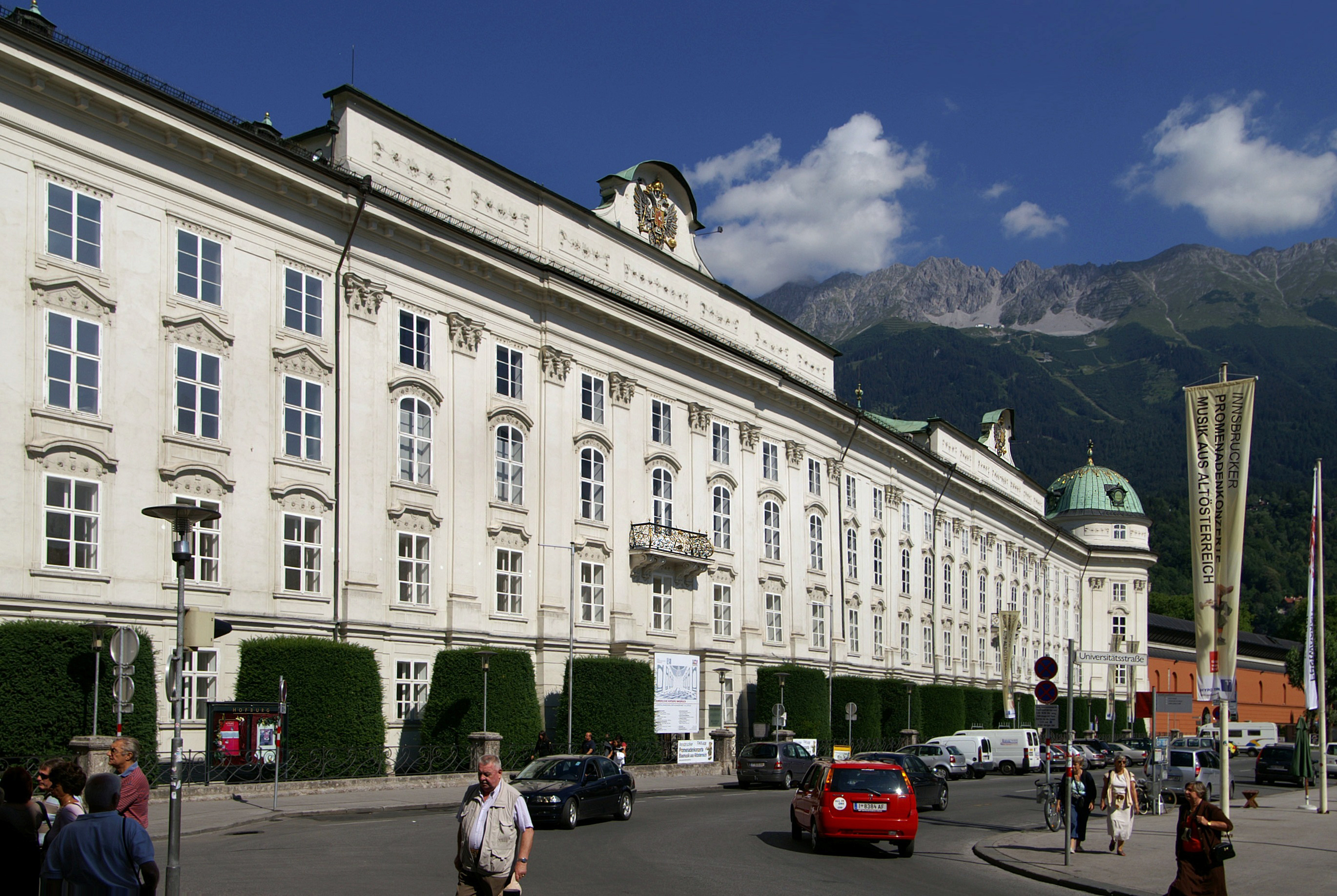
Hofburg, Innsbruck
They called him Frederick with the Empty Pockets. When Duke Frederick IV took control of Tyrol in 1406, his treasury was so depleted that the nickname stuck for centuries. Yet it was this cash-strapped ruler who made the decision that would shape Innsbruck's identity: he moved the seat of Tyrolean power from Meran to this Inn Valley city and built his New Residence nearby. Within decades, what began as a modest residence beside the eastern city wall would grow into the Hofburg -- a palace complex that Austria now ranks alongside the Hofburg Palace and Schonbrunn Palace in Vienna as one of the country's three most significant cultural buildings.
From Fortress Wall to Imperial Showcase
The Hofburg's bones are older than its Baroque facade suggests. Archduke Sigismund assembled the original palace around 1460 from sections of medieval fortifications that ran along Innsbruck's eastern defenses. The Rumer Gate, once a functional part of the city wall, was converted into the Heraldic Tower in 1499 by architect Jorg Kolderer under Emperor Maximilian I -- the same ruler who moved the imperial court to Innsbruck in the 1490s and turned the city into a center of European politics. Over the next 250 years, successive Habsburg rulers expanded the palace, each generation layering its own architectural ambitions onto the medieval core. The result is a building where Gothic foundations meet Baroque grandeur, each renovation revealing a different chapter of dynastic confidence.
Maria Theresa's Memorial
The palace's most dramatic transformation came under Empress Maria Theresa, who reimagined the Hofburg as a memorial to her husband, Emperor Francis I, after his sudden death in 1765 during their son's wedding celebrations in Innsbruck. The vestments in the palace chapel bear the appliqued imperial coats of arms of Hungary, Bohemia, Burgundy, and Tyrol -- a fabric genealogy of Habsburg power. The empress's initials, M.T., appear throughout: on altar niches, cartouches, and crowning scrolls. What had been a working residence became a shrine where personal grief and imperial grandeur were inseparable. The Portrait Gallery, transferred from Vienna, contains likenesses of every Habsburg emperor from Joseph I through Franz Joseph, spanning two centuries of rule from 1705 to 1916.
Beneath the Baroque Floor
Below the palace's polished state rooms, the Gothic Hall tells a rougher story. Built in 1494 as a five-nave hall with cross-groined vaults and medieval brickwork, this basement space once served as the entrance connecting the northern gate to the drawbridge -- a reminder that the Hofburg began its life as a fortified position, not a residence for entertaining. The western portion retains its original Gothic condition, while the southern section was lowered during the Renaissance and the eastern part was divided by arched walls between 1765 and 1779 to serve as a kitchen. At 650 square meters, the hall is substantial enough to feel like a building within a building, a medieval undercroft hiding beneath centuries of refinement.
The Courtyard and Its Surroundings
The palace's cobblestoned courtyard -- 1,300 square meters enclosed by the Hofburg's wings -- is considered the most beautiful inner courtyard in Innsbruck. Since the Baroque reconstruction, pilasters, cornices, and cartouches bearing the Austrian striped shield have decorated the facades, though the varying old structures behind the east, south, north, and west walls create subtle asymmetries that betray the building's piecemeal origins. Beyond the courtyard, the Hofburg anchors an entire cultural quarter: the Hofkirche houses Emperor Maximilian's cenotaph guarded by the Schwarzen Mandern, the oversized bronze figures that stand watch over the empty tomb. The Tyrolean Folk Art Museum, Innsbruck Cathedral, the Silver Chapel with its Renaissance organ, and the Hofgarten complete a complex that functions as a concentrated archive of Tyrolean history.
From the Air
Located at 47.269N, 11.394E in the center of Innsbruck, the Hofburg sits along the Inn River in the narrow valley between the Nordkette mountain range to the north and the Patscherkofel to the south. Best viewed from 3,000-4,000 feet AGL approaching from the west along the Inn Valley, where the palace complex is visible adjacent to the Hofgarten and Hofkirche. Innsbruck Airport (LOWI) is approximately 2 nm to the west. The Nordkette cable car station is visible on the mountainside directly north.