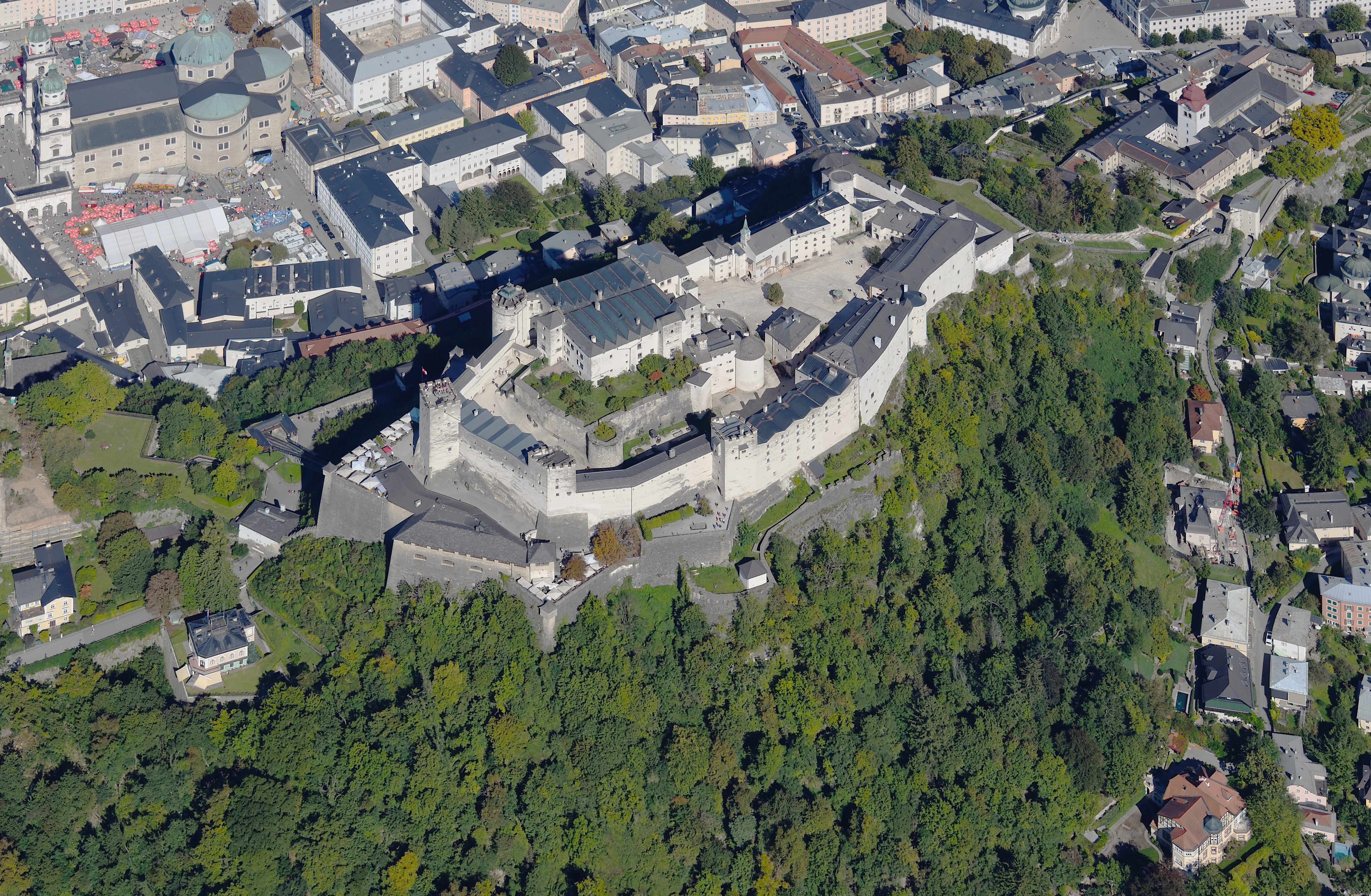
Hohensalzburg Fortress: The Archbishop's Stronghold Above the Salzach
Three times a day, from Palm Sunday through October, a mechanical organ with more than 200 pipes bellows from a tower above Salzburg. Locals call it the Salzburg Bull, and it has been sounding since 1502, when Archbishop Leonhard von Keutschach installed the instrument inside the Krautturm of Hohensalzburg Fortress. The sound carries across the city and down the Salzach valley - a daily reminder that this is not some crumbling ruin on a hill. At 250 meters long and 150 meters wide, Hohensalzburg is one of the largest medieval fortifications in Europe, and it has never been conquered.
Born in a Power Struggle
The fortress owes its existence to a fight between a pope and an emperor. In 1077, Archbishop Gebhard von Helfenstein began construction on the Festungsberg during the Investiture Controversy, the bitter dispute between Pope Gregory VII and Emperor Henry IV over who held the right to appoint church officials. Gebhard sided with the pope and the anti-king Rudolf of Rheinfelden, and he needed a stronghold to back up his politics. The original structure was modest - a basic bailey with wooden walls - but its position, 506 meters above sea level on a natural rock outcrop, made it formidable from the start. Archaeological excavations have revealed that a Roman fort once stood at the summit, suggesting that military minds had recognized this advantage for centuries before Gebhard broke ground.
Centuries of Stone
What began as a wooden enclosure grew over four centuries into a labyrinth of stone. Prince-Archbishop Burkhard II von Weisspriach added the ring walls and towers in 1462. But the most ambitious builder was Leonhard von Keutschach, who held power from 1495 to 1519 and transformed the fortress from a military necessity into something approaching a palace. He installed the magnificent state apartments on the third floor, including the Golden Hall with its coffered ceiling studded with gilded buttons meant to represent stars. He had four massive marble pillars built to support a new loggia, and a 17-meter beam - painted with the coats of arms of the Holy Roman Empire, major German cities, and Salzburg's allied bishoprics - holds up the ceiling. His personal heraldic symbol, a turnip, appears carved throughout the complex, marking each project as his own. External bastions were added in the 16th and 17th centuries against the threat of Ottoman invasion, though the Turks never reached Salzburg.
The Oldest Railway on Earth
In 1515, Keutschach's coadjutor Matthaeus Lang von Wellenburg described a device called the Reisszug - a primitive funicular railway that hauled freight up the steep hillside to the fortress's upper courtyard. The line still operates today, updated many times over the centuries but never abandoned, making it probably the oldest operational railway in the world. The idea of a tracked, mechanically assisted transport system predated the steam locomotive by three centuries, yet here it was, pulling supplies up a mountainside in the Austrian Alps. The fortress also contains other surprises of medieval engineering: the prince-bishop's bedchamber features elaborate wainscoting to insulate against alpine cold, and behind one door sits a toilet - essentially a hole in the floor with a wooden frame - that was considered a state-of-the-art sanitary facility, accessible from each level of the building.
Gilt and Grandeur Inside the Walls
The interior rooms reveal that the archbishops did not simply endure their fortress - they lived well in it. The Golden Chamber is the most lavishly appointed space, its walls lined with carved benches decorated with vines, grapes, foliage, and animals, once upholstered in cloth or leather long since lost. Gold-embossed leather tapestry covered the lower walls. Keutschach's chapel features a richly ornamented star vault and a stucco-covered door framed by painted red columns on a high plinth with grey capitals. Two openings in the north wall allowed the archbishop to attend services from a private side room without entering the chapel itself. Below these princely quarters, the fortress also served as barracks, warehouse, and prison - a self-contained world perched above a city that existed, in many ways, at its pleasure.
The View from the Festungsberg
From the fortress walls, Salzburg spreads out along both banks of the Salzach River - the domes of the cathedral and the Residenz clustered in the old town, the spire of Nonnberg Abbey on its neighboring ridge, and the northern Alps rising beyond. The fortress has been a fixture of this skyline for nearly a thousand years. It appeared on a commemorative Austrian coin in 1977 for its 900th anniversary, and again in 2006 as the backdrop for a coin honoring Nonnberg Abbey. Today more than a million visitors climb the hill each year, but the fortress retains its gravity. The Salzburg Bull still plays at seven, eleven, and six o'clock. The Reisszug still hauls its loads. The turnip of Leonhard von Keutschach still peers from cornices and lintels, marking the ambitions of a man who made a mountain fortress feel like a palace.
From the Air
Located at 47.795N, 13.047E atop the Festungsberg at 506 meters elevation in Salzburg, Austria. The fortress is 250m long and 150m wide, making it highly visible from the air as a massive white-walled complex on the prominent hill south of Salzburg's old town. The Salzach River curves below to the north. Salzburg Airport (LOWS) is approximately 3 km to the west-southwest. Best viewed at 2,000-4,000 feet AGL for the fortress's dramatic relationship with the city below. The Alps rise sharply to the south, and the Untersberg massif is visible to the southwest.