Hokenoyama Kofun: The Tomb That May Belong to Himiko's Age
Inside a five-meter-long coffin hollowed from Japanese cedar, someone once lay painted in vermillion. Bronze mirrors engraved with divine beasts surrounded the body. Arrowheads of bronze and iron, swords, and tools filled the stone chamber. Then looters came, and centuries passed, and a road was cut through one end of the burial mound. But when archaeologists opened the Hokenoyama Kofun in 1995, enough remained to date the tomb to the mid-third century -- the era of Queen Himiko, the shamanistic ruler described in Chinese chronicles, whose kingdom of Yamataikoku scholars have debated for generations. Whether this 80-meter mound near Sakurai in Nara Prefecture holds any connection to that legendary queen remains unproven. But the artifacts speak for themselves.
A Shape Unlike Any Other
The Hokenoyama Kofun does not conform to the standard keyhole shape of most large burial mounds in Japan. Its design is a distinctive scallop shape, with a large circular rear section measuring 60 meters in diameter, built in three tiers to a height of 8.5 meters, and a short rectangular frontal extension just 20 meters long and only 3.5 meters high. The whole structure stretches approximately 80 meters in length, orientated to the southeast, and is surrounded by a moat that varies from 10.5 to 17 meters wide. The exterior was covered with fukiishi -- roofing stones gathered from the nearby Makimuku River -- but no haniwa clay figures were found, placing its construction before that tradition became standard. The mound sits east of the much larger Hashihaka Kofun, within the Makimuku Kofun Cluster, collectively designated a National Historic Site in 2006.
Mirrors and a Cedar Coffin
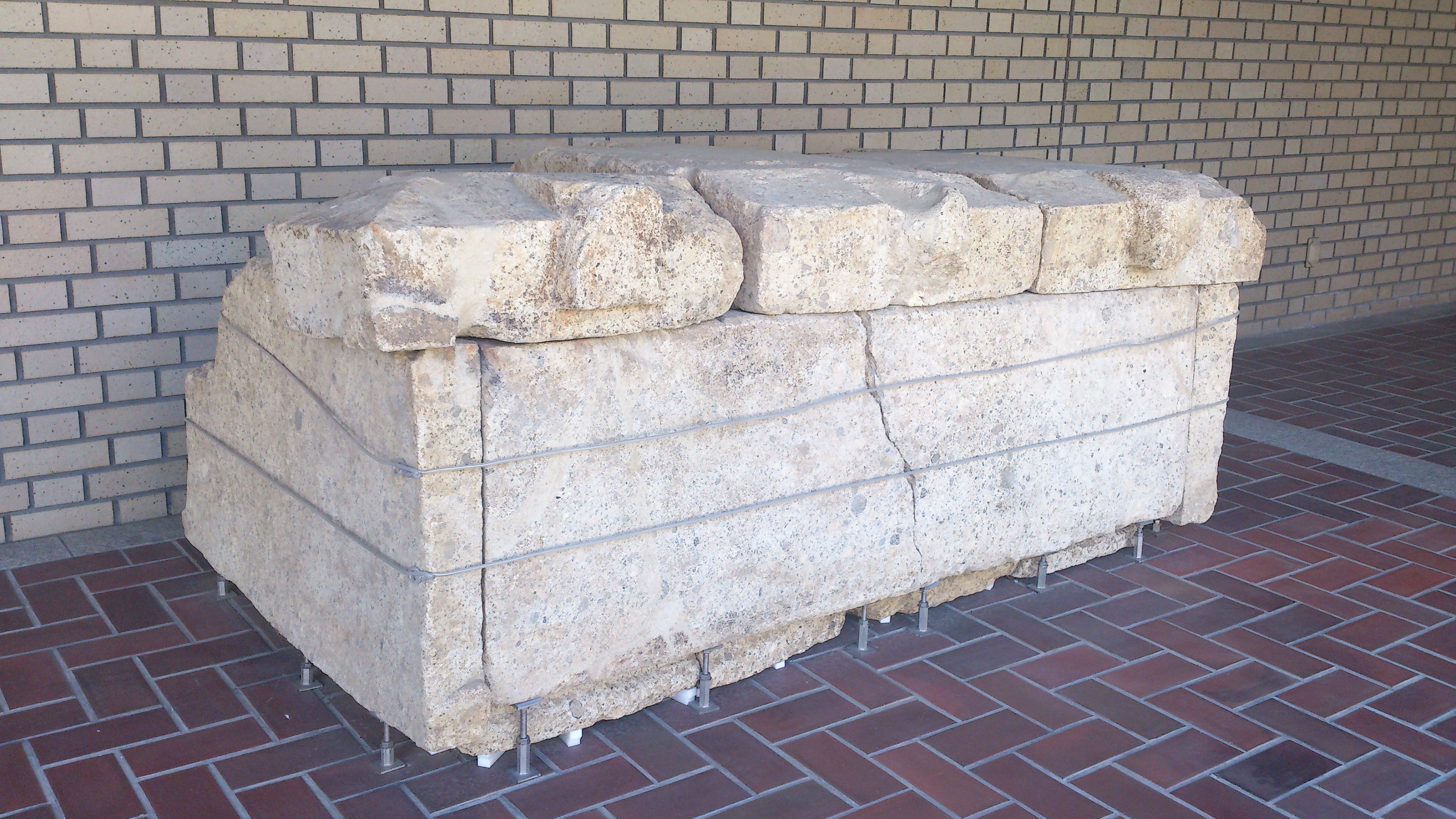
The 1995 excavation reached the heart of the circular mound and found a stone burial chamber with walls of piled river stones and a wooden ceiling. Inside lay a massive stone sarcophagus, approximately 6.5 meters long and 2.6 meters wide, enclosing a split-bamboo-shaped wooden coffin carved from a single piece of Japanese cedar. The coffin's interior had been painted with vermillion. Decorated jar-shaped earthenware was arranged at the top of the coffin, though it had fallen inward as the wood decayed over centuries. Despite partial looting, the grave goods were extraordinary: a complete picture-and-text-belted divine beast bronze mirror, 23 fragments of a second divine beast mirror that had been deliberately broken before burial, an inner-circle floral pattern bronze mirror, and numerous bronze and iron arrowheads, swords, and tools. Pottery came from not just the local area but also the Tokai region and the Seto Inland Sea, suggesting far-reaching political or trade connections.
The Shadow of Queen Himiko
The mid-third-century dating of the Hokenoyama Kofun places it in one of the most debated periods in Japanese history. Chinese chronicles, particularly the Records of the Three Kingdoms, describe a powerful shamanistic queen named Himiko who ruled the kingdom of Yamataikoku during this era. Scholars have long argued over where Yamataikoku was located -- northern Kyushu and the Yamato region of Nara are the leading candidates. The Makimuku area, where the Hokenoyama Kofun sits, is central to the Yamato theory. The nearby Omiwa Shrine asserts, without physical evidence, that this tumulus is the grave of Toyosukiiri-hime, a daughter of Emperor Sujin and chief priestess of the Ise Grand Shrine. Whether royal or not, the occupant commanded impressive resources: a cedar coffin large enough for a person of high status, bronze mirrors with Chinese-influenced designs, and weapons gathered from across the Japanese archipelago. One of the bronze mirrors from the tomb is now kept at the Omiwa Shrine.
Layers of the Dead
The Hokenoyama Kofun was not used once and sealed. A second wooden coffin was discovered in the rectangular frontal portion of the mound, and a simple direct burial was found in the narrow connecting section between the two halves. Most intriguingly, a second stone burial chamber exists on the west side of the circular mound -- a subsequent interment from around the end of the sixth century, three hundred years after the original burial. Someone chose to reuse this ancient mound for their own dead, grafting new significance onto a structure already centuries old. The artifacts excavated from the original burial are collectively designated a National Important Cultural Property. Today the mound sits quietly in the Hashihaka neighborhood of Sakurai, its contours softened by erosion, a road slicing through its southeast end, the vermillion coffin and divine beast mirrors long removed to museums and shrines.
From the Air
Located at 34.540°N, 135.845°E in the city of Sakurai, Nara Prefecture, within the Makimuku archaeological district. From altitude, the Makimuku area appears as flat agricultural land at the eastern edge of the Nara Basin, with the Miwa Mountains rising immediately to the east. The scallop-shaped mound is visible as a raised tree-covered area amid rice paddies, near the larger keyhole-shaped Hashihaka Kofun. Nearest major airports are Kansai International Airport (RJBB), approximately 45 nautical miles southwest, and Osaka Itami Airport (RJOO), about 20 nautical miles northwest. The Yamato River system threads through the basin below.